

80
3 Giant Magnetoresistance (GMR)
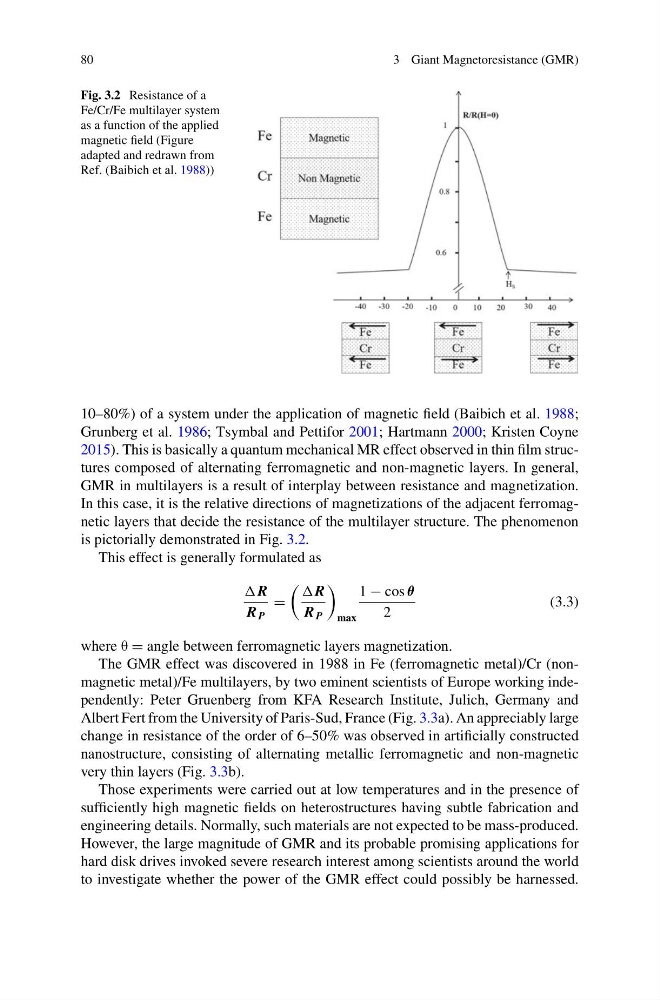
Fig. 3.2 Resistance of a
Fe/Cr/Fe multilayer system
as a function of the applied
magnetic field (Figure
adapted and redrawn from
Ref. (Baibich et al. 1988))
10–80%) of a system under the application of magnetic field (Baibich et al. 1988;
Grunberg et al. 1986; Tsymbal and Pettifor 2001; Hartmann 2000; Kristen Coyne
2015). This is basically a quantum mechanical MR effect observed in thin film structures composed of alternating ferromagnetic and non-magnetic layers. In general,
GMR in multilayers is a result of interplay between resistance and magnetization.
In this case, it is the relative directions of magnetizations of the adjacent ferromagnetic layers that decide the resistance of the multilayer structure. The phenomenon
is pictorially demonstrated in Fig. 3.2.
This effect is generally formulated as
R
R P
=
R
R P
max
1 − cos θ
2
(3.3)
where θ = angle between ferromagnetic layers magnetization.
The GMR effect was discovered in 1988 in Fe (ferromagnetic metal)/Cr (nonmagnetic metal)/Fe multilayers, by two eminent scientists of Europe working independently: Peter Gruenberg from KFA Research Institute, Julich, Germany and
Albert Fert from the University of Paris-Sud, France (Fig. 3.3a). An appreciably large
change in resistance of the order of 6–50% was observed in artificially constructed
nanostructure, consisting of alternating metallic ferromagnetic and non-magnetic
very thin layers (Fig. 3.3b).
Those experiments were carried out at low temperatures and in the presence of
sufficiently high magnetic fields on heterostructures having subtle fabrication and
engineering details. Normally, such materials are not expected to be mass-produced.
However, the large magnitude of GMR and its probable promising applications for
hard disk drives invoked severe research interest among scientists around the world
to investigate whether the power of the GMR effect could possibly be harnessed.
3 Giant Magnetoresistance (GMR)
Fig. 3.2 Resistance of a
Fe/Cr/Fe multilayer system
as a function of the applied
magnetic field (Figure
adapted and redrawn from
Ref. (Baibich et al. 1988))
10–80%) of a system under the application of magnetic field (Baibich et al. 1988;
Grunberg et al. 1986; Tsymbal and Pettifor 2001; Hartmann 2000; Kristen Coyne
2015). This is basically a quantum mechanical MR effect observed in thin film structures composed of alternating ferromagnetic and non-magnetic layers. In general,
GMR in multilayers is a result of interplay between resistance and magnetization.
In this case, it is the relative directions of magnetizations of the adjacent ferromagnetic layers that decide the resistance of the multilayer structure. The phenomenon
is pictorially demonstrated in Fig. 3.2.
This effect is generally formulated as
R
R P
=
R
R P
max
1 − cos θ
2
(3.3)
where θ = angle between ferromagnetic layers magnetization.
The GMR effect was discovered in 1988 in Fe (ferromagnetic metal)/Cr (nonmagnetic metal)/Fe multilayers, by two eminent scientists of Europe working independently: Peter Gruenberg from KFA Research Institute, Julich, Germany and
Albert Fert from the University of Paris-Sud, France (Fig. 3.3a). An appreciably large
change in resistance of the order of 6–50% was observed in artificially constructed
nanostructure, consisting of alternating metallic ferromagnetic and non-magnetic
very thin layers (Fig. 3.3b).
Those experiments were carried out at low temperatures and in the presence of
sufficiently high magnetic fields on heterostructures having subtle fabrication and
engineering details. Normally, such materials are not expected to be mass-produced.
However, the large magnitude of GMR and its probable promising applications for
hard disk drives invoked severe research interest among scientists around the world
to investigate whether the power of the GMR effect could possibly be harnessed.