

3.2 Different Kinds of MR
79
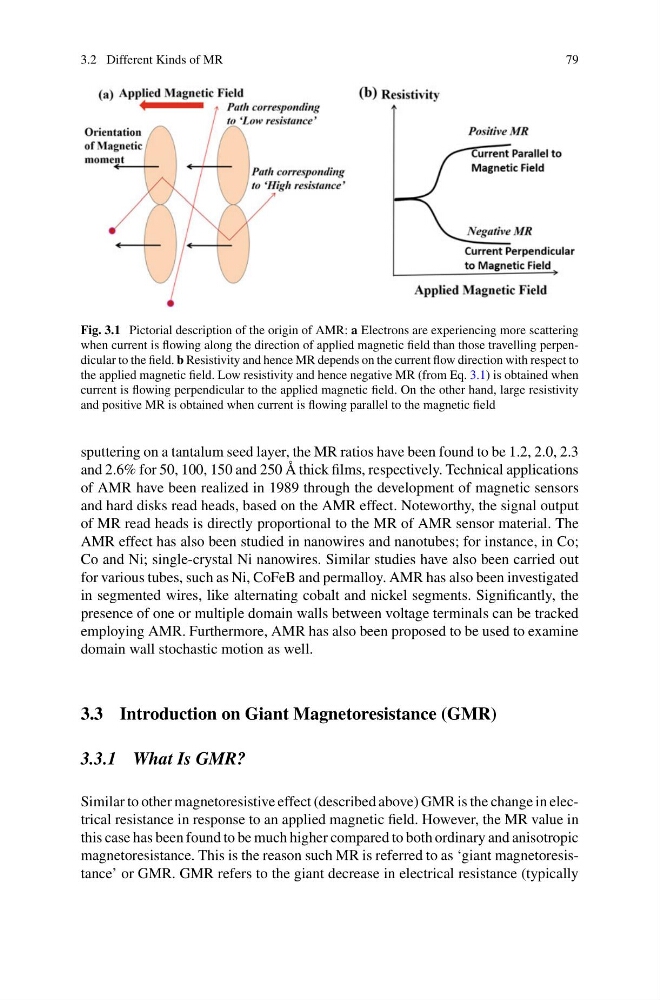
Fig. 3.1 Pictorial description of the origin of AMR: a Electrons are experiencing more scattering
when current is flowing along the direction of applied magnetic field than those travelling perpendicular to the field. b Resistivity and hence MR depends on the current flow direction with respect to
the applied magnetic field. Low resistivity and hence negative MR (from Eq. 3.1) is obtained when
current is flowing perpendicular to the applied magnetic field. On the other hand, large resistivity
and positive MR is obtained when current is flowing parallel to the magnetic field
sputtering on a tantalum seed layer, the MR ratios have been found to be 1.2, 2.0, 2.3
and 2.6% for 50, 100, 150 and 250 Å thick films, respectively. Technical applications
of AMR have been realized in 1989 through the development of magnetic sensors
and hard disks read heads, based on the AMR effect. Noteworthy, the signal output
of MR read heads is directly proportional to the MR of AMR sensor material. The
AMR effect has also been studied in nanowires and nanotubes; for instance, in Co;
Co and Ni; single-crystal Ni nanowires. Similar studies have also been carried out
for various tubes, such as Ni, CoFeB and permalloy. AMR has also been investigated
in segmented wires, like alternating cobalt and nickel segments. Significantly, the
presence of one or multiple domain walls between voltage terminals can be tracked
employing AMR. Furthermore, AMR has also been proposed to be used to examine
domain wall stochastic motion as well.
3.3 Introduction on Giant Magnetoresistance (GMR)
3.3.1 What Is GMR?
Similar to other magnetoresistive effect (described above) GMR is the change in electrical resistance in response to an applied magnetic field. However, the MR value in
this case has been found to be much higher compared to both ordinary and anisotropic
magnetoresistance. This is the reason such MR is referred to as ‘giant magnetoresistance’ or GMR. GMR refers to the giant decrease in electrical resistance (typically
79
Fig. 3.1 Pictorial description of the origin of AMR: a Electrons are experiencing more scattering
when current is flowing along the direction of applied magnetic field than those travelling perpendicular to the field. b Resistivity and hence MR depends on the current flow direction with respect to
the applied magnetic field. Low resistivity and hence negative MR (from Eq. 3.1) is obtained when
current is flowing perpendicular to the applied magnetic field. On the other hand, large resistivity
and positive MR is obtained when current is flowing parallel to the magnetic field
sputtering on a tantalum seed layer, the MR ratios have been found to be 1.2, 2.0, 2.3
and 2.6% for 50, 100, 150 and 250 Å thick films, respectively. Technical applications
of AMR have been realized in 1989 through the development of magnetic sensors
and hard disks read heads, based on the AMR effect. Noteworthy, the signal output
of MR read heads is directly proportional to the MR of AMR sensor material. The
AMR effect has also been studied in nanowires and nanotubes; for instance, in Co;
Co and Ni; single-crystal Ni nanowires. Similar studies have also been carried out
for various tubes, such as Ni, CoFeB and permalloy. AMR has also been investigated
in segmented wires, like alternating cobalt and nickel segments. Significantly, the
presence of one or multiple domain walls between voltage terminals can be tracked
employing AMR. Furthermore, AMR has also been proposed to be used to examine
domain wall stochastic motion as well.
3.3 Introduction on Giant Magnetoresistance (GMR)
3.3.1 What Is GMR?
Similar to other magnetoresistive effect (described above) GMR is the change in electrical resistance in response to an applied magnetic field. However, the MR value in
this case has been found to be much higher compared to both ordinary and anisotropic
magnetoresistance. This is the reason such MR is referred to as ‘giant magnetoresistance’ or GMR. GMR refers to the giant decrease in electrical resistance (typically