

2.3 Spin Generation and Injection
29
2.3.3 Knowledge of Some Essential Parameters of Injector
Ferromagnet
In order to understand the spin injection process, knowledge of the following
quantities of an injector ferromagnet is essential as discussed below:
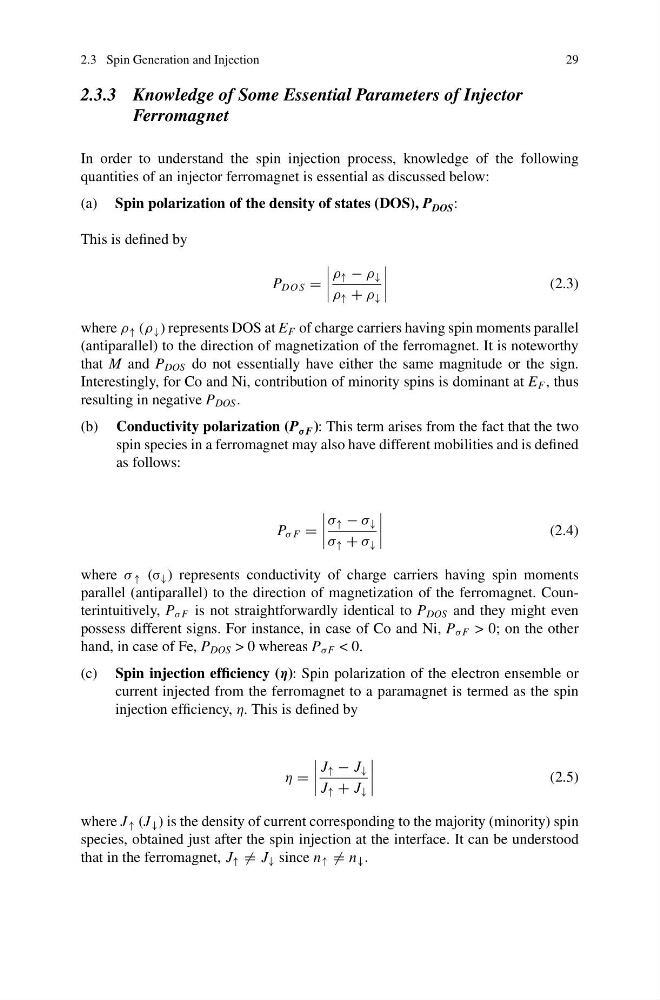
(a) Spin polarization of the density of states (DOS), P DOS :
This is defined by
P DO S =
ρ ↑ − ρ ↓
ρ ↑ + ρ ↓
(2.3)
where ρ ↑ (ρ ↓ ) represents DOS at E F of charge carriers having spin moments parallel
(antiparallel) to the direction of magnetization of the ferromagnet. It is noteworthy
that M and P DOS do not essentially have either the same magnitude or the sign.
Interestingly, for Co and Ni, contribution of minority spins is dominant at E F , thus
resulting in negative P DOS .
(b) Conductivity polarization (P σ F ): This term arises from the fact that the two
spin species in a ferromagnet may also have different mobilities and is defined
as follows:
P σ F =
σ ↑ − σ ↓
σ ↑ + σ ↓
(2.4)
where σ ↑ (σ ↓ ) represents conductivity of charge carriers having spin moments
parallel (antiparallel) to the direction of magnetization of the ferromagnet. Counterintuitively, P σ F is not straightforwardly identical to P DOS and they might even
possess different signs. For instance, in case of Co and Ni, P σ F > 0; on the other
hand, in case of Fe, P DOS > 0 whereas P σ F < 0.
(c) Spin injection efficiency (η): Spin polarization of the electron ensemble or
current injected from the ferromagnet to a paramagnet is termed as the spin
injection efficiency, η. This is defined by
η =
J ↑ − J ↓
J ↑ + J ↓
(2.5)
where J ↑ (J ↓ ) is the density of current corresponding to the majority (minority) spin
species, obtained just after the spin injection at the interface. It can be understood
that in the ferromagnet, J ↑ = J ↓ since n ↑ = n ↓ .
29
2.3.3 Knowledge of Some Essential Parameters of Injector
Ferromagnet
In order to understand the spin injection process, knowledge of the following
quantities of an injector ferromagnet is essential as discussed below:
(a) Spin polarization of the density of states (DOS), P DOS :
This is defined by
P DO S =
ρ ↑ − ρ ↓
ρ ↑ + ρ ↓
(2.3)
where ρ ↑ (ρ ↓ ) represents DOS at E F of charge carriers having spin moments parallel
(antiparallel) to the direction of magnetization of the ferromagnet. It is noteworthy
that M and P DOS do not essentially have either the same magnitude or the sign.
Interestingly, for Co and Ni, contribution of minority spins is dominant at E F , thus
resulting in negative P DOS .
(b) Conductivity polarization (P σ F ): This term arises from the fact that the two
spin species in a ferromagnet may also have different mobilities and is defined
as follows:
P σ F =
σ ↑ − σ ↓
σ ↑ + σ ↓
(2.4)
where σ ↑ (σ ↓ ) represents conductivity of charge carriers having spin moments
parallel (antiparallel) to the direction of magnetization of the ferromagnet. Counterintuitively, P σ F is not straightforwardly identical to P DOS and they might even
possess different signs. For instance, in case of Co and Ni, P σ F > 0; on the other
hand, in case of Fe, P DOS > 0 whereas P σ F < 0.
(c) Spin injection efficiency (η): Spin polarization of the electron ensemble or
current injected from the ferromagnet to a paramagnet is termed as the spin
injection efficiency, η. This is defined by
η =
J ↑ − J ↓
J ↑ + J ↓
(2.5)
where J ↑ (J ↓ ) is the density of current corresponding to the majority (minority) spin
species, obtained just after the spin injection at the interface. It can be understood
that in the ferromagnet, J ↑ = J ↓ since n ↑ = n ↓ .