

28
2 Basic Elements of Spintronics
of charge carriers and consequently results in charge current. However, from spintronics point of view, we need to achieve ‘spin transport’, rather than mere charge
transport. In this attempt, the basic principle is to create a net non-zero spin moment
inside the device through the spin injection process. This is the fundamental idea of
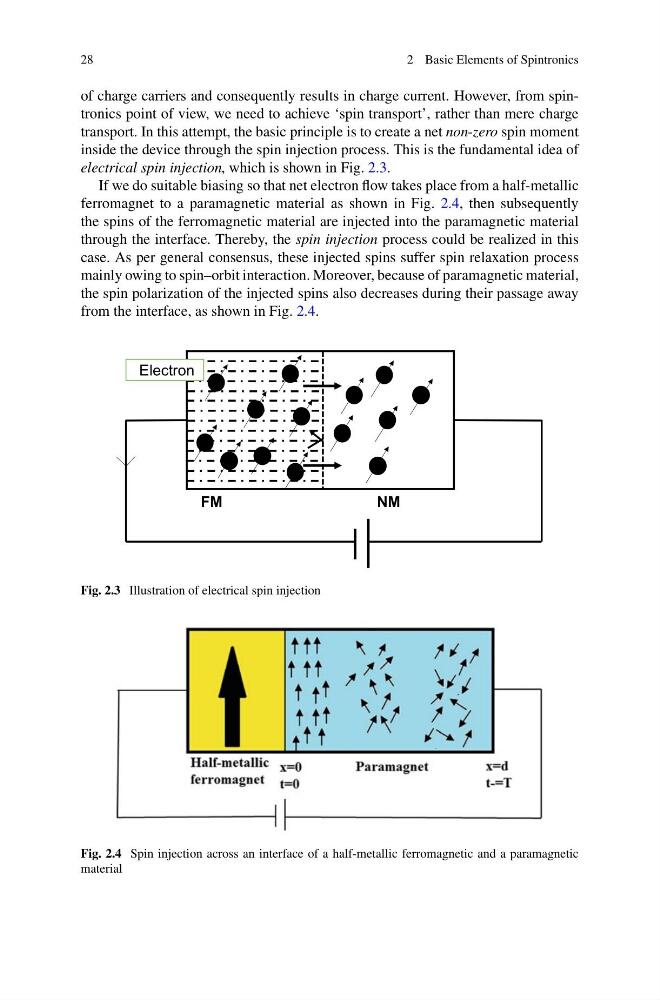
electrical spin injection, which is shown in Fig. 2.3.
If we do suitable biasing so that net electron flow takes place from a half-metallic
ferromagnet to a paramagnetic material as shown in Fig. 2.4, then subsequently
the spins of the ferromagnetic material are injected into the paramagnetic material
through the interface. Thereby, the spin injection process could be realized in this
case. As per general consensus, these injected spins suffer spin relaxation process
mainly owing to spin–orbit interaction. Moreover, because of paramagnetic material,
the spin polarization of the injected spins also decreases during their passage away
from the interface, as shown in Fig. 2.4.
Electron
FM
NM
Fig. 2.3 Illustration of electrical spin injection
Fig. 2.4 Spin injection across an interface of a half-metallic ferromagnetic and a paramagnetic
material
2 Basic Elements of Spintronics
of charge carriers and consequently results in charge current. However, from spintronics point of view, we need to achieve ‘spin transport’, rather than mere charge
transport. In this attempt, the basic principle is to create a net non-zero spin moment
inside the device through the spin injection process. This is the fundamental idea of
electrical spin injection, which is shown in Fig. 2.3.
If we do suitable biasing so that net electron flow takes place from a half-metallic
ferromagnet to a paramagnetic material as shown in Fig. 2.4, then subsequently
the spins of the ferromagnetic material are injected into the paramagnetic material
through the interface. Thereby, the spin injection process could be realized in this
case. As per general consensus, these injected spins suffer spin relaxation process
mainly owing to spin–orbit interaction. Moreover, because of paramagnetic material,
the spin polarization of the injected spins also decreases during their passage away
from the interface, as shown in Fig. 2.4.
Electron
FM
NM
Fig. 2.3 Illustration of electrical spin injection
Fig. 2.4 Spin injection across an interface of a half-metallic ferromagnetic and a paramagnetic
material