

258
10 Spintronics Applications
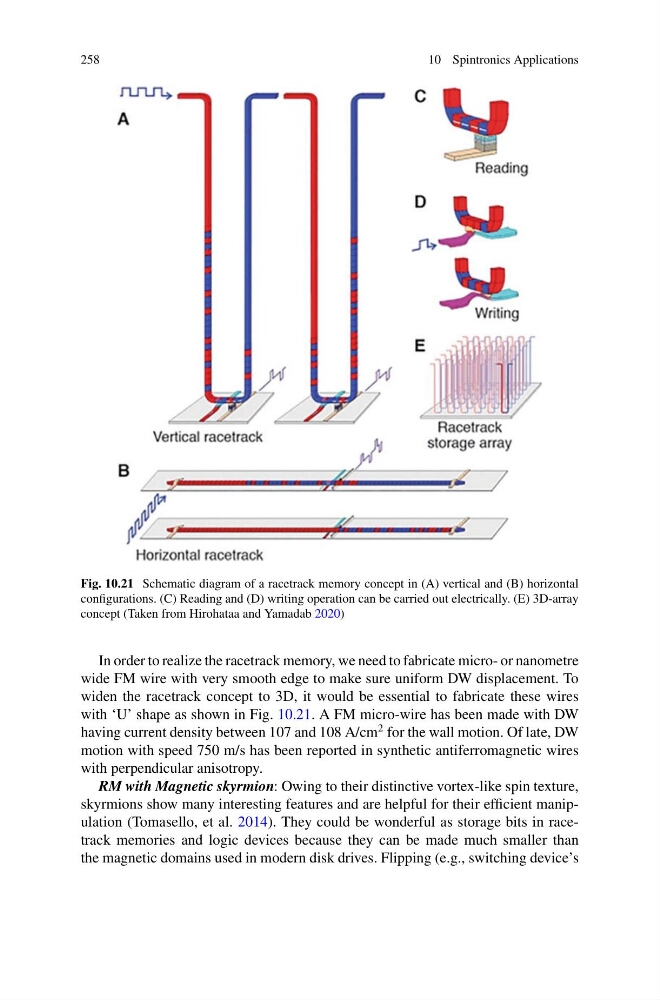
Fig. 10.21 Schematic diagram of a racetrack memory concept in (A) vertical and (B) horizontal
configurations. (C) Reading and (D) writing operation can be carried out electrically. (E) 3D-array
concept (Taken from Hirohataa and Yamadab 2020)
In order to realize the racetrack memory, we need to fabricate micro- or nanometre
wide FM wire with very smooth edge to make sure uniform DW displacement. To
widen the racetrack concept to 3D, it would be essential to fabricate these wires
with ‘U’ shape as shown in Fig. 10.21. A FM micro-wire has been made with DW
having current density between 107 and 108 A/cm
2 for the wall motion. Of late, DW
motion with speed 750 m/s has been reported in synthetic antiferromagnetic wires
with perpendicular anisotropy.
RM with Magnetic skyrmion: Owing to their distinctive vortex-like spin texture,
skyrmions show many interesting features and are helpful for their efficient manipulation (Tomasello, et al. 2014). They could be wonderful as storage bits in racetrack memories and logic devices because they can be made much smaller than
the magnetic domains used in modern disk drives. Flipping (e.g., switching device’s
10 Spintronics Applications
Fig. 10.21 Schematic diagram of a racetrack memory concept in (A) vertical and (B) horizontal
configurations. (C) Reading and (D) writing operation can be carried out electrically. (E) 3D-array
concept (Taken from Hirohataa and Yamadab 2020)
In order to realize the racetrack memory, we need to fabricate micro- or nanometre
wide FM wire with very smooth edge to make sure uniform DW displacement. To
widen the racetrack concept to 3D, it would be essential to fabricate these wires
with ‘U’ shape as shown in Fig. 10.21. A FM micro-wire has been made with DW
having current density between 107 and 108 A/cm
2 for the wall motion. Of late, DW
motion with speed 750 m/s has been reported in synthetic antiferromagnetic wires
with perpendicular anisotropy.
RM with Magnetic skyrmion: Owing to their distinctive vortex-like spin texture,
skyrmions show many interesting features and are helpful for their efficient manipulation (Tomasello, et al. 2014). They could be wonderful as storage bits in racetrack memories and logic devices because they can be made much smaller than
the magnetic domains used in modern disk drives. Flipping (e.g., switching device’s