

250
10 Spintronics Applications
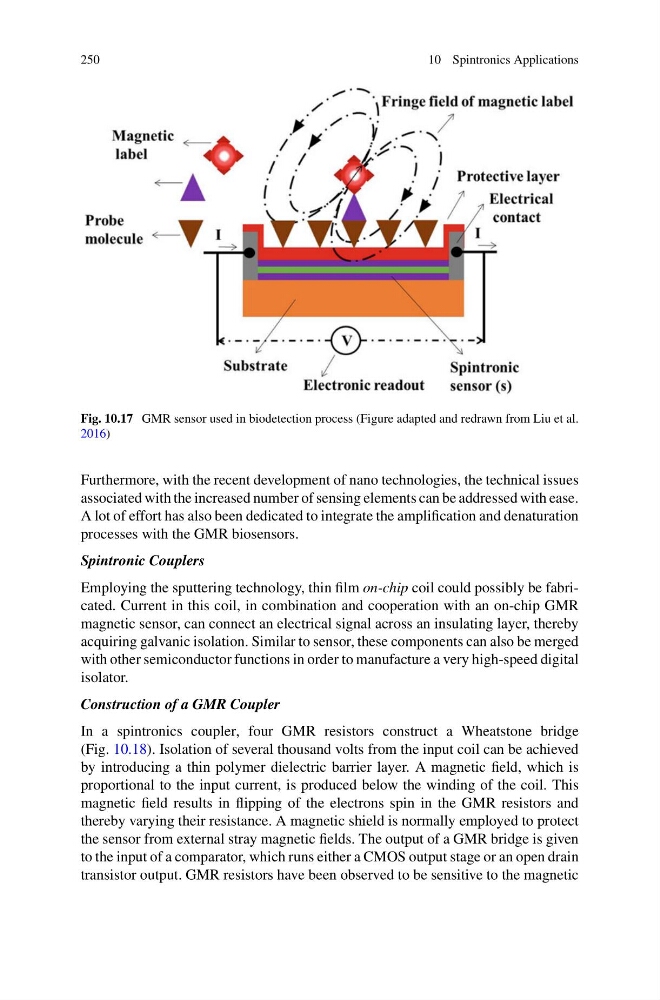
Fig. 10.17 GMR sensor used in biodetection process (Figure adapted and redrawn from Liu et al.
2016)
Furthermore, with the recent development of nano technologies, the technical issues
associated with the increased number of sensing elements can be addressed with ease.
A lot of effort has also been dedicated to integrate the amplification and denaturation
processes with the GMR biosensors.
Spintronic Couplers
Employing the sputtering technology, thin film on-chip coil could possibly be fabricated. Current in this coil, in combination and cooperation with an on-chip GMR
magnetic sensor, can connect an electrical signal across an insulating layer, thereby
acquiring galvanic isolation. Similar to sensor, these components can also be merged
with other semiconductor functions in order to manufacture a very high-speed digital
isolator.
Construction of a GMR Coupler
In a spintronics coupler, four GMR resistors construct a Wheatstone bridge
(Fig. 10.18). Isolation of several thousand volts from the input coil can be achieved
by introducing a thin polymer dielectric barrier layer. A magnetic field, which is
proportional to the input current, is produced below the winding of the coil. This
magnetic field results in flipping of the electrons spin in the GMR resistors and
thereby varying their resistance. A magnetic shield is normally employed to protect
the sensor from external stray magnetic fields. The output of a GMR bridge is given
to the input of a comparator, which runs either a CMOS output stage or an open drain
transistor output. GMR resistors have been observed to be sensitive to the magnetic
10 Spintronics Applications
Fig. 10.17 GMR sensor used in biodetection process (Figure adapted and redrawn from Liu et al.
2016)
Furthermore, with the recent development of nano technologies, the technical issues
associated with the increased number of sensing elements can be addressed with ease.
A lot of effort has also been dedicated to integrate the amplification and denaturation
processes with the GMR biosensors.
Spintronic Couplers
Employing the sputtering technology, thin film on-chip coil could possibly be fabricated. Current in this coil, in combination and cooperation with an on-chip GMR
magnetic sensor, can connect an electrical signal across an insulating layer, thereby
acquiring galvanic isolation. Similar to sensor, these components can also be merged
with other semiconductor functions in order to manufacture a very high-speed digital
isolator.
Construction of a GMR Coupler
In a spintronics coupler, four GMR resistors construct a Wheatstone bridge
(Fig. 10.18). Isolation of several thousand volts from the input coil can be achieved
by introducing a thin polymer dielectric barrier layer. A magnetic field, which is
proportional to the input current, is produced below the winding of the coil. This
magnetic field results in flipping of the electrons spin in the GMR resistors and
thereby varying their resistance. A magnetic shield is normally employed to protect
the sensor from external stray magnetic fields. The output of a GMR bridge is given
to the input of a comparator, which runs either a CMOS output stage or an open drain
transistor output. GMR resistors have been observed to be sensitive to the magnetic