

10.6 Spintronics Sensors
247
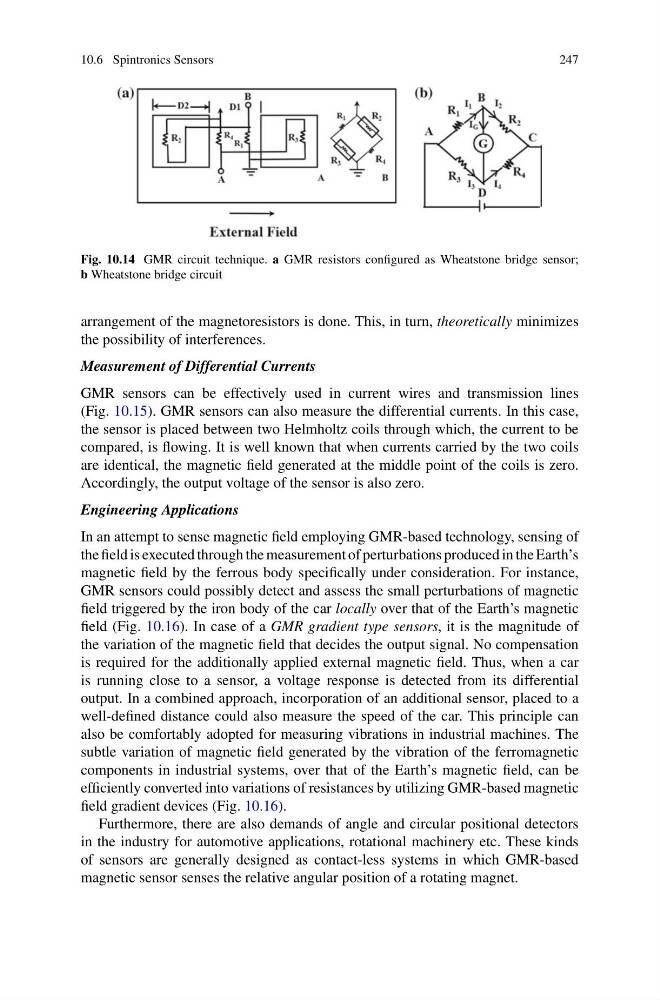
Fig. 10.14 GMR circuit technique. a GMR resistors configured as Wheatstone bridge sensor;
b Wheatstone bridge circuit
arrangement of the magnetoresistors is done. This, in turn, theoretically minimizes
the possibility of interferences.
Measurement of Differential Currents
GMR sensors can be effectively used in current wires and transmission lines
(Fig. 10.15). GMR sensors can also measure the differential currents. In this case,
the sensor is placed between two Helmholtz coils through which, the current to be
compared, is flowing. It is well known that when currents carried by the two coils
are identical, the magnetic field generated at the middle point of the coils is zero.
Accordingly, the output voltage of the sensor is also zero.
Engineering Applications
In an attempt to sense magnetic field employing GMR-based technology, sensing of
the field is executed through the measurement of perturbations produced in the Earth’s
magnetic field by the ferrous body specifically under consideration. For instance,
GMR sensors could possibly detect and assess the small perturbations of magnetic
field triggered by the iron body of the car locally over that of the Earth’s magnetic
field (Fig. 10.16). In case of a GMR gradient type sensors, it is the magnitude of
the variation of the magnetic field that decides the output signal. No compensation
is required for the additionally applied external magnetic field. Thus, when a car
is running close to a sensor, a voltage response is detected from its differential
output. In a combined approach, incorporation of an additional sensor, placed to a
well-defined distance could also measure the speed of the car. This principle can
also be comfortably adopted for measuring vibrations in industrial machines. The
subtle variation of magnetic field generated by the vibration of the ferromagnetic
components in industrial systems, over that of the Earth’s magnetic field, can be
efficiently converted into variations of resistances by utilizing GMR-based magnetic
field gradient devices (Fig. 10.16).
Furthermore, there are also demands of angle and circular positional detectors
in the industry for automotive applications, rotational machinery etc. These kinds
of sensors are generally designed as contact-less systems in which GMR-based
magnetic sensor senses the relative angular position of a rotating magnet.
247
Fig. 10.14 GMR circuit technique. a GMR resistors configured as Wheatstone bridge sensor;
b Wheatstone bridge circuit
arrangement of the magnetoresistors is done. This, in turn, theoretically minimizes
the possibility of interferences.
Measurement of Differential Currents
GMR sensors can be effectively used in current wires and transmission lines
(Fig. 10.15). GMR sensors can also measure the differential currents. In this case,
the sensor is placed between two Helmholtz coils through which, the current to be
compared, is flowing. It is well known that when currents carried by the two coils
are identical, the magnetic field generated at the middle point of the coils is zero.
Accordingly, the output voltage of the sensor is also zero.
Engineering Applications
In an attempt to sense magnetic field employing GMR-based technology, sensing of
the field is executed through the measurement of perturbations produced in the Earth’s
magnetic field by the ferrous body specifically under consideration. For instance,
GMR sensors could possibly detect and assess the small perturbations of magnetic
field triggered by the iron body of the car locally over that of the Earth’s magnetic
field (Fig. 10.16). In case of a GMR gradient type sensors, it is the magnitude of
the variation of the magnetic field that decides the output signal. No compensation
is required for the additionally applied external magnetic field. Thus, when a car
is running close to a sensor, a voltage response is detected from its differential
output. In a combined approach, incorporation of an additional sensor, placed to a
well-defined distance could also measure the speed of the car. This principle can
also be comfortably adopted for measuring vibrations in industrial machines. The
subtle variation of magnetic field generated by the vibration of the ferromagnetic
components in industrial systems, over that of the Earth’s magnetic field, can be
efficiently converted into variations of resistances by utilizing GMR-based magnetic
field gradient devices (Fig. 10.16).
Furthermore, there are also demands of angle and circular positional detectors
in the industry for automotive applications, rotational machinery etc. These kinds
of sensors are generally designed as contact-less systems in which GMR-based
magnetic sensor senses the relative angular position of a rotating magnet.