

10.6 Spintronics Sensors
245
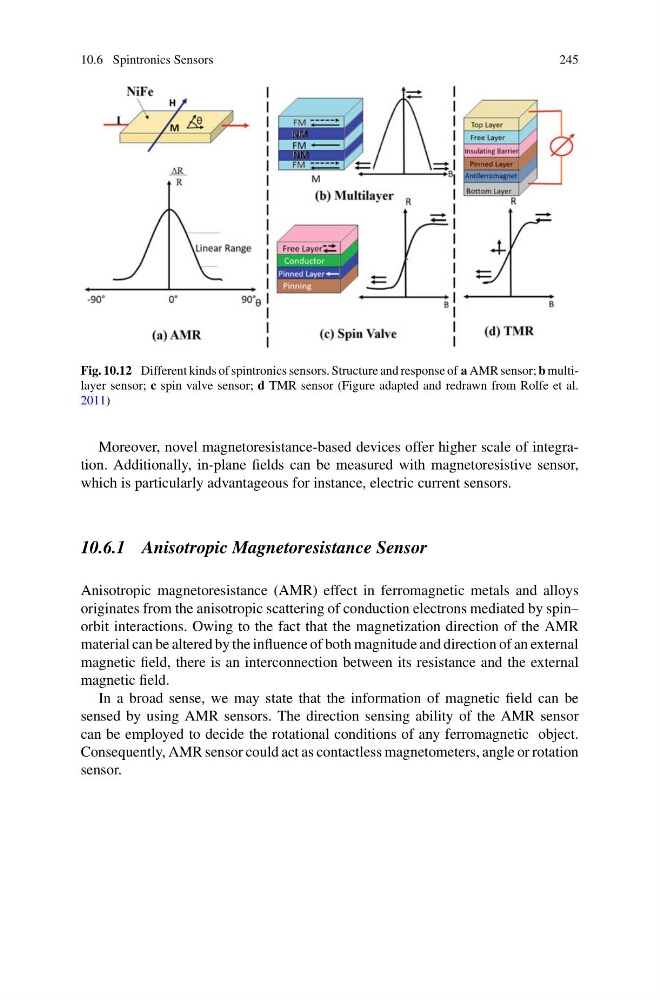
Fig. 10.12 Different kinds of spintronics sensors. Structure and response of a AMR sensor; b multilayer sensor; c spin valve sensor; d TMR sensor (Figure adapted and redrawn from Rolfe et al.
2011)
Moreover, novel magnetoresistance-based devices offer higher scale of integration. Additionally, in-plane fields can be measured with magnetoresistive sensor,
which is particularly advantageous for instance, electric current sensors.
10.6.1 Anisotropic Magnetoresistance Sensor
Anisotropic magnetoresistance (AMR) effect in ferromagnetic metals and alloys
originates from the anisotropic scattering of conduction electrons mediated by spin–
orbit interactions. Owing to the fact that the magnetization direction of the AMR
material can be altered by the influence of both magnitude and direction of an external
magnetic field, there is an interconnection between its resistance and the external
magnetic field.
In a broad sense, we may state that the information of magnetic field can be
sensed by using AMR sensors. The direction sensing ability of the AMR sensor
can be employed to decide the rotational conditions of any ferromagnetic object.
Consequently, AMR sensor could act as contactless magnetometers, angle or rotation
sensor.
245
Fig. 10.12 Different kinds of spintronics sensors. Structure and response of a AMR sensor; b multilayer sensor; c spin valve sensor; d TMR sensor (Figure adapted and redrawn from Rolfe et al.
2011)
Moreover, novel magnetoresistance-based devices offer higher scale of integration. Additionally, in-plane fields can be measured with magnetoresistive sensor,
which is particularly advantageous for instance, electric current sensors.
10.6.1 Anisotropic Magnetoresistance Sensor
Anisotropic magnetoresistance (AMR) effect in ferromagnetic metals and alloys
originates from the anisotropic scattering of conduction electrons mediated by spin–
orbit interactions. Owing to the fact that the magnetization direction of the AMR
material can be altered by the influence of both magnitude and direction of an external
magnetic field, there is an interconnection between its resistance and the external
magnetic field.
In a broad sense, we may state that the information of magnetic field can be
sensed by using AMR sensors. The direction sensing ability of the AMR sensor
can be employed to decide the rotational conditions of any ferromagnetic object.
Consequently, AMR sensor could act as contactless magnetometers, angle or rotation
sensor.