

244
10 Spintronics Applications
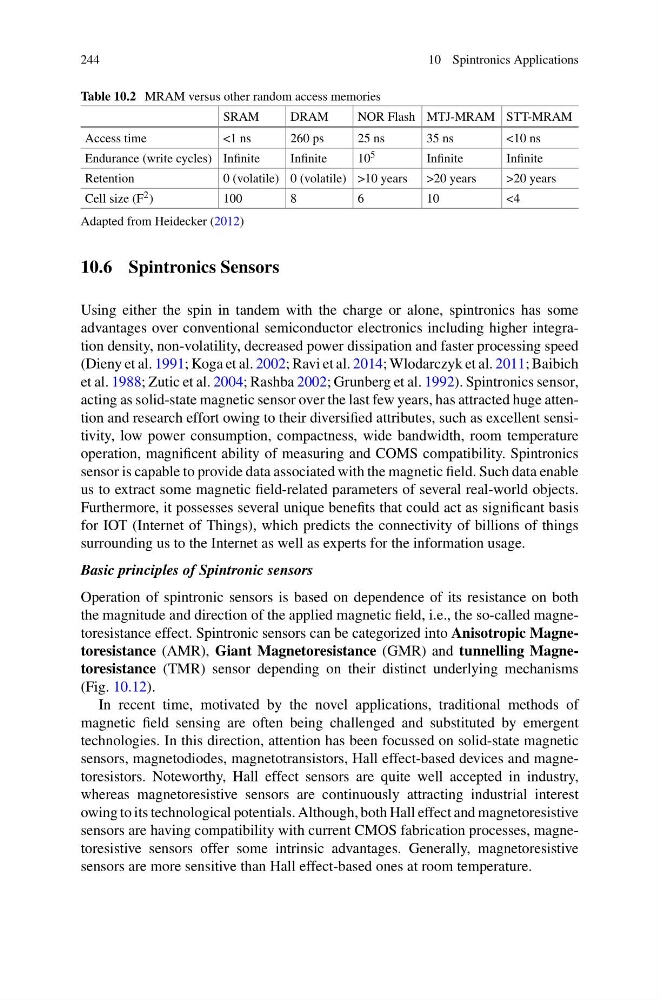
Table 10.2 MRAM versus other random access memories
SRAM
DRAM
NOR Flash MTJ-MRAM STT-MRAM
Access time
<1 ns
260 ps
25 ns
35 ns
<10 ns
Endurance (write cycles) Infinite
Infinite
10 5
Infinite
Infinite
Retention
0 (volatile) 0 (volatile) >10 years >20 years
>20 years
Cell size (F 2 )
100
8
6
10
<4
Adapted from Heidecker (2012)
10.6 Spintronics Sensors
Using either the spin in tandem with the charge or alone, spintronics has some
advantages over conventional semiconductor electronics including higher integration density, non-volatility, decreased power dissipation and faster processing speed
(Dieny et al. 1991; Koga et al. 2002; Ravi et al. 2014; Wlodarczyk et al. 2011; Baibich
et al. 1988; Zutic et al. 2004; Rashba 2002; Grunberg et al. 1992). Spintronics sensor,
acting as solid-state magnetic sensor over the last few years, has attracted huge attention and research effort owing to their diversified attributes, such as excellent sensitivity, low power consumption, compactness, wide bandwidth, room temperature
operation, magnificent ability of measuring and COMS compatibility. Spintronics
sensor is capable to provide data associated with the magnetic field. Such data enable
us to extract some magnetic field-related parameters of several real-world objects.
Furthermore, it possesses several unique benefits that could act as significant basis
for IOT (Internet of Things), which predicts the connectivity of billions of things
surrounding us to the Internet as well as experts for the information usage.
Basic principles of Spintronic sensors
Operation of spintronic sensors is based on dependence of its resistance on both
the magnitude and direction of the applied magnetic field, i.e., the so-called magnetoresistance effect. Spintronic sensors can be categorized into Anisotropic Magnetoresistance (AMR), Giant Magnetoresistance (GMR) and tunnelling Magnetoresistance (TMR) sensor depending on their distinct underlying mechanisms
(Fig. 10.12).
In recent time, motivated by the novel applications, traditional methods of
magnetic field sensing are often being challenged and substituted by emergent
technologies. In this direction, attention has been focussed on solid-state magnetic
sensors, magnetodiodes, magnetotransistors, Hall effect-based devices and magnetoresistors. Noteworthy, Hall effect sensors are quite well accepted in industry,
whereas magnetoresistive sensors are continuously attracting industrial interest
owing to its technological potentials. Although, both Hall effect and magnetoresistive
sensors are having compatibility with current CMOS fabrication processes, magnetoresistive sensors offer some intrinsic advantages. Generally, magnetoresistive
sensors are more sensitive than Hall effect-based ones at room temperature.
10 Spintronics Applications
Table 10.2 MRAM versus other random access memories
SRAM
DRAM
NOR Flash MTJ-MRAM STT-MRAM
Access time
<1 ns
260 ps
25 ns
35 ns
<10 ns
Endurance (write cycles) Infinite
Infinite
10 5
Infinite
Infinite
Retention
0 (volatile) 0 (volatile) >10 years >20 years
>20 years
Cell size (F 2 )
100
8
6
10
<4
Adapted from Heidecker (2012)
10.6 Spintronics Sensors
Using either the spin in tandem with the charge or alone, spintronics has some
advantages over conventional semiconductor electronics including higher integration density, non-volatility, decreased power dissipation and faster processing speed
(Dieny et al. 1991; Koga et al. 2002; Ravi et al. 2014; Wlodarczyk et al. 2011; Baibich
et al. 1988; Zutic et al. 2004; Rashba 2002; Grunberg et al. 1992). Spintronics sensor,
acting as solid-state magnetic sensor over the last few years, has attracted huge attention and research effort owing to their diversified attributes, such as excellent sensitivity, low power consumption, compactness, wide bandwidth, room temperature
operation, magnificent ability of measuring and COMS compatibility. Spintronics
sensor is capable to provide data associated with the magnetic field. Such data enable
us to extract some magnetic field-related parameters of several real-world objects.
Furthermore, it possesses several unique benefits that could act as significant basis
for IOT (Internet of Things), which predicts the connectivity of billions of things
surrounding us to the Internet as well as experts for the information usage.
Basic principles of Spintronic sensors
Operation of spintronic sensors is based on dependence of its resistance on both
the magnitude and direction of the applied magnetic field, i.e., the so-called magnetoresistance effect. Spintronic sensors can be categorized into Anisotropic Magnetoresistance (AMR), Giant Magnetoresistance (GMR) and tunnelling Magnetoresistance (TMR) sensor depending on their distinct underlying mechanisms
(Fig. 10.12).
In recent time, motivated by the novel applications, traditional methods of
magnetic field sensing are often being challenged and substituted by emergent
technologies. In this direction, attention has been focussed on solid-state magnetic
sensors, magnetodiodes, magnetotransistors, Hall effect-based devices and magnetoresistors. Noteworthy, Hall effect sensors are quite well accepted in industry,
whereas magnetoresistive sensors are continuously attracting industrial interest
owing to its technological potentials. Although, both Hall effect and magnetoresistive
sensors are having compatibility with current CMOS fabrication processes, magnetoresistive sensors offer some intrinsic advantages. Generally, magnetoresistive
sensors are more sensitive than Hall effect-based ones at room temperature.