

240
10 Spintronics Applications
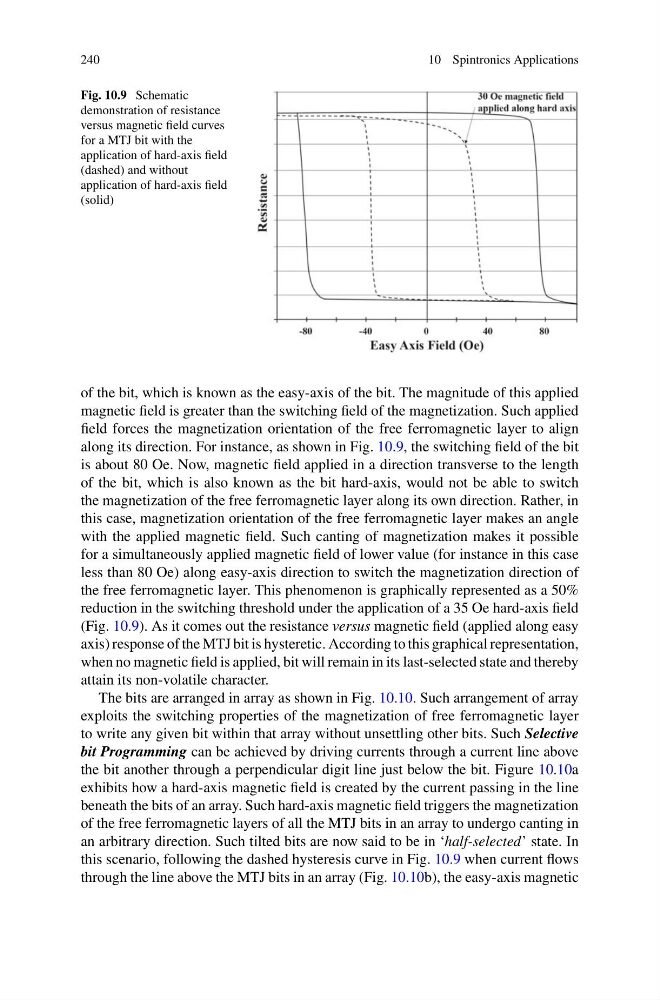
Fig. 10.9 Schematic
demonstration of resistance
versus magnetic field curves
for a MTJ bit with the
application of hard-axis field
(dashed) and without
application of hard-axis field
(solid)
of the bit, which is known as the easy-axis of the bit. The magnitude of this applied
magnetic field is greater than the switching field of the magnetization. Such applied
field forces the magnetization orientation of the free ferromagnetic layer to align
along its direction. For instance, as shown in Fig. 10.9, the switching field of the bit
is about 80 Oe. Now, magnetic field applied in a direction transverse to the length
of the bit, which is also known as the bit hard-axis, would not be able to switch
the magnetization of the free ferromagnetic layer along its own direction. Rather, in
this case, magnetization orientation of the free ferromagnetic layer makes an angle
with the applied magnetic field. Such canting of magnetization makes it possible
for a simultaneously applied magnetic field of lower value (for instance in this case
less than 80 Oe) along easy-axis direction to switch the magnetization direction of
the free ferromagnetic layer. This phenomenon is graphically represented as a 50%
reduction in the switching threshold under the application of a 35 Oe hard-axis field
(Fig. 10.9). As it comes out the resistance versus magnetic field (applied along easy
axis) response of the MTJ bit is hysteretic. According to this graphical representation,
when no magnetic field is applied, bit will remain in its last-selected state and thereby
attain its non-volatile character.
The bits are arranged in array as shown in Fig. 10.10. Such arrangement of array
exploits the switching properties of the magnetization of free ferromagnetic layer
to write any given bit within that array without unsettling other bits. Such Selective
bit Programming can be achieved by driving currents through a current line above
the bit another through a perpendicular digit line just below the bit. Figure 10.10a
exhibits how a hard-axis magnetic field is created by the current passing in the line
beneath the bits of an array. Such hard-axis magnetic field triggers the magnetization
of the free ferromagnetic layers of all the MTJ bits in an array to undergo canting in
an arbitrary direction. Such tilted bits are now said to be in ‘half-selected’ state. In
this scenario, following the dashed hysteresis curve in Fig. 10.9 when current flows
through the line above the MTJ bits in an array (Fig. 10.10b), the easy-axis magnetic
10 Spintronics Applications
Fig. 10.9 Schematic
demonstration of resistance
versus magnetic field curves
for a MTJ bit with the
application of hard-axis field
(dashed) and without
application of hard-axis field
(solid)
of the bit, which is known as the easy-axis of the bit. The magnitude of this applied
magnetic field is greater than the switching field of the magnetization. Such applied
field forces the magnetization orientation of the free ferromagnetic layer to align
along its direction. For instance, as shown in Fig. 10.9, the switching field of the bit
is about 80 Oe. Now, magnetic field applied in a direction transverse to the length
of the bit, which is also known as the bit hard-axis, would not be able to switch
the magnetization of the free ferromagnetic layer along its own direction. Rather, in
this case, magnetization orientation of the free ferromagnetic layer makes an angle
with the applied magnetic field. Such canting of magnetization makes it possible
for a simultaneously applied magnetic field of lower value (for instance in this case
less than 80 Oe) along easy-axis direction to switch the magnetization direction of
the free ferromagnetic layer. This phenomenon is graphically represented as a 50%
reduction in the switching threshold under the application of a 35 Oe hard-axis field
(Fig. 10.9). As it comes out the resistance versus magnetic field (applied along easy
axis) response of the MTJ bit is hysteretic. According to this graphical representation,
when no magnetic field is applied, bit will remain in its last-selected state and thereby
attain its non-volatile character.
The bits are arranged in array as shown in Fig. 10.10. Such arrangement of array
exploits the switching properties of the magnetization of free ferromagnetic layer
to write any given bit within that array without unsettling other bits. Such Selective
bit Programming can be achieved by driving currents through a current line above
the bit another through a perpendicular digit line just below the bit. Figure 10.10a
exhibits how a hard-axis magnetic field is created by the current passing in the line
beneath the bits of an array. Such hard-axis magnetic field triggers the magnetization
of the free ferromagnetic layers of all the MTJ bits in an array to undergo canting in
an arbitrary direction. Such tilted bits are now said to be in ‘half-selected’ state. In
this scenario, following the dashed hysteresis curve in Fig. 10.9 when current flows
through the line above the MTJ bits in an array (Fig. 10.10b), the easy-axis magnetic