

10.3 Read Head in Magnetic Data Storage
233
10.3.7 Some Important Features of Spin-Valve GMR Read
Head Applications
In order to achieve optimized read head applications, two important deciding factors
are: (a) large magnetoresistance values and (b) effective exchange field, created at
the pinned layer/exchange layer interface. Obviously to ensure the room temperature
application of the device, the blocking temperature, i.e., the temperature where the
exchange field vanishes, should exceed 300 °C. This, in turn, prevents the accidental
depinning of the pinned layer during the fabrication of read head. Furthermore, the
exchange energy should be large enough (>0.2 mJ/m
2 ) so that it predominates over
the demagnetizing fields at read head level. Now, we will discuss those two important
factors, which play a key role to yield proper and improved read head applications,
as mentioned above, consecutively.
(a) Large Magnetoresistance values: Enhancement in magnetoresistance values
can be achieved in two ways:
(1) A Dual Symmetric Spin Valve: In this kind of device, two spin valves, one of
them is bottom pinned another top pinned, share a common free ferromagnetic
layer. Such dual symmetric spin valve offers magnetoresistance signals that
surpass even 20%. However, spin valve of this kind has not been employed in
hard disk read head because of its larger thickness.
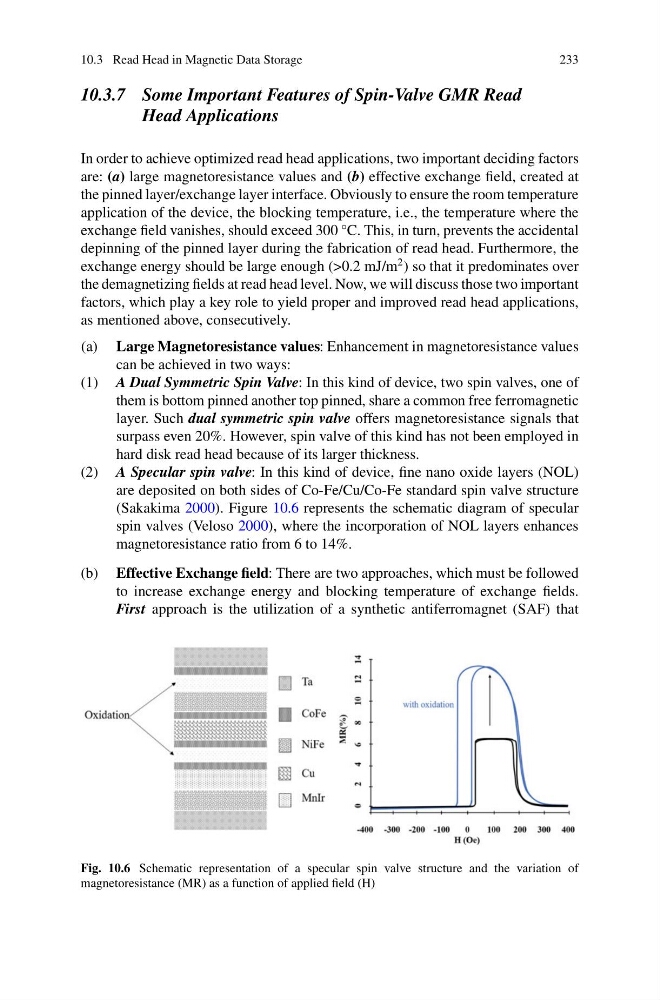
(2) A Specular spin valve: In this kind of device, fine nano oxide layers (NOL)
are deposited on both sides of Co-Fe/Cu/Co-Fe standard spin valve structure
(Sakakima 2000). Figure 10.6 represents the schematic diagram of specular
spin valves (Veloso 2000), where the incorporation of NOL layers enhances
magnetoresistance ratio from 6 to 14%.
(b) Effective Exchange field: There are two approaches, which must be followed
to increase exchange energy and blocking temperature of exchange fields.
First approach is the utilization of a synthetic antiferromagnet (SAF) that
Fig. 10.6 Schematic representation of a specular spin valve structure and the variation of
magnetoresistance (MR) as a function of applied field (H)
233
10.3.7 Some Important Features of Spin-Valve GMR Read
Head Applications
In order to achieve optimized read head applications, two important deciding factors
are: (a) large magnetoresistance values and (b) effective exchange field, created at
the pinned layer/exchange layer interface. Obviously to ensure the room temperature
application of the device, the blocking temperature, i.e., the temperature where the
exchange field vanishes, should exceed 300 °C. This, in turn, prevents the accidental
depinning of the pinned layer during the fabrication of read head. Furthermore, the
exchange energy should be large enough (>0.2 mJ/m
2 ) so that it predominates over
the demagnetizing fields at read head level. Now, we will discuss those two important
factors, which play a key role to yield proper and improved read head applications,
as mentioned above, consecutively.
(a) Large Magnetoresistance values: Enhancement in magnetoresistance values
can be achieved in two ways:
(1) A Dual Symmetric Spin Valve: In this kind of device, two spin valves, one of
them is bottom pinned another top pinned, share a common free ferromagnetic
layer. Such dual symmetric spin valve offers magnetoresistance signals that
surpass even 20%. However, spin valve of this kind has not been employed in
hard disk read head because of its larger thickness.
(2) A Specular spin valve: In this kind of device, fine nano oxide layers (NOL)
are deposited on both sides of Co-Fe/Cu/Co-Fe standard spin valve structure
(Sakakima 2000). Figure 10.6 represents the schematic diagram of specular
spin valves (Veloso 2000), where the incorporation of NOL layers enhances
magnetoresistance ratio from 6 to 14%.
(b) Effective Exchange field: There are two approaches, which must be followed
to increase exchange energy and blocking temperature of exchange fields.
First approach is the utilization of a synthetic antiferromagnet (SAF) that
Fig. 10.6 Schematic representation of a specular spin valve structure and the variation of
magnetoresistance (MR) as a function of applied field (H)