

232
10 Spintronics Applications
10.3.6 Spin Valve Sensors
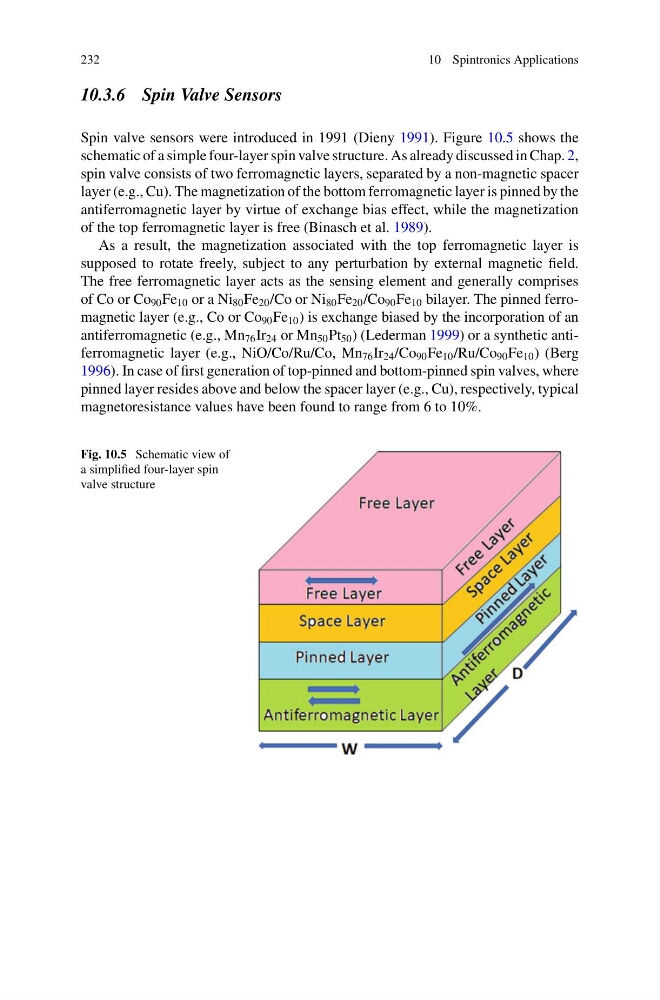
Spin valve sensors were introduced in 1991 (Dieny 1991). Figure 10.5 shows the
schematic of a simple four-layer spin valve structure. As already discussed in Chap. 2,
spin valve consists of two ferromagnetic layers, separated by a non-magnetic spacer
layer (e.g., Cu). The magnetization of the bottom ferromagnetic layer is pinned by the
antiferromagnetic layer by virtue of exchange bias effect, while the magnetization
of the top ferromagnetic layer is free (Binasch et al. 1989).
As a result, the magnetization associated with the top ferromagnetic layer is
supposed to rotate freely, subject to any perturbation by external magnetic field.
The free ferromagnetic layer acts as the sensing element and generally comprises
of Co or Co 90 Fe 10 or a Ni 80 Fe 20 /Co or Ni 80 Fe 20 /Co 90 Fe 10 bilayer. The pinned ferromagnetic layer (e.g., Co or Co 90 Fe 10 ) is exchange biased by the incorporation of an
antiferromagnetic (e.g., Mn 76 Ir 24 or Mn 50 Pt 50 ) (Lederman 1999) or a synthetic antiferromagnetic layer (e.g., NiO/Co/Ru/Co, Mn 76 Ir 24 /Co 90 Fe 10 /Ru/Co 90 Fe 10 ) (Berg
1996). In case of first generation of top-pinned and bottom-pinned spin valves, where
pinned layer resides above and below the spacer layer (e.g., Cu), respectively, typical
magnetoresistance values have been found to range from 6 to 10%.
Fig. 10.5 Schematic view of
a simplified four-layer spin
valve structure
10 Spintronics Applications
10.3.6 Spin Valve Sensors
Spin valve sensors were introduced in 1991 (Dieny 1991). Figure 10.5 shows the
schematic of a simple four-layer spin valve structure. As already discussed in Chap. 2,
spin valve consists of two ferromagnetic layers, separated by a non-magnetic spacer
layer (e.g., Cu). The magnetization of the bottom ferromagnetic layer is pinned by the
antiferromagnetic layer by virtue of exchange bias effect, while the magnetization
of the top ferromagnetic layer is free (Binasch et al. 1989).
As a result, the magnetization associated with the top ferromagnetic layer is
supposed to rotate freely, subject to any perturbation by external magnetic field.
The free ferromagnetic layer acts as the sensing element and generally comprises
of Co or Co 90 Fe 10 or a Ni 80 Fe 20 /Co or Ni 80 Fe 20 /Co 90 Fe 10 bilayer. The pinned ferromagnetic layer (e.g., Co or Co 90 Fe 10 ) is exchange biased by the incorporation of an
antiferromagnetic (e.g., Mn 76 Ir 24 or Mn 50 Pt 50 ) (Lederman 1999) or a synthetic antiferromagnetic layer (e.g., NiO/Co/Ru/Co, Mn 76 Ir 24 /Co 90 Fe 10 /Ru/Co 90 Fe 10 ) (Berg
1996). In case of first generation of top-pinned and bottom-pinned spin valves, where
pinned layer resides above and below the spacer layer (e.g., Cu), respectively, typical
magnetoresistance values have been found to range from 6 to 10%.
Fig. 10.5 Schematic view of
a simplified four-layer spin
valve structure