

10.3 Read Head in Magnetic Data Storage
231
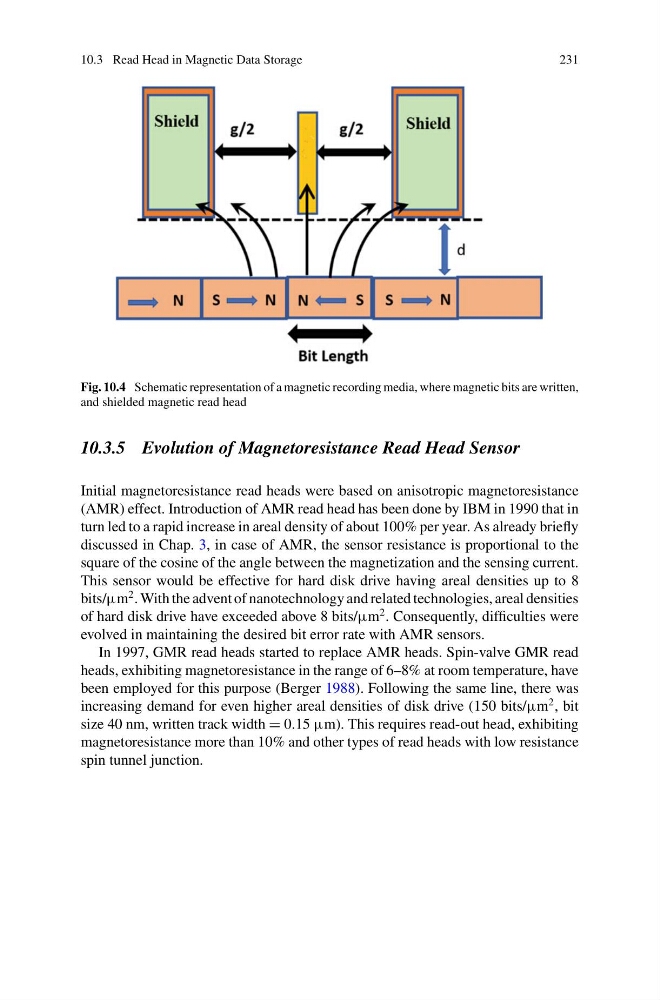
Fig. 10.4 Schematic representation of a magnetic recording media, where magnetic bits are written,
and shielded magnetic read head
10.3.5 Evolution of Magnetoresistance Read Head Sensor
Initial magnetoresistance read heads were based on anisotropic magnetoresistance
(AMR) effect. Introduction of AMR read head has been done by IBM in 1990 that in
turn led to a rapid increase in areal density of about 100% per year. As already briefly
discussed in Chap. 3, in case of AMR, the sensor resistance is proportional to the
square of the cosine of the angle between the magnetization and the sensing current.
This sensor would be effective for hard disk drive having areal densities up to 8
bits/μm
2 . With the advent of nanotechnology and related technologies, areal densities
of hard disk drive have exceeded above 8 bits/μm
2 . Consequently, difficulties were
evolved in maintaining the desired bit error rate with AMR sensors.
In 1997, GMR read heads started to replace AMR heads. Spin-valve GMR read
heads, exhibiting magnetoresistance in the range of 6–8% at room temperature, have
been employed for this purpose (Berger 1988). Following the same line, there was
increasing demand for even higher areal densities of disk drive (150 bits/μm
2 , bit
size 40 nm, written track width = 0.15 μm). This requires read-out head, exhibiting
magnetoresistance more than 10% and other types of read heads with low resistance
spin tunnel junction.
231
Fig. 10.4 Schematic representation of a magnetic recording media, where magnetic bits are written,
and shielded magnetic read head
10.3.5 Evolution of Magnetoresistance Read Head Sensor
Initial magnetoresistance read heads were based on anisotropic magnetoresistance
(AMR) effect. Introduction of AMR read head has been done by IBM in 1990 that in
turn led to a rapid increase in areal density of about 100% per year. As already briefly
discussed in Chap. 3, in case of AMR, the sensor resistance is proportional to the
square of the cosine of the angle between the magnetization and the sensing current.
This sensor would be effective for hard disk drive having areal densities up to 8
bits/μm
2 . With the advent of nanotechnology and related technologies, areal densities
of hard disk drive have exceeded above 8 bits/μm
2 . Consequently, difficulties were
evolved in maintaining the desired bit error rate with AMR sensors.
In 1997, GMR read heads started to replace AMR heads. Spin-valve GMR read
heads, exhibiting magnetoresistance in the range of 6–8% at room temperature, have
been employed for this purpose (Berger 1988). Following the same line, there was
increasing demand for even higher areal densities of disk drive (150 bits/μm
2 , bit
size 40 nm, written track width = 0.15 μm). This requires read-out head, exhibiting
magnetoresistance more than 10% and other types of read heads with low resistance
spin tunnel junction.