

9.5 Conclusion
219
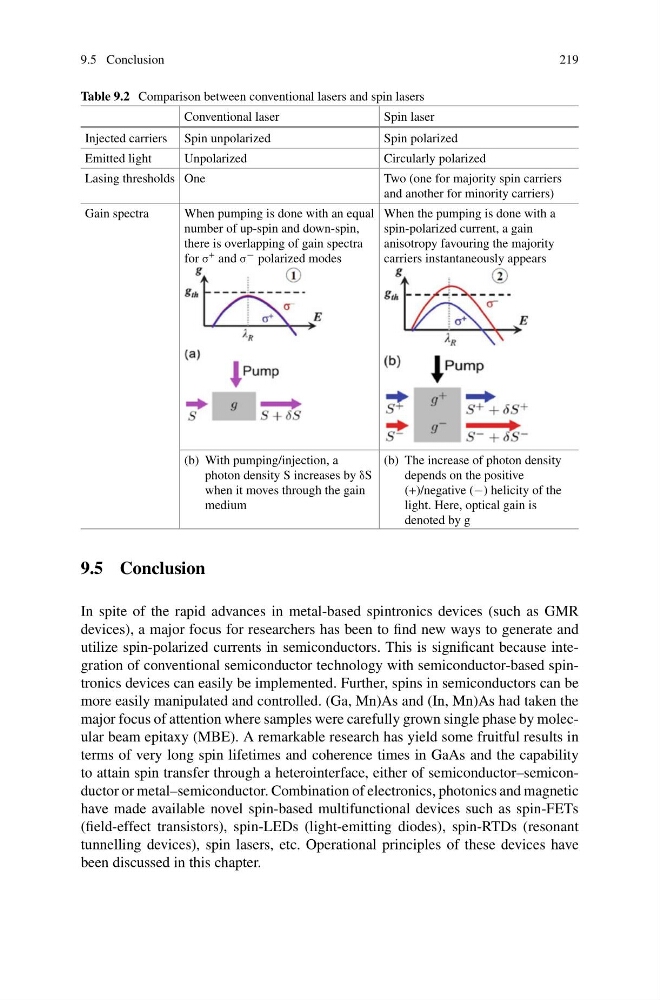
Table 9.2 Comparison between conventional lasers and spin lasers
Conventional laser
Spin laser
Injected carriers Spin unpolarized
Spin polarized
Emitted light
Unpolarized
Circularly polarized
Lasing thresholds One
Two (one for majority spin carriers
and another for minority carriers)
Gain spectra
When pumping is done with an equal
number of up-spin and down-spin,
there is overlapping of gain spectra
for σ + and σ − polarized modes
When the pumping is done with a
spin-polarized current, a gain
anisotropy favouring the majority
carriers instantaneously appears
(b) With pumping/injection, a
photon density S increases by δS
when it moves through the gain
medium
(b) The increase of photon density
depends on the positive
(+)/negative (−) helicity of the
light. Here, optical gain is
denoted by g
9.5 Conclusion
In spite of the rapid advances in metal-based spintronics devices (such as GMR
devices), a major focus for researchers has been to find new ways to generate and
utilize spin-polarized currents in semiconductors. This is significant because integration of conventional semiconductor technology with semiconductor-based spintronics devices can easily be implemented. Further, spins in semiconductors can be
more easily manipulated and controlled. (Ga, Mn)As and (In, Mn)As had taken the
major focus of attention where samples were carefully grown single phase by molecular beam epitaxy (MBE). A remarkable research has yield some fruitful results in
terms of very long spin lifetimes and coherence times in GaAs and the capability
to attain spin transfer through a heterointerface, either of semiconductor–semiconductor or metal–semiconductor. Combination of electronics, photonics and magnetic
have made available novel spin-based multifunctional devices such as spin-FETs
(field-effect transistors), spin-LEDs (light-emitting diodes), spin-RTDs (resonant
tunnelling devices), spin lasers, etc. Operational principles of these devices have
been discussed in this chapter.
219
Table 9.2 Comparison between conventional lasers and spin lasers
Conventional laser
Spin laser
Injected carriers Spin unpolarized
Spin polarized
Emitted light
Unpolarized
Circularly polarized
Lasing thresholds One
Two (one for majority spin carriers
and another for minority carriers)
Gain spectra
When pumping is done with an equal
number of up-spin and down-spin,
there is overlapping of gain spectra
for σ + and σ − polarized modes
When the pumping is done with a
spin-polarized current, a gain
anisotropy favouring the majority
carriers instantaneously appears
(b) With pumping/injection, a
photon density S increases by δS
when it moves through the gain
medium
(b) The increase of photon density
depends on the positive
(+)/negative (−) helicity of the
light. Here, optical gain is
denoted by g
9.5 Conclusion
In spite of the rapid advances in metal-based spintronics devices (such as GMR
devices), a major focus for researchers has been to find new ways to generate and
utilize spin-polarized currents in semiconductors. This is significant because integration of conventional semiconductor technology with semiconductor-based spintronics devices can easily be implemented. Further, spins in semiconductors can be
more easily manipulated and controlled. (Ga, Mn)As and (In, Mn)As had taken the
major focus of attention where samples were carefully grown single phase by molecular beam epitaxy (MBE). A remarkable research has yield some fruitful results in
terms of very long spin lifetimes and coherence times in GaAs and the capability
to attain spin transfer through a heterointerface, either of semiconductor–semiconductor or metal–semiconductor. Combination of electronics, photonics and magnetic
have made available novel spin-based multifunctional devices such as spin-FETs
(field-effect transistors), spin-LEDs (light-emitting diodes), spin-RTDs (resonant
tunnelling devices), spin lasers, etc. Operational principles of these devices have
been discussed in this chapter.