

218
9 Semiconductor Spintronics
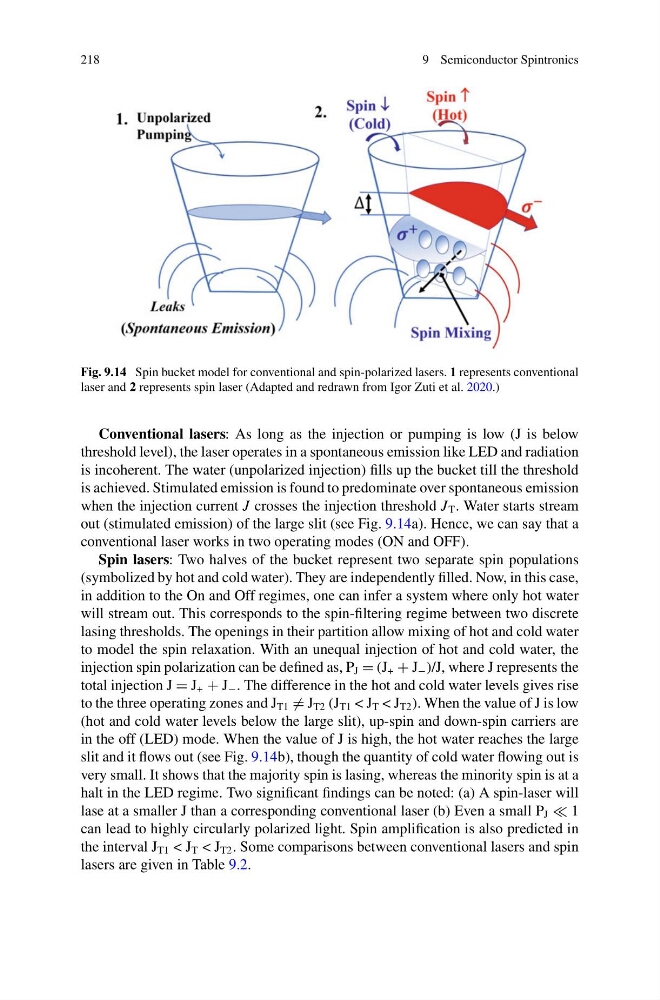
Fig. 9.14 Spin bucket model for conventional and spin-polarized lasers. 1 represents conventional
laser and 2 represents spin laser (Adapted and redrawn from Igor Zuti et al. 2020.)
Conventional lasers: As long as the injection or pumping is low (J is below
threshold level), the laser operates in a spontaneous emission like LED and radiation
is incoherent. The water (unpolarized injection) fills up the bucket till the threshold
is achieved. Stimulated emission is found to predominate over spontaneous emission
when the injection current J crosses the injection threshold J T . Water starts stream
out (stimulated emission) of the large slit (see Fig. 9.14a). Hence, we can say that a
conventional laser works in two operating modes (ON and OFF).
Spin lasers: Two halves of the bucket represent two separate spin populations
(symbolized by hot and cold water). They are independently filled. Now, in this case,
in addition to the On and Off regimes, one can infer a system where only hot water
will stream out. This corresponds to the spin-filtering regime between two discrete
lasing thresholds. The openings in their partition allow mixing of hot and cold water
to model the spin relaxation. With an unequal injection of hot and cold water, the
injection spin polarization can be defined as, P J = (J + + J − )/J, where J represents the
total injection J = J + + J − . The difference in the hot and cold water levels gives rise
to the three operating zones and J T1 = J T2 (J T1 < J T < J T2 ). When the value of J is low
(hot and cold water levels below the large slit), up-spin and down-spin carriers are
in the off (LED) mode. When the value of J is high, the hot water reaches the large
slit and it flows out (see Fig. 9.14b), though the quantity of cold water flowing out is
very small. It shows that the majority spin is lasing, whereas the minority spin is at a
halt in the LED regime. Two significant findings can be noted: (a) A spin-laser will
lase at a smaller J than a corresponding conventional laser (b) Even a small P J 1
can lead to highly circularly polarized light. Spin amplification is also predicted in
the interval J T1 < J T < J T2 . Some comparisons between conventional lasers and spin
lasers are given in Table 9.2.
9 Semiconductor Spintronics
Fig. 9.14 Spin bucket model for conventional and spin-polarized lasers. 1 represents conventional
laser and 2 represents spin laser (Adapted and redrawn from Igor Zuti et al. 2020.)
Conventional lasers: As long as the injection or pumping is low (J is below
threshold level), the laser operates in a spontaneous emission like LED and radiation
is incoherent. The water (unpolarized injection) fills up the bucket till the threshold
is achieved. Stimulated emission is found to predominate over spontaneous emission
when the injection current J crosses the injection threshold J T . Water starts stream
out (stimulated emission) of the large slit (see Fig. 9.14a). Hence, we can say that a
conventional laser works in two operating modes (ON and OFF).
Spin lasers: Two halves of the bucket represent two separate spin populations
(symbolized by hot and cold water). They are independently filled. Now, in this case,
in addition to the On and Off regimes, one can infer a system where only hot water
will stream out. This corresponds to the spin-filtering regime between two discrete
lasing thresholds. The openings in their partition allow mixing of hot and cold water
to model the spin relaxation. With an unequal injection of hot and cold water, the
injection spin polarization can be defined as, P J = (J + + J − )/J, where J represents the
total injection J = J + + J − . The difference in the hot and cold water levels gives rise
to the three operating zones and J T1 = J T2 (J T1 < J T < J T2 ). When the value of J is low
(hot and cold water levels below the large slit), up-spin and down-spin carriers are
in the off (LED) mode. When the value of J is high, the hot water reaches the large
slit and it flows out (see Fig. 9.14b), though the quantity of cold water flowing out is
very small. It shows that the majority spin is lasing, whereas the minority spin is at a
halt in the LED regime. Two significant findings can be noted: (a) A spin-laser will
lase at a smaller J than a corresponding conventional laser (b) Even a small P J 1
can lead to highly circularly polarized light. Spin amplification is also predicted in
the interval J T1 < J T < J T2 . Some comparisons between conventional lasers and spin
lasers are given in Table 9.2.