

9.4 Spin-Polarized Semiconductor Devices
217
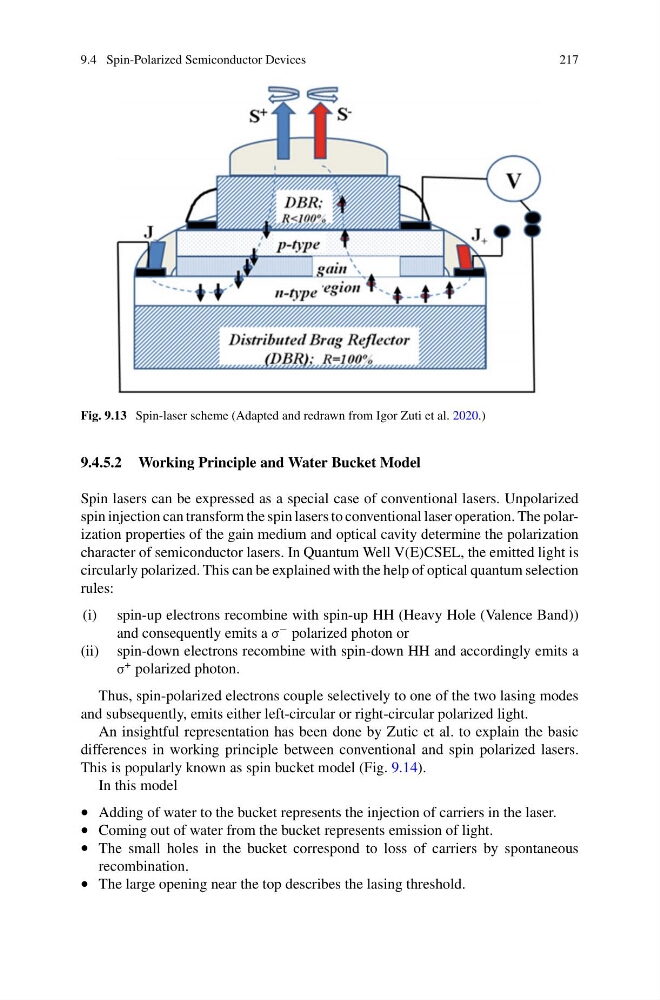
Fig. 9.13 Spin-laser scheme (Adapted and redrawn from Igor Zuti et al. 2020.)
9.4.5.2 Working Principle and Water Bucket Model
Spin lasers can be expressed as a special case of conventional lasers. Unpolarized
spin injection can transform the spin lasers to conventional laser operation. The polarization properties of the gain medium and optical cavity determine the polarization
character of semiconductor lasers. In Quantum Well V(E)CSEL, the emitted light is
circularly polarized. This can be explained with the help of optical quantum selection
rules:
(i) spin-up electrons recombine with spin-up HH (Heavy Hole (Valence Band))
and consequently emits a σ
− polarized photon or
(ii) spin-down electrons recombine with spin-down HH and accordingly emits a
σ
+ polarized photon.
Thus, spin-polarized electrons couple selectively to one of the two lasing modes
and subsequently, emits either left-circular or right-circular polarized light.
An insightful representation has been done by Zutic et al. to explain the basic
differences in working principle between conventional and spin polarized lasers.
This is popularly known as spin bucket model (Fig. 9.14).
In this model
• Adding of water to the bucket represents the injection of carriers in the laser.
• Coming out of water from the bucket represents emission of light.
• The small holes in the bucket correspond to loss of carriers by spontaneous
recombination.
• The large opening near the top describes the lasing threshold.
217
Fig. 9.13 Spin-laser scheme (Adapted and redrawn from Igor Zuti et al. 2020.)
9.4.5.2 Working Principle and Water Bucket Model
Spin lasers can be expressed as a special case of conventional lasers. Unpolarized
spin injection can transform the spin lasers to conventional laser operation. The polarization properties of the gain medium and optical cavity determine the polarization
character of semiconductor lasers. In Quantum Well V(E)CSEL, the emitted light is
circularly polarized. This can be explained with the help of optical quantum selection
rules:
(i) spin-up electrons recombine with spin-up HH (Heavy Hole (Valence Band))
and consequently emits a σ
− polarized photon or
(ii) spin-down electrons recombine with spin-down HH and accordingly emits a
σ
+ polarized photon.
Thus, spin-polarized electrons couple selectively to one of the two lasing modes
and subsequently, emits either left-circular or right-circular polarized light.
An insightful representation has been done by Zutic et al. to explain the basic
differences in working principle between conventional and spin polarized lasers.
This is popularly known as spin bucket model (Fig. 9.14).
In this model
• Adding of water to the bucket represents the injection of carriers in the laser.
• Coming out of water from the bucket represents emission of light.
• The small holes in the bucket correspond to loss of carriers by spontaneous
recombination.
• The large opening near the top describes the lasing threshold.