

214
9 Semiconductor Spintronics
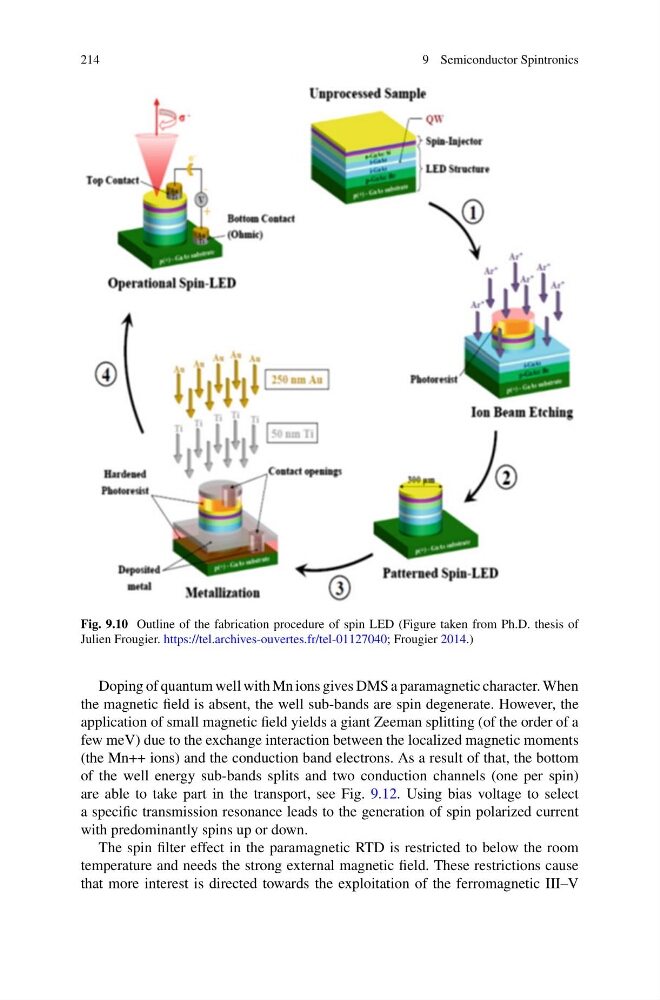
Fig. 9.10 Outline of the fabrication procedure of spin LED (Figure taken from Ph.D. thesis of
Julien Frougier. https://tel.archives-ouvertes.fr/tel-01127040; Frougier 2014.)
Doping of quantum well with Mn ions gives DMS a paramagnetic character. When
the magnetic field is absent, the well sub-bands are spin degenerate. However, the
application of small magnetic field yields a giant Zeeman splitting (of the order of a
few meV) due to the exchange interaction between the localized magnetic moments
(the Mn++ ions) and the conduction band electrons. As a result of that, the bottom
of the well energy sub-bands splits and two conduction channels (one per spin)
are able to take part in the transport, see Fig. 9.12. Using bias voltage to select
a specific transmission resonance leads to the generation of spin polarized current
with predominantly spins up or down.
The spin filter effect in the paramagnetic RTD is restricted to below the room
temperature and needs the strong external magnetic field. These restrictions cause
that more interest is directed towards the exploitation of the ferromagnetic III–V
9 Semiconductor Spintronics
Fig. 9.10 Outline of the fabrication procedure of spin LED (Figure taken from Ph.D. thesis of
Julien Frougier. https://tel.archives-ouvertes.fr/tel-01127040; Frougier 2014.)
Doping of quantum well with Mn ions gives DMS a paramagnetic character. When
the magnetic field is absent, the well sub-bands are spin degenerate. However, the
application of small magnetic field yields a giant Zeeman splitting (of the order of a
few meV) due to the exchange interaction between the localized magnetic moments
(the Mn++ ions) and the conduction band electrons. As a result of that, the bottom
of the well energy sub-bands splits and two conduction channels (one per spin)
are able to take part in the transport, see Fig. 9.12. Using bias voltage to select
a specific transmission resonance leads to the generation of spin polarized current
with predominantly spins up or down.
The spin filter effect in the paramagnetic RTD is restricted to below the room
temperature and needs the strong external magnetic field. These restrictions cause
that more interest is directed towards the exploitation of the ferromagnetic III–V