

9.4 Spin-Polarized Semiconductor Devices
207
right circularly polarized light for use in encrypted communication, spin-polarized
laser, spin interference device, etc. (https://nptel.ac.in/courses/115/103/115103039/;
Zuti et al. 2020; Pearton et al. 2003, 2005; Nitta 2004; Tang and Wang 2015; Kantser
2006; Lee et al. 2014). Spin light emitting diodes (spin-LEDs) and spin-polarized
lasers (spin-laser) are an important class of semiconductor spintronic devices. In these
devices, spin-polarized electrons (or holes) are injected into an active region where
they recombine radiatively with unpolarized holes (or electrons) to emit preferentially
right or left-circularly polarized light.
Various approaches have been made to manage of the electron spin degree of
freedom that works through one of the following interactions:
• Magnetic interaction,
• Spin–orbit interaction (SOI)
• Exchange interaction
• Hyperfine interaction with nuclear spins.
SOI is believed to be the most important channel for spin controlling due to
relatively large magnitude and potential of using the electric fields, optical radiation
and others for modification of spin states. The schemes of useful control and handling
of the spin system through SOI mechanisms in semiconductor spintronics can be
placed into three categories:
• Optical
• Electrical
• Magnetic.
9.4.1 Three Terminal Spintronic Devices
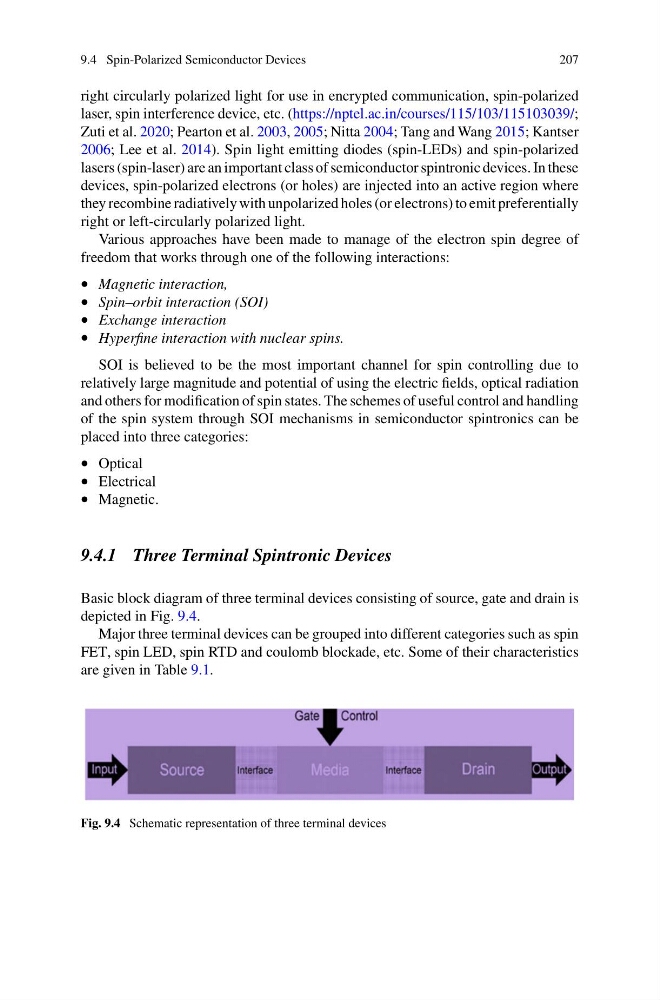
Basic block diagram of three terminal devices consisting of source, gate and drain is
depicted in Fig. 9.4.
Major three terminal devices can be grouped into different categories such as spin
FET, spin LED, spin RTD and coulomb blockade, etc. Some of their characteristics
are given in Table 9.1.
Fig. 9.4 Schematic representation of three terminal devices
207
right circularly polarized light for use in encrypted communication, spin-polarized
laser, spin interference device, etc. (https://nptel.ac.in/courses/115/103/115103039/;
Zuti et al. 2020; Pearton et al. 2003, 2005; Nitta 2004; Tang and Wang 2015; Kantser
2006; Lee et al. 2014). Spin light emitting diodes (spin-LEDs) and spin-polarized
lasers (spin-laser) are an important class of semiconductor spintronic devices. In these
devices, spin-polarized electrons (or holes) are injected into an active region where
they recombine radiatively with unpolarized holes (or electrons) to emit preferentially
right or left-circularly polarized light.
Various approaches have been made to manage of the electron spin degree of
freedom that works through one of the following interactions:
• Magnetic interaction,
• Spin–orbit interaction (SOI)
• Exchange interaction
• Hyperfine interaction with nuclear spins.
SOI is believed to be the most important channel for spin controlling due to
relatively large magnitude and potential of using the electric fields, optical radiation
and others for modification of spin states. The schemes of useful control and handling
of the spin system through SOI mechanisms in semiconductor spintronics can be
placed into three categories:
• Optical
• Electrical
• Magnetic.
9.4.1 Three Terminal Spintronic Devices
Basic block diagram of three terminal devices consisting of source, gate and drain is
depicted in Fig. 9.4.
Major three terminal devices can be grouped into different categories such as spin
FET, spin LED, spin RTD and coulomb blockade, etc. Some of their characteristics
are given in Table 9.1.
Fig. 9.4 Schematic representation of three terminal devices