

206
9 Semiconductor Spintronics
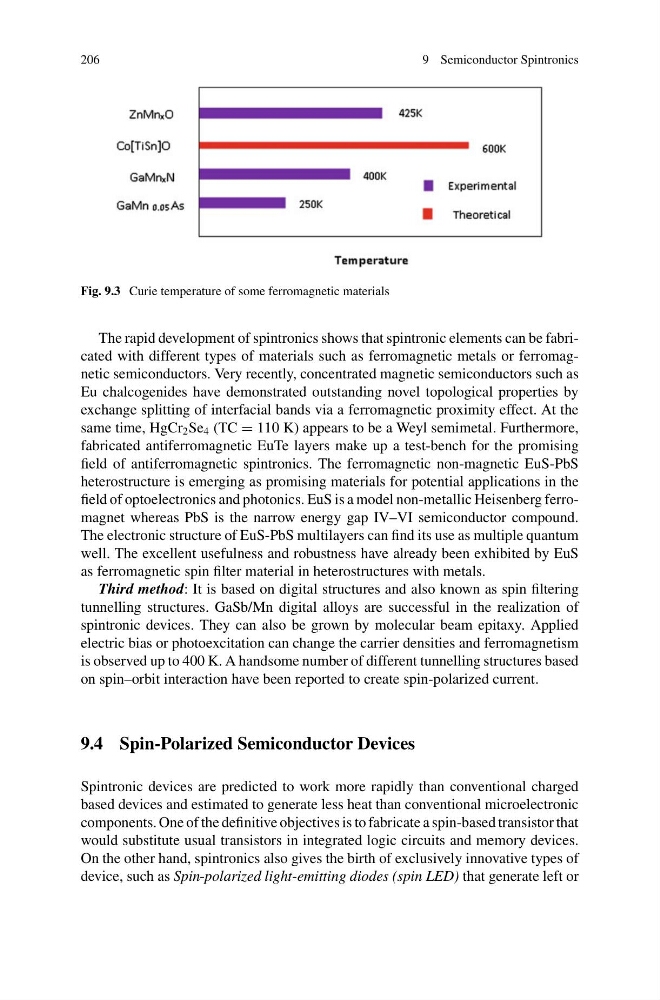
Fig. 9.3 Curie temperature of some ferromagnetic materials
The rapid development of spintronics shows that spintronic elements can be fabricated with different types of materials such as ferromagnetic metals or ferromagnetic semiconductors. Very recently, concentrated magnetic semiconductors such as
Eu chalcogenides have demonstrated outstanding novel topological properties by
exchange splitting of interfacial bands via a ferromagnetic proximity effect. At the
same time, HgCr 2 Se 4 (TC = 110 K) appears to be a Weyl semimetal. Furthermore,
fabricated antiferromagnetic EuTe layers make up a test-bench for the promising
field of antiferromagnetic spintronics. The ferromagnetic non-magnetic EuS-PbS
heterostructure is emerging as promising materials for potential applications in the
field of optoelectronics and photonics. EuS is a model non-metallic Heisenberg ferromagnet whereas PbS is the narrow energy gap IV–VI semiconductor compound.
The electronic structure of EuS-PbS multilayers can find its use as multiple quantum
well. The excellent usefulness and robustness have already been exhibited by EuS
as ferromagnetic spin filter material in heterostructures with metals.
Third method: It is based on digital structures and also known as spin filtering
tunnelling structures. GaSb/Mn digital alloys are successful in the realization of
spintronic devices. They can also be grown by molecular beam epitaxy. Applied
electric bias or photoexcitation can change the carrier densities and ferromagnetism
is observed up to 400 K. A handsome number of different tunnelling structures based
on spin–orbit interaction have been reported to create spin-polarized current.
9.4 Spin-Polarized Semiconductor Devices
Spintronic devices are predicted to work more rapidly than conventional charged
based devices and estimated to generate less heat than conventional microelectronic
components. One of the definitive objectives is to fabricate a spin-based transistor that
would substitute usual transistors in integrated logic circuits and memory devices.
On the other hand, spintronics also gives the birth of exclusively innovative types of
device, such as Spin-polarized light-emitting diodes (spin LED) that generate left or
9 Semiconductor Spintronics
Fig. 9.3 Curie temperature of some ferromagnetic materials
The rapid development of spintronics shows that spintronic elements can be fabricated with different types of materials such as ferromagnetic metals or ferromagnetic semiconductors. Very recently, concentrated magnetic semiconductors such as
Eu chalcogenides have demonstrated outstanding novel topological properties by
exchange splitting of interfacial bands via a ferromagnetic proximity effect. At the
same time, HgCr 2 Se 4 (TC = 110 K) appears to be a Weyl semimetal. Furthermore,
fabricated antiferromagnetic EuTe layers make up a test-bench for the promising
field of antiferromagnetic spintronics. The ferromagnetic non-magnetic EuS-PbS
heterostructure is emerging as promising materials for potential applications in the
field of optoelectronics and photonics. EuS is a model non-metallic Heisenberg ferromagnet whereas PbS is the narrow energy gap IV–VI semiconductor compound.
The electronic structure of EuS-PbS multilayers can find its use as multiple quantum
well. The excellent usefulness and robustness have already been exhibited by EuS
as ferromagnetic spin filter material in heterostructures with metals.
Third method: It is based on digital structures and also known as spin filtering
tunnelling structures. GaSb/Mn digital alloys are successful in the realization of
spintronic devices. They can also be grown by molecular beam epitaxy. Applied
electric bias or photoexcitation can change the carrier densities and ferromagnetism
is observed up to 400 K. A handsome number of different tunnelling structures based
on spin–orbit interaction have been reported to create spin-polarized current.
9.4 Spin-Polarized Semiconductor Devices
Spintronic devices are predicted to work more rapidly than conventional charged
based devices and estimated to generate less heat than conventional microelectronic
components. One of the definitive objectives is to fabricate a spin-based transistor that
would substitute usual transistors in integrated logic circuits and memory devices.
On the other hand, spintronics also gives the birth of exclusively innovative types of
device, such as Spin-polarized light-emitting diodes (spin LED) that generate left or