

8.6 Terahertz Writing
197
Fig. 8.13 a Schematic
picture of the CuMnAs
crystal. b Detailed electron
microscope image [Adapted
from Olejnik et al., Science
Advances (2018) and T.
Seifert, Ph.D. thesis Refs.
Seifert (2017); Saitoh et al.
(2006)]
in antiferromagnets takes place at a much shorter time scale (picosecond scale) than
in ferromagnets. This increases the possibility of faster decimation of information.
The writing speeds for ferromagnetic memories are restricted to the gigahertz range,
whereas it is possible to achieve THz writing speed in antiferromagnets. Besides
that, antiferromagnets are more abundant in nature than ferromagnets and many of
them are good insulators with low dissipation of energy. Encoding of information is
provided by Néel vector in case of antiferromagnets.
The most promising antiferromagnetic material for writing magnetic memory
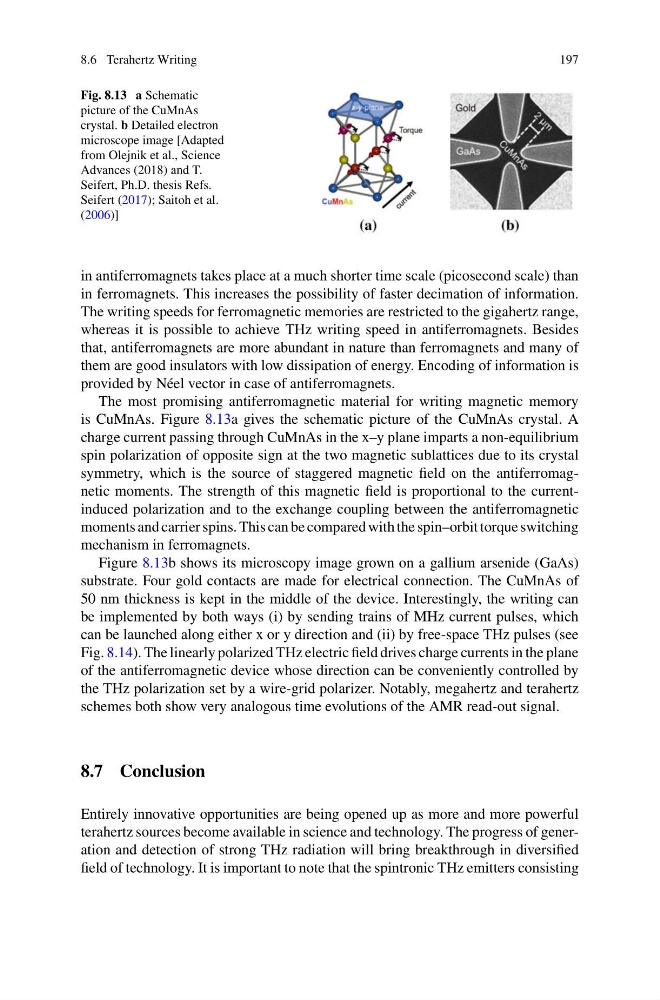
is CuMnAs. Figure 8.13a gives the schematic picture of the CuMnAs crystal. A
charge current passing through CuMnAs in the x–y plane imparts a non-equilibrium
spin polarization of opposite sign at the two magnetic sublattices due to its crystal
symmetry, which is the source of staggered magnetic field on the antiferromagnetic moments. The strength of this magnetic field is proportional to the currentinduced polarization and to the exchange coupling between the antiferromagnetic
moments and carrier spins. This can be compared with the spin–orbit torque switching
mechanism in ferromagnets.
Figure 8.13b shows its microscopy image grown on a gallium arsenide (GaAs)
substrate. Four gold contacts are made for electrical connection. The CuMnAs of
50 nm thickness is kept in the middle of the device. Interestingly, the writing can
be implemented by both ways (i) by sending trains of MHz current pulses, which
can be launched along either x or y direction and (ii) by free-space THz pulses (see
Fig. 8.14). The linearly polarized THz electric field drives charge currents in the plane
of the antiferromagnetic device whose direction can be conveniently controlled by
the THz polarization set by a wire-grid polarizer. Notably, megahertz and terahertz
schemes both show very analogous time evolutions of the AMR read-out signal.
8.7 Conclusion
Entirely innovative opportunities are being opened up as more and more powerful
terahertz sources become available in science and technology. The progress of generation and detection of strong THz radiation will bring breakthrough in diversified
field of technology. It is important to note that the spintronic THz emitters consisting
197
Fig. 8.13 a Schematic
picture of the CuMnAs
crystal. b Detailed electron
microscope image [Adapted
from Olejnik et al., Science
Advances (2018) and T.
Seifert, Ph.D. thesis Refs.
Seifert (2017); Saitoh et al.
(2006)]
in antiferromagnets takes place at a much shorter time scale (picosecond scale) than
in ferromagnets. This increases the possibility of faster decimation of information.
The writing speeds for ferromagnetic memories are restricted to the gigahertz range,
whereas it is possible to achieve THz writing speed in antiferromagnets. Besides
that, antiferromagnets are more abundant in nature than ferromagnets and many of
them are good insulators with low dissipation of energy. Encoding of information is
provided by Néel vector in case of antiferromagnets.
The most promising antiferromagnetic material for writing magnetic memory
is CuMnAs. Figure 8.13a gives the schematic picture of the CuMnAs crystal. A
charge current passing through CuMnAs in the x–y plane imparts a non-equilibrium
spin polarization of opposite sign at the two magnetic sublattices due to its crystal
symmetry, which is the source of staggered magnetic field on the antiferromagnetic moments. The strength of this magnetic field is proportional to the currentinduced polarization and to the exchange coupling between the antiferromagnetic
moments and carrier spins. This can be compared with the spin–orbit torque switching
mechanism in ferromagnets.
Figure 8.13b shows its microscopy image grown on a gallium arsenide (GaAs)
substrate. Four gold contacts are made for electrical connection. The CuMnAs of
50 nm thickness is kept in the middle of the device. Interestingly, the writing can
be implemented by both ways (i) by sending trains of MHz current pulses, which
can be launched along either x or y direction and (ii) by free-space THz pulses (see
Fig. 8.14). The linearly polarized THz electric field drives charge currents in the plane
of the antiferromagnetic device whose direction can be conveniently controlled by
the THz polarization set by a wire-grid polarizer. Notably, megahertz and terahertz
schemes both show very analogous time evolutions of the AMR read-out signal.
8.7 Conclusion
Entirely innovative opportunities are being opened up as more and more powerful
terahertz sources become available in science and technology. The progress of generation and detection of strong THz radiation will bring breakthrough in diversified
field of technology. It is important to note that the spintronic THz emitters consisting