

196
8 Terahertz Spintronics
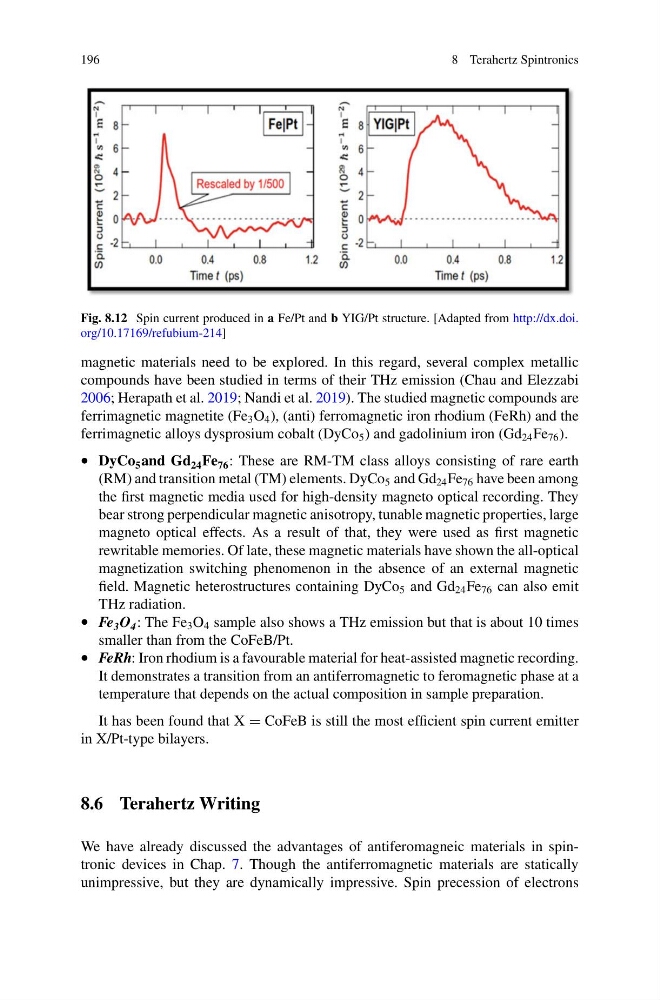
Fig. 8.12 Spin current produced in a Fe/Pt and b YIG/Pt structure. [Adapted from http://dx.doi.
org/10.17169/refubium-214]
magnetic materials need to be explored. In this regard, several complex metallic
compounds have been studied in terms of their THz emission (Chau and Elezzabi
2006; Herapath et al. 2019; Nandi et al. 2019). The studied magnetic compounds are
ferrimagnetic magnetite (Fe 3 O 4 ), (anti) ferromagnetic iron rhodium (FeRh) and the
ferrimagnetic alloys dysprosium cobalt (DyCo 5 ) and gadolinium iron (Gd 24 Fe 76 ).
• DyCo 5 and Gd 24 Fe 76 : These are RM-TM class alloys consisting of rare earth
(RM) and transition metal (TM) elements. DyCo 5 and Gd 24 Fe 76 have been among
the first magnetic media used for high-density magneto optical recording. They
bear strong perpendicular magnetic anisotropy, tunable magnetic properties, large
magneto optical effects. As a result of that, they were used as first magnetic
rewritable memories. Of late, these magnetic materials have shown the all-optical
magnetization switching phenomenon in the absence of an external magnetic
field. Magnetic heterostructures containing DyCo 5 and Gd 24 Fe 76 can also emit
THz radiation.
• Fe 3 O 4 : The Fe 3 O 4 sample also shows a THz emission but that is about 10 times
smaller than from the CoFeB/Pt.
• FeRh: Iron rhodium is a favourable material for heat-assisted magnetic recording.
It demonstrates a transition from an antiferromagnetic to feromagnetic phase at a
temperature that depends on the actual composition in sample preparation.
It has been found that X = CoFeB is still the most efficient spin current emitter
in X/Pt-type bilayers.
8.6 Terahertz Writing
We have already discussed the advantages of antiferomagneic materials in spintronic devices in Chap. 7. Though the antiferromagnetic materials are statically
unimpressive, but they are dynamically impressive. Spin precession of electrons
8 Terahertz Spintronics
Fig. 8.12 Spin current produced in a Fe/Pt and b YIG/Pt structure. [Adapted from http://dx.doi.
org/10.17169/refubium-214]
magnetic materials need to be explored. In this regard, several complex metallic
compounds have been studied in terms of their THz emission (Chau and Elezzabi
2006; Herapath et al. 2019; Nandi et al. 2019). The studied magnetic compounds are
ferrimagnetic magnetite (Fe 3 O 4 ), (anti) ferromagnetic iron rhodium (FeRh) and the
ferrimagnetic alloys dysprosium cobalt (DyCo 5 ) and gadolinium iron (Gd 24 Fe 76 ).
• DyCo 5 and Gd 24 Fe 76 : These are RM-TM class alloys consisting of rare earth
(RM) and transition metal (TM) elements. DyCo 5 and Gd 24 Fe 76 have been among
the first magnetic media used for high-density magneto optical recording. They
bear strong perpendicular magnetic anisotropy, tunable magnetic properties, large
magneto optical effects. As a result of that, they were used as first magnetic
rewritable memories. Of late, these magnetic materials have shown the all-optical
magnetization switching phenomenon in the absence of an external magnetic
field. Magnetic heterostructures containing DyCo 5 and Gd 24 Fe 76 can also emit
THz radiation.
• Fe 3 O 4 : The Fe 3 O 4 sample also shows a THz emission but that is about 10 times
smaller than from the CoFeB/Pt.
• FeRh: Iron rhodium is a favourable material for heat-assisted magnetic recording.
It demonstrates a transition from an antiferromagnetic to feromagnetic phase at a
temperature that depends on the actual composition in sample preparation.
It has been found that X = CoFeB is still the most efficient spin current emitter
in X/Pt-type bilayers.
8.6 Terahertz Writing
We have already discussed the advantages of antiferomagneic materials in spintronic devices in Chap. 7. Though the antiferromagnetic materials are statically
unimpressive, but they are dynamically impressive. Spin precession of electrons