

8.5 Spintronic Terahertz Emitter (STE)
195
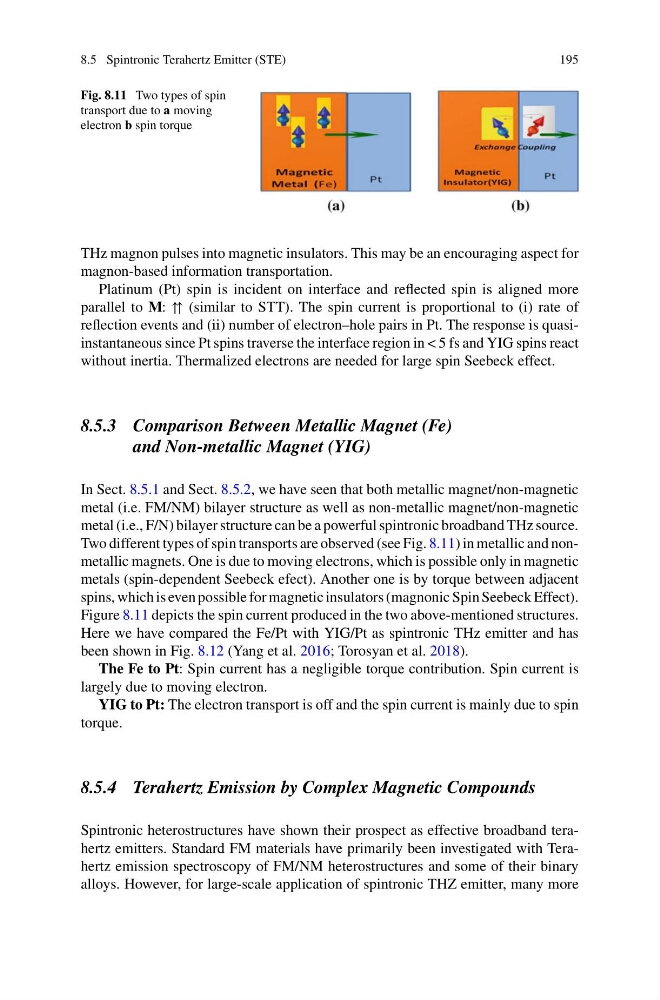
Fig. 8.11 Two types of spin
transport due to a moving
electron b spin torque
THz magnon pulses into magnetic insulators. This may be an encouraging aspect for
magnon-based information transportation.
Platinum (Pt) spin is incident on interface and reflected spin is aligned more
parallel to M: ⇈ (similar to STT). The spin current is proportional to (i) rate of
reflection events and (ii) number of electron–hole pairs in Pt. The response is quasiinstantaneous since Pt spins traverse the interface region in < 5 fs and YIG spins react
without inertia. Thermalized electrons are needed for large spin Seebeck effect.
8.5.3 Comparison Between Metallic Magnet (Fe)
and Non-metallic Magnet (YIG)
In Sect. 8.5.1 and Sect. 8.5.2, we have seen that both metallic magnet/non-magnetic
metal (i.e. FM/NM) bilayer structure as well as non-metallic magnet/non-magnetic
metal (i.e., F/N) bilayer structure can be a powerful spintronic broadband THz source.
Two different types of spin transports are observed (see Fig. 8.11) in metallic and nonmetallic magnets. One is due to moving electrons, which is possible only in magnetic
metals (spin-dependent Seebeck efect). Another one is by torque between adjacent
spins, which is even possible for magnetic insulators (magnonic Spin Seebeck Effect).
Figure 8.11 depicts the spin current produced in the two above-mentioned structures.
Here we have compared the Fe/Pt with YIG/Pt as spintronic THz emitter and has
been shown in Fig. 8.12 (Yang et al. 2016; Torosyan et al. 2018).
The Fe to Pt: Spin current has a negligible torque contribution. Spin current is
largely due to moving electron.
YIG to Pt: The electron transport is off and the spin current is mainly due to spin
torque.
8.5.4 Terahertz Emission by Complex Magnetic Compounds
Spintronic heterostructures have shown their prospect as effective broadband terahertz emitters. Standard FM materials have primarily been investigated with Terahertz emission spectroscopy of FM/NM heterostructures and some of their binary
alloys. However, for large-scale application of spintronic THZ emitter, many more
195
Fig. 8.11 Two types of spin
transport due to a moving
electron b spin torque
THz magnon pulses into magnetic insulators. This may be an encouraging aspect for
magnon-based information transportation.
Platinum (Pt) spin is incident on interface and reflected spin is aligned more
parallel to M: ⇈ (similar to STT). The spin current is proportional to (i) rate of
reflection events and (ii) number of electron–hole pairs in Pt. The response is quasiinstantaneous since Pt spins traverse the interface region in < 5 fs and YIG spins react
without inertia. Thermalized electrons are needed for large spin Seebeck effect.
8.5.3 Comparison Between Metallic Magnet (Fe)
and Non-metallic Magnet (YIG)
In Sect. 8.5.1 and Sect. 8.5.2, we have seen that both metallic magnet/non-magnetic
metal (i.e. FM/NM) bilayer structure as well as non-metallic magnet/non-magnetic
metal (i.e., F/N) bilayer structure can be a powerful spintronic broadband THz source.
Two different types of spin transports are observed (see Fig. 8.11) in metallic and nonmetallic magnets. One is due to moving electrons, which is possible only in magnetic
metals (spin-dependent Seebeck efect). Another one is by torque between adjacent
spins, which is even possible for magnetic insulators (magnonic Spin Seebeck Effect).
Figure 8.11 depicts the spin current produced in the two above-mentioned structures.
Here we have compared the Fe/Pt with YIG/Pt as spintronic THz emitter and has
been shown in Fig. 8.12 (Yang et al. 2016; Torosyan et al. 2018).
The Fe to Pt: Spin current has a negligible torque contribution. Spin current is
largely due to moving electron.
YIG to Pt: The electron transport is off and the spin current is mainly due to spin
torque.
8.5.4 Terahertz Emission by Complex Magnetic Compounds
Spintronic heterostructures have shown their prospect as effective broadband terahertz emitters. Standard FM materials have primarily been investigated with Terahertz emission spectroscopy of FM/NM heterostructures and some of their binary
alloys. However, for large-scale application of spintronic THZ emitter, many more