

194
8 Terahertz Spintronics
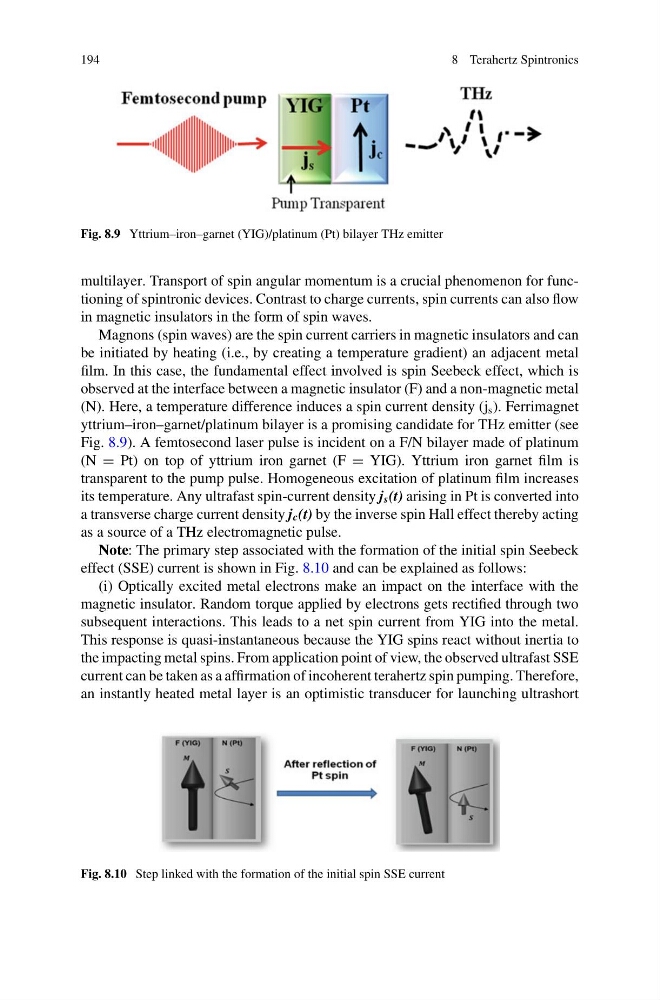
Fig. 8.9 Yttrium–iron–garnet (YIG)/platinum (Pt) bilayer THz emitter
multilayer. Transport of spin angular momentum is a crucial phenomenon for functioning of spintronic devices. Contrast to charge currents, spin currents can also flow
in magnetic insulators in the form of spin waves.
Magnons (spin waves) are the spin current carriers in magnetic insulators and can
be initiated by heating (i.e., by creating a temperature gradient) an adjacent metal
film. In this case, the fundamental effect involved is spin Seebeck effect, which is
observed at the interface between a magnetic insulator (F) and a non-magnetic metal
(N). Here, a temperature difference induces a spin current density (j s ). Ferrimagnet
yttrium–iron–garnet/platinum bilayer is a promising candidate for THz emitter (see
Fig. 8.9). A femtosecond laser pulse is incident on a F/N bilayer made of platinum
(N = Pt) on top of yttrium iron garnet (F = YIG). Yttrium iron garnet film is
transparent to the pump pulse. Homogeneous excitation of platinum film increases
its temperature. Any ultrafast spin-current density j s (t) arising in Pt is converted into
a transverse charge current density j c (t) by the inverse spin Hall effect thereby acting
as a source of a THz electromagnetic pulse.
Note: The primary step associated with the formation of the initial spin Seebeck
effect (SSE) current is shown in Fig. 8.10 and can be explained as follows:
(i) Optically excited metal electrons make an impact on the interface with the
magnetic insulator. Random torque applied by electrons gets rectified through two
subsequent interactions. This leads to a net spin current from YIG into the metal.
This response is quasi-instantaneous because the YIG spins react without inertia to
the impacting metal spins. From application point of view, the observed ultrafast SSE
current can be taken as a affirmation of incoherent terahertz spin pumping. Therefore,
an instantly heated metal layer is an optimistic transducer for launching ultrashort
Fig. 8.10 Step linked with the formation of the initial spin SSE current
8 Terahertz Spintronics
Fig. 8.9 Yttrium–iron–garnet (YIG)/platinum (Pt) bilayer THz emitter
multilayer. Transport of spin angular momentum is a crucial phenomenon for functioning of spintronic devices. Contrast to charge currents, spin currents can also flow
in magnetic insulators in the form of spin waves.
Magnons (spin waves) are the spin current carriers in magnetic insulators and can
be initiated by heating (i.e., by creating a temperature gradient) an adjacent metal
film. In this case, the fundamental effect involved is spin Seebeck effect, which is
observed at the interface between a magnetic insulator (F) and a non-magnetic metal
(N). Here, a temperature difference induces a spin current density (j s ). Ferrimagnet
yttrium–iron–garnet/platinum bilayer is a promising candidate for THz emitter (see
Fig. 8.9). A femtosecond laser pulse is incident on a F/N bilayer made of platinum
(N = Pt) on top of yttrium iron garnet (F = YIG). Yttrium iron garnet film is
transparent to the pump pulse. Homogeneous excitation of platinum film increases
its temperature. Any ultrafast spin-current density j s (t) arising in Pt is converted into
a transverse charge current density j c (t) by the inverse spin Hall effect thereby acting
as a source of a THz electromagnetic pulse.
Note: The primary step associated with the formation of the initial spin Seebeck
effect (SSE) current is shown in Fig. 8.10 and can be explained as follows:
(i) Optically excited metal electrons make an impact on the interface with the
magnetic insulator. Random torque applied by electrons gets rectified through two
subsequent interactions. This leads to a net spin current from YIG into the metal.
This response is quasi-instantaneous because the YIG spins react without inertia to
the impacting metal spins. From application point of view, the observed ultrafast SSE
current can be taken as a affirmation of incoherent terahertz spin pumping. Therefore,
an instantly heated metal layer is an optimistic transducer for launching ultrashort
Fig. 8.10 Step linked with the formation of the initial spin SSE current