

198
8 Terahertz Spintronics
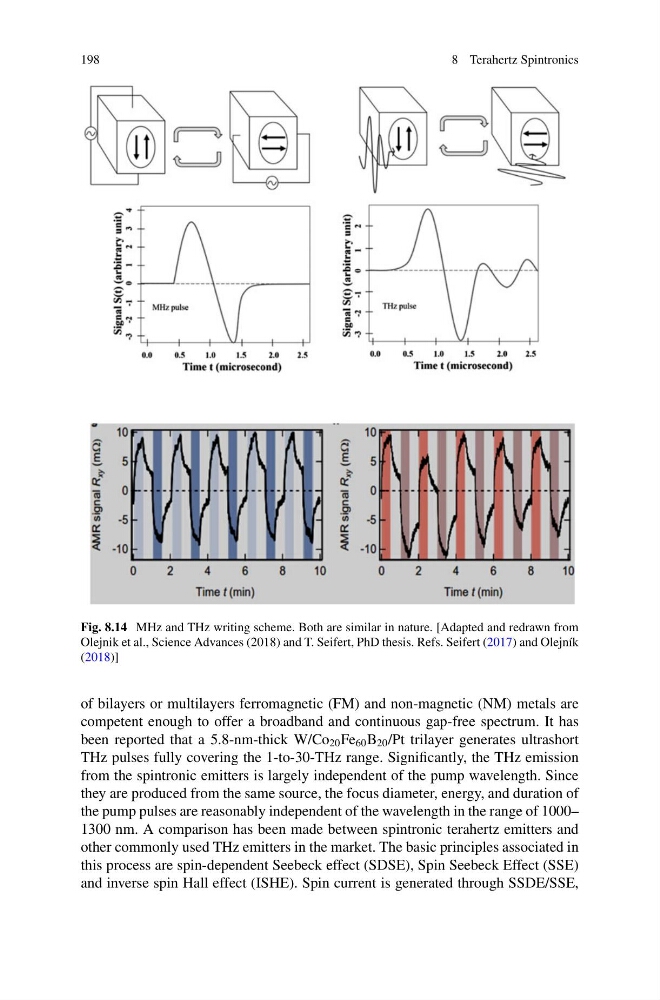
Fig. 8.14 MHz and THz writing scheme. Both are similar in nature. [Adapted and redrawn from
Olejnik et al., Science Advances (2018) and T. Seifert, PhD thesis. Refs. Seifert (2017) and Olejník
(2018)]
of bilayers or multilayers ferromagnetic (FM) and non-magnetic (NM) metals are
competent enough to offer a broadband and continuous gap-free spectrum. It has
been reported that a 5.8-nm-thick W/Co 20 Fe 60 B 20 /Pt trilayer generates ultrashort
THz pulses fully covering the 1-to-30-THz range. Significantly, the THz emission
from the spintronic emitters is largely independent of the pump wavelength. Since
they are produced from the same source, the focus diameter, energy, and duration of
the pump pulses are reasonably independent of the wavelength in the range of 1000–
1300 nm. A comparison has been made between spintronic terahertz emitters and
other commonly used THz emitters in the market. The basic principles associated in
this process are spin-dependent Seebeck effect (SDSE), Spin Seebeck Effect (SSE)
and inverse spin Hall effect (ISHE). Spin current is generated through SSDE/SSE,
8 Terahertz Spintronics
Fig. 8.14 MHz and THz writing scheme. Both are similar in nature. [Adapted and redrawn from
Olejnik et al., Science Advances (2018) and T. Seifert, PhD thesis. Refs. Seifert (2017) and Olejník
(2018)]
of bilayers or multilayers ferromagnetic (FM) and non-magnetic (NM) metals are
competent enough to offer a broadband and continuous gap-free spectrum. It has
been reported that a 5.8-nm-thick W/Co 20 Fe 60 B 20 /Pt trilayer generates ultrashort
THz pulses fully covering the 1-to-30-THz range. Significantly, the THz emission
from the spintronic emitters is largely independent of the pump wavelength. Since
they are produced from the same source, the focus diameter, energy, and duration of
the pump pulses are reasonably independent of the wavelength in the range of 1000–
1300 nm. A comparison has been made between spintronic terahertz emitters and
other commonly used THz emitters in the market. The basic principles associated in
this process are spin-dependent Seebeck effect (SDSE), Spin Seebeck Effect (SSE)
and inverse spin Hall effect (ISHE). Spin current is generated through SSDE/SSE,