

192
8 Terahertz Spintronics
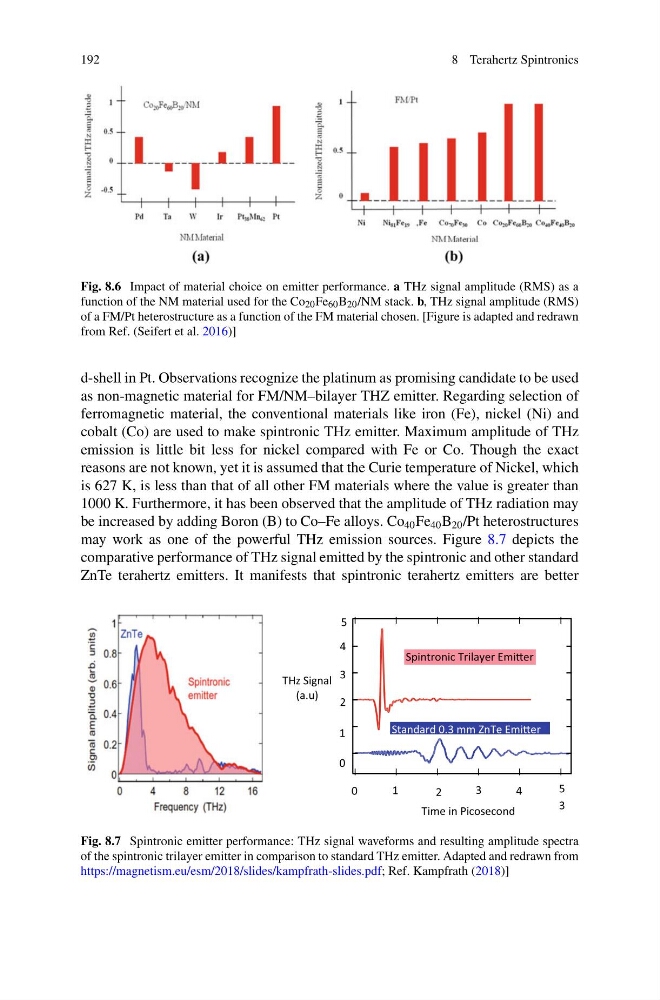
Fig. 8.6 Impact of material choice on emitter performance. a THz signal amplitude (RMS) as a
function of the NM material used for the Co 20 Fe 60 B 20 /NM stack. b, THz signal amplitude (RMS)
of a FM/Pt heterostructure as a function of the FM material chosen. [Figure is adapted and redrawn
from Ref. (Seifert et al. 2016)]
d-shell in Pt. Observations recognize the platinum as promising candidate to be used
as non-magnetic material for FM/NM–bilayer THZ emitter. Regarding selection of
ferromagnetic material, the conventional materials like iron (Fe), nickel (Ni) and
cobalt (Co) are used to make spintronic THz emitter. Maximum amplitude of THz
emission is little bit less for nickel compared with Fe or Co. Though the exact
reasons are not known, yet it is assumed that the Curie temperature of Nickel, which
is 627 K, is less than that of all other FM materials where the value is greater than
1000 K. Furthermore, it has been observed that the amplitude of THz radiation may
be increased by adding Boron (B) to Co–Fe alloys. Co 40 Fe 40 B 20 /Pt heterostructures
may work as one of the powerful THz emission sources. Figure 8.7 depicts the
comparative performance of THz signal emitted by the spintronic and other standard
ZnTe terahertz emitters. It manifests that spintronic terahertz emitters are better
Spintronic Trilayer EmiƩer
Standard 0.3 mm ZnTe EmiƩer
EmiƩer
0
THz Signal
(a.u)
1
1
2
2
3
3
4
5
3
4
5
0
Time in Picosecond
Fig. 8.7 Spintronic emitter performance: THz signal waveforms and resulting amplitude spectra
of the spintronic trilayer emitter in comparison to standard THz emitter. Adapted and redrawn from
https://magnetism.eu/esm/2018/slides/kampfrath-slides.pdf; Ref. Kampfrath (2018)]
8 Terahertz Spintronics
Fig. 8.6 Impact of material choice on emitter performance. a THz signal amplitude (RMS) as a
function of the NM material used for the Co 20 Fe 60 B 20 /NM stack. b, THz signal amplitude (RMS)
of a FM/Pt heterostructure as a function of the FM material chosen. [Figure is adapted and redrawn
from Ref. (Seifert et al. 2016)]
d-shell in Pt. Observations recognize the platinum as promising candidate to be used
as non-magnetic material for FM/NM–bilayer THZ emitter. Regarding selection of
ferromagnetic material, the conventional materials like iron (Fe), nickel (Ni) and
cobalt (Co) are used to make spintronic THz emitter. Maximum amplitude of THz
emission is little bit less for nickel compared with Fe or Co. Though the exact
reasons are not known, yet it is assumed that the Curie temperature of Nickel, which
is 627 K, is less than that of all other FM materials where the value is greater than
1000 K. Furthermore, it has been observed that the amplitude of THz radiation may
be increased by adding Boron (B) to Co–Fe alloys. Co 40 Fe 40 B 20 /Pt heterostructures
may work as one of the powerful THz emission sources. Figure 8.7 depicts the
comparative performance of THz signal emitted by the spintronic and other standard
ZnTe terahertz emitters. It manifests that spintronic terahertz emitters are better
Spintronic Trilayer EmiƩer
Standard 0.3 mm ZnTe EmiƩer
EmiƩer
0
THz Signal
(a.u)
1
1
2
2
3
3
4
5
3
4
5
0
Time in Picosecond
Fig. 8.7 Spintronic emitter performance: THz signal waveforms and resulting amplitude spectra
of the spintronic trilayer emitter in comparison to standard THz emitter. Adapted and redrawn from
https://magnetism.eu/esm/2018/slides/kampfrath-slides.pdf; Ref. Kampfrath (2018)]