

8.5 Spintronic Terahertz Emitter (STE)
191
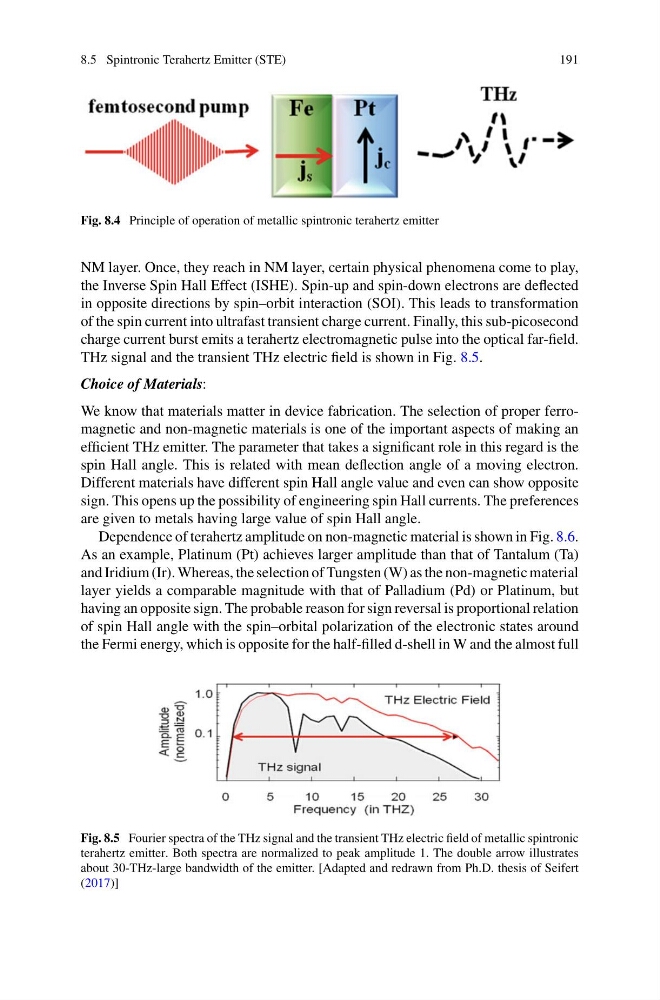
Fig. 8.4 Principle of operation of metallic spintronic terahertz emitter
NM layer. Once, they reach in NM layer, certain physical phenomena come to play,
the Inverse Spin Hall Effect (ISHE). Spin-up and spin-down electrons are deflected
in opposite directions by spin–orbit interaction (SOI). This leads to transformation
of the spin current into ultrafast transient charge current. Finally, this sub-picosecond
charge current burst emits a terahertz electromagnetic pulse into the optical far-field.
THz signal and the transient THz electric field is shown in Fig. 8.5.
Choice of Materials:
We know that materials matter in device fabrication. The selection of proper ferromagnetic and non-magnetic materials is one of the important aspects of making an
efficient THz emitter. The parameter that takes a significant role in this regard is the
spin Hall angle. This is related with mean deflection angle of a moving electron.
Different materials have different spin Hall angle value and even can show opposite
sign. This opens up the possibility of engineering spin Hall currents. The preferences
are given to metals having large value of spin Hall angle.
Dependence of terahertz amplitude on non-magnetic material is shown in Fig. 8.6.
As an example, Platinum (Pt) achieves larger amplitude than that of Tantalum (Ta)
and Iridium (Ir). Whereas, the selection of Tungsten (W) as the non-magnetic material
layer yields a comparable magnitude with that of Palladium (Pd) or Platinum, but
having an opposite sign. The probable reason for sign reversal is proportional relation
of spin Hall angle with the spin–orbital polarization of the electronic states around
the Fermi energy, which is opposite for the half-filled d-shell in W and the almost full
Fig. 8.5 Fourier spectra of the THz signal and the transient THz electric field of metallic spintronic
terahertz emitter. Both spectra are normalized to peak amplitude 1. The double arrow illustrates
about 30-THz-large bandwidth of the emitter. [Adapted and redrawn from Ph.D. thesis of Seifert
(2017)]
191
Fig. 8.4 Principle of operation of metallic spintronic terahertz emitter
NM layer. Once, they reach in NM layer, certain physical phenomena come to play,
the Inverse Spin Hall Effect (ISHE). Spin-up and spin-down electrons are deflected
in opposite directions by spin–orbit interaction (SOI). This leads to transformation
of the spin current into ultrafast transient charge current. Finally, this sub-picosecond
charge current burst emits a terahertz electromagnetic pulse into the optical far-field.
THz signal and the transient THz electric field is shown in Fig. 8.5.
Choice of Materials:
We know that materials matter in device fabrication. The selection of proper ferromagnetic and non-magnetic materials is one of the important aspects of making an
efficient THz emitter. The parameter that takes a significant role in this regard is the
spin Hall angle. This is related with mean deflection angle of a moving electron.
Different materials have different spin Hall angle value and even can show opposite
sign. This opens up the possibility of engineering spin Hall currents. The preferences
are given to metals having large value of spin Hall angle.
Dependence of terahertz amplitude on non-magnetic material is shown in Fig. 8.6.
As an example, Platinum (Pt) achieves larger amplitude than that of Tantalum (Ta)
and Iridium (Ir). Whereas, the selection of Tungsten (W) as the non-magnetic material
layer yields a comparable magnitude with that of Palladium (Pd) or Platinum, but
having an opposite sign. The probable reason for sign reversal is proportional relation
of spin Hall angle with the spin–orbital polarization of the electronic states around
the Fermi energy, which is opposite for the half-filled d-shell in W and the almost full
Fig. 8.5 Fourier spectra of the THz signal and the transient THz electric field of metallic spintronic
terahertz emitter. Both spectra are normalized to peak amplitude 1. The double arrow illustrates
about 30-THz-large bandwidth of the emitter. [Adapted and redrawn from Ph.D. thesis of Seifert
(2017)]