

148
6 Magnetic Domain Wall Motion
critical value of the linear dimension, l c = B = A, it can be well understood that
when l > l c , the demagnetizing energy is larger than the domain wall energy. Thus,
this condition seems to favour a multidomain state of a ferromagnetic material. On
the other hand, when l < l c , the domain wall energy of a single magnetic domain
would be larger than the demagnetizing energy of this system. Hence, this condition
seems to favour a mono-domain state of a ferromagnetic material. Noteworthy, such
critical values of l c have been typically found in the nm regime.
As already stated, in bulk ferromagnetic materials, the magnetic domains are
arranged in such a way that the vector summation of all the magnetic moments associated with different magnetic domains comes out to be zero. This, in turn, leaves
the ferromagnetic materials unmagnetized in the virgin state. With the reduction of
dimension of a ferromagnetic material, the number of domains and hence domain
walls can be controlled in a systematic manner. Therefore, in case of nanoscopic materials, domain wall motion can be controlled in any particular direction. This kind of
tuning feasibility of magnetic domain wall motion allows us to explore the associated
domain wall dynamics for possible implementation in the futuristic novel magnetic
storage devices. Consequently, a new avenue of the study of dynamical behaviour of
magnetic domain wall has opened up in the field of spintronics. In this direction, a
number of experimental studies on domain wall dynamics in nanomagnetic systems
have already been demonstrated at the laboratory level.
6.2 Magnetic Domain Wall Motion in Spintronics
Advancement in lithography techniques facilitates the fabrication of the nanoscale
magnets possessing simple magnetic domain structure. Owing to their simplified
domain configuration, such nanodimensional magnets are suitable for carrying out
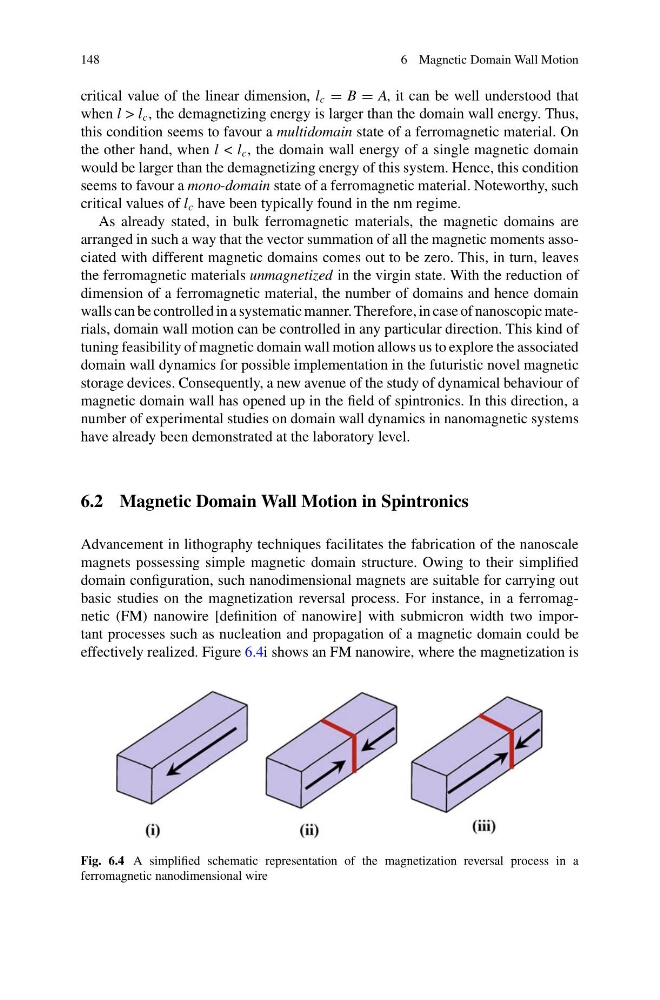
basic studies on the magnetization reversal process. For instance, in a ferromagnetic (FM) nanowire [definition of nanowire] with submicron width two important processes such as nucleation and propagation of a magnetic domain could be
effectively realized. Figure 6.4i shows an FM nanowire, where the magnetization is
Fig. 6.4 A simplified schematic representation of the magnetization reversal process in a
ferromagnetic nanodimensional wire
6 Magnetic Domain Wall Motion
critical value of the linear dimension, l c = B = A, it can be well understood that
when l > l c , the demagnetizing energy is larger than the domain wall energy. Thus,
this condition seems to favour a multidomain state of a ferromagnetic material. On
the other hand, when l < l c , the domain wall energy of a single magnetic domain
would be larger than the demagnetizing energy of this system. Hence, this condition
seems to favour a mono-domain state of a ferromagnetic material. Noteworthy, such
critical values of l c have been typically found in the nm regime.
As already stated, in bulk ferromagnetic materials, the magnetic domains are
arranged in such a way that the vector summation of all the magnetic moments associated with different magnetic domains comes out to be zero. This, in turn, leaves
the ferromagnetic materials unmagnetized in the virgin state. With the reduction of
dimension of a ferromagnetic material, the number of domains and hence domain
walls can be controlled in a systematic manner. Therefore, in case of nanoscopic materials, domain wall motion can be controlled in any particular direction. This kind of
tuning feasibility of magnetic domain wall motion allows us to explore the associated
domain wall dynamics for possible implementation in the futuristic novel magnetic
storage devices. Consequently, a new avenue of the study of dynamical behaviour of
magnetic domain wall has opened up in the field of spintronics. In this direction, a
number of experimental studies on domain wall dynamics in nanomagnetic systems
have already been demonstrated at the laboratory level.
6.2 Magnetic Domain Wall Motion in Spintronics
Advancement in lithography techniques facilitates the fabrication of the nanoscale
magnets possessing simple magnetic domain structure. Owing to their simplified
domain configuration, such nanodimensional magnets are suitable for carrying out
basic studies on the magnetization reversal process. For instance, in a ferromagnetic (FM) nanowire [definition of nanowire] with submicron width two important processes such as nucleation and propagation of a magnetic domain could be
effectively realized. Figure 6.4i shows an FM nanowire, where the magnetization is
Fig. 6.4 A simplified schematic representation of the magnetization reversal process in a
ferromagnetic nanodimensional wire