

6.1 Introduction on Magnetic Domain Wall Motion
147
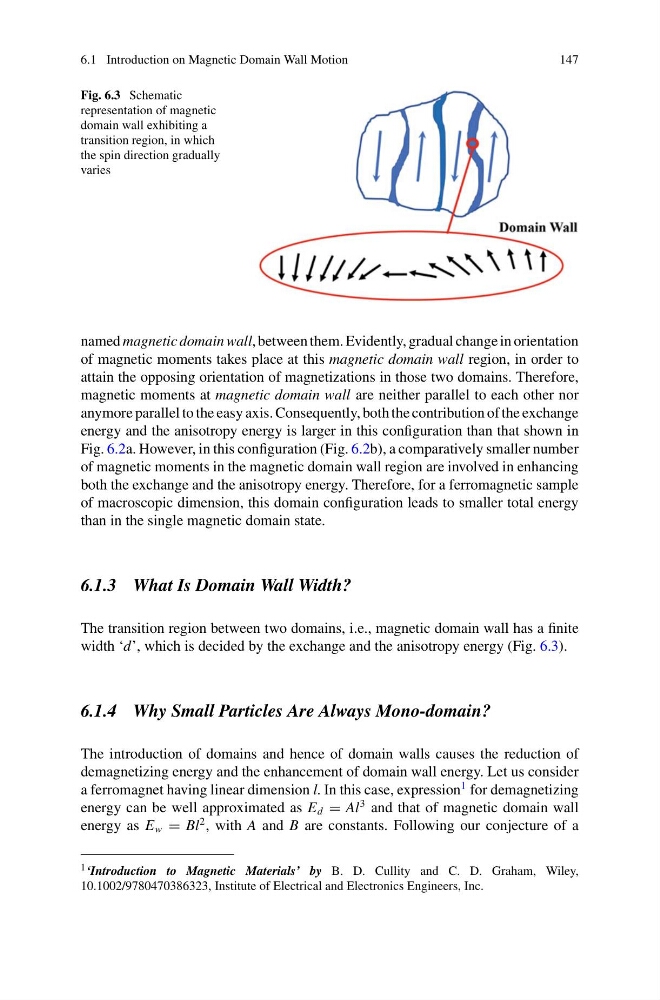
Fig. 6.3 Schematic
representation of magnetic
domain wall exhibiting a
transition region, in which
the spin direction gradually
varies
named magnetic domain wall, between them. Evidently, gradual change in orientation
of magnetic moments takes place at this magnetic domain wall region, in order to
attain the opposing orientation of magnetizations in those two domains. Therefore,
magnetic moments at magnetic domain wall are neither parallel to each other nor
anymore parallel to the easy axis. Consequently, both the contribution of the exchange
energy and the anisotropy energy is larger in this configuration than that shown in
Fig. 6.2a. However, in this configuration (Fig. 6.2b), a comparatively smaller number
of magnetic moments in the magnetic domain wall region are involved in enhancing
both the exchange and the anisotropy energy. Therefore, for a ferromagnetic sample
of macroscopic dimension, this domain configuration leads to smaller total energy
than in the single magnetic domain state.
6.1.3 What Is Domain Wall Width?
The transition region between two domains, i.e., magnetic domain wall has a finite
width ‘d’, which is decided by the exchange and the anisotropy energy (Fig. 6.3).
6.1.4 Why Small Particles Are Always Mono-domain?
The introduction of domains and hence of domain walls causes the reduction of
demagnetizing energy and the enhancement of domain wall energy. Let us consider
a ferromagnet having linear dimension l. In this case, expression
1 for demagnetizing
energy can be well approximated as E d = Al
3 and that of magnetic domain wall
energy as E w = Bl
2 , with A and B are constants. Following our conjecture of a
1 ‘Introduction to Magnetic Materials’ by B. D. Cullity and C. D. Graham, Wiley,
10.1002/9780470386323, Institute of Electrical and Electronics Engineers, Inc.
147
Fig. 6.3 Schematic
representation of magnetic
domain wall exhibiting a
transition region, in which
the spin direction gradually
varies
named magnetic domain wall, between them. Evidently, gradual change in orientation
of magnetic moments takes place at this magnetic domain wall region, in order to
attain the opposing orientation of magnetizations in those two domains. Therefore,
magnetic moments at magnetic domain wall are neither parallel to each other nor
anymore parallel to the easy axis. Consequently, both the contribution of the exchange
energy and the anisotropy energy is larger in this configuration than that shown in
Fig. 6.2a. However, in this configuration (Fig. 6.2b), a comparatively smaller number
of magnetic moments in the magnetic domain wall region are involved in enhancing
both the exchange and the anisotropy energy. Therefore, for a ferromagnetic sample
of macroscopic dimension, this domain configuration leads to smaller total energy
than in the single magnetic domain state.
6.1.3 What Is Domain Wall Width?
The transition region between two domains, i.e., magnetic domain wall has a finite
width ‘d’, which is decided by the exchange and the anisotropy energy (Fig. 6.3).
6.1.4 Why Small Particles Are Always Mono-domain?
The introduction of domains and hence of domain walls causes the reduction of
demagnetizing energy and the enhancement of domain wall energy. Let us consider
a ferromagnet having linear dimension l. In this case, expression
1 for demagnetizing
energy can be well approximated as E d = Al
3 and that of magnetic domain wall
energy as E w = Bl
2 , with A and B are constants. Following our conjecture of a
1 ‘Introduction to Magnetic Materials’ by B. D. Cullity and C. D. Graham, Wiley,
10.1002/9780470386323, Institute of Electrical and Electronics Engineers, Inc.