

6.2 Magnetic Domain Wall Motion in Spintronics
149
restricted to be oriented parallel to the axis of the wire because of its shape anisotropy.
Suppose an external magnetic field is applied against the magnetization direction,
subsequently, nucleation of a magnetic domain wall takes place at one end of the
wire and eventually propagates through the wire to the other end. This is clearly
demonstrated in Fig. 6.4ii, iii.
6.2.1 Detection of Domain-Wall (DW) Propagation
Investigation of nucleation and propagation of a magnetic domain wall (DW) has been
conveniently and suitably carried out on a magnetic nanowire, where only one dimension is being macroscopically realizable and other two dimensions are nanoscopic.
The idea behind the choice of such nanoscopic wire, for this kind of study, lies in its
reduced dimension. Since two out of three dimensions are already being reduced, DW
motion is realizable and measurable in only one dimension and hence, monitoring
of DW motion in that dimension is sufficient for extracting necessary information at
any point of time. However, owing to the minute volume of the magnetic nanowire,
detection of the small variation in the magnetic moments, induced by the propagation of the DW, is quite difficult. In this attempt, a highly sensitive technique
such as GMR has been proposed for the detection of DW propagation in magnetic
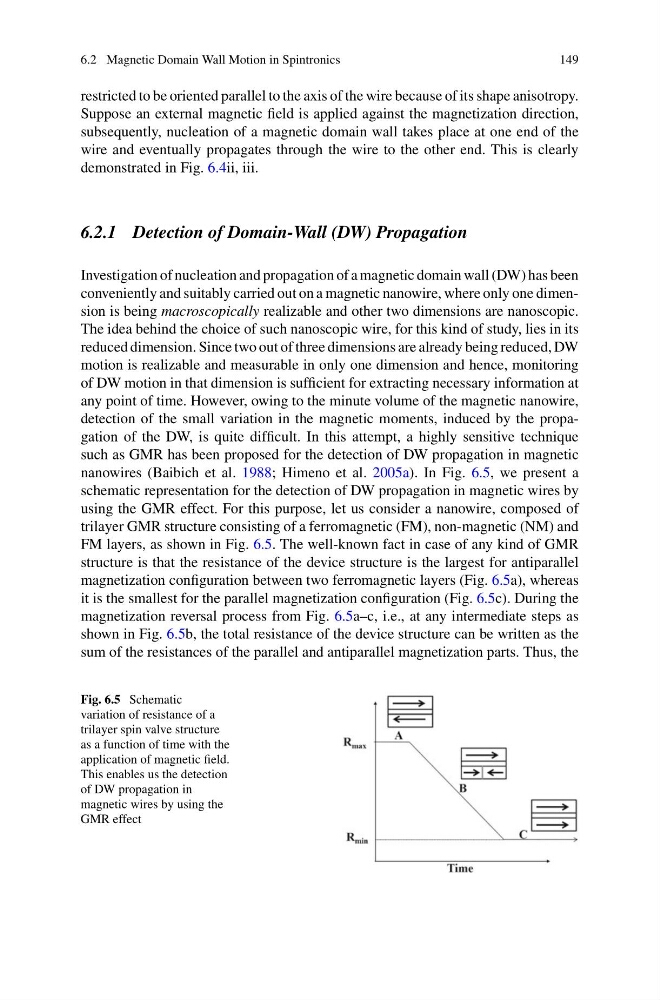
nanowires (Baibich et al. 1988; Himeno et al. 2005a). In Fig. 6.5, we present a
schematic representation for the detection of DW propagation in magnetic wires by
using the GMR effect. For this purpose, let us consider a nanowire, composed of
trilayer GMR structure consisting of a ferromagnetic (FM), non-magnetic (NM) and
FM layers, as shown in Fig. 6.5. The well-known fact in case of any kind of GMR
structure is that the resistance of the device structure is the largest for antiparallel
magnetization configuration between two ferromagnetic layers (Fig. 6.5a), whereas
it is the smallest for the parallel magnetization configuration (Fig. 6.5c). During the
magnetization reversal process from Fig. 6.5a–c, i.e., at any intermediate steps as
shown in Fig. 6.5b, the total resistance of the device structure can be written as the
sum of the resistances of the parallel and antiparallel magnetization parts. Thus, the
Fig. 6.5 Schematic
variation of resistance of a
trilayer spin valve structure
as a function of time with the
application of magnetic field.
This enables us the detection
of DW propagation in
magnetic wires by using the
GMR effect
149
restricted to be oriented parallel to the axis of the wire because of its shape anisotropy.
Suppose an external magnetic field is applied against the magnetization direction,
subsequently, nucleation of a magnetic domain wall takes place at one end of the
wire and eventually propagates through the wire to the other end. This is clearly
demonstrated in Fig. 6.4ii, iii.
6.2.1 Detection of Domain-Wall (DW) Propagation
Investigation of nucleation and propagation of a magnetic domain wall (DW) has been
conveniently and suitably carried out on a magnetic nanowire, where only one dimension is being macroscopically realizable and other two dimensions are nanoscopic.
The idea behind the choice of such nanoscopic wire, for this kind of study, lies in its
reduced dimension. Since two out of three dimensions are already being reduced, DW
motion is realizable and measurable in only one dimension and hence, monitoring
of DW motion in that dimension is sufficient for extracting necessary information at
any point of time. However, owing to the minute volume of the magnetic nanowire,
detection of the small variation in the magnetic moments, induced by the propagation of the DW, is quite difficult. In this attempt, a highly sensitive technique
such as GMR has been proposed for the detection of DW propagation in magnetic
nanowires (Baibich et al. 1988; Himeno et al. 2005a). In Fig. 6.5, we present a
schematic representation for the detection of DW propagation in magnetic wires by
using the GMR effect. For this purpose, let us consider a nanowire, composed of
trilayer GMR structure consisting of a ferromagnetic (FM), non-magnetic (NM) and
FM layers, as shown in Fig. 6.5. The well-known fact in case of any kind of GMR
structure is that the resistance of the device structure is the largest for antiparallel
magnetization configuration between two ferromagnetic layers (Fig. 6.5a), whereas
it is the smallest for the parallel magnetization configuration (Fig. 6.5c). During the
magnetization reversal process from Fig. 6.5a–c, i.e., at any intermediate steps as
shown in Fig. 6.5b, the total resistance of the device structure can be written as the
sum of the resistances of the parallel and antiparallel magnetization parts. Thus, the
Fig. 6.5 Schematic
variation of resistance of a
trilayer spin valve structure
as a function of time with the
application of magnetic field.
This enables us the detection
of DW propagation in
magnetic wires by using the
GMR effect