

110
4 Tunnelling Magnetoresistance (TMR)
x = 0
Γδ(x) + Γ'σ x δ(x)
↑ + ↑
↑ + ↓
↓
↑
↑ + ↓
↓
Fig. 4.6 Representation of scattering problem for majority spin electron incident from the left
ferromagnetic electrode when the magnetizations alignment between the two electrodes are assumed
to be parallel (Figure adapted and redrawn from Ref. (Bandyopadhyay and Cahay 2008))
G AP =
8k
F
↑ k
F
↓
k
F
↑ + k
F
↓
2
e
2
h
.
(4.7)
Case 2: Spin-scattering takes place at the interface
In this case, Γ and Γ
= 0. Let us calculate the conductance for majority spin
electrons, incident from the left ferromagnetic electrode with magnetizations in the
two ferromagnetic contacts are assumed to be parallel. The incoming and outgoing
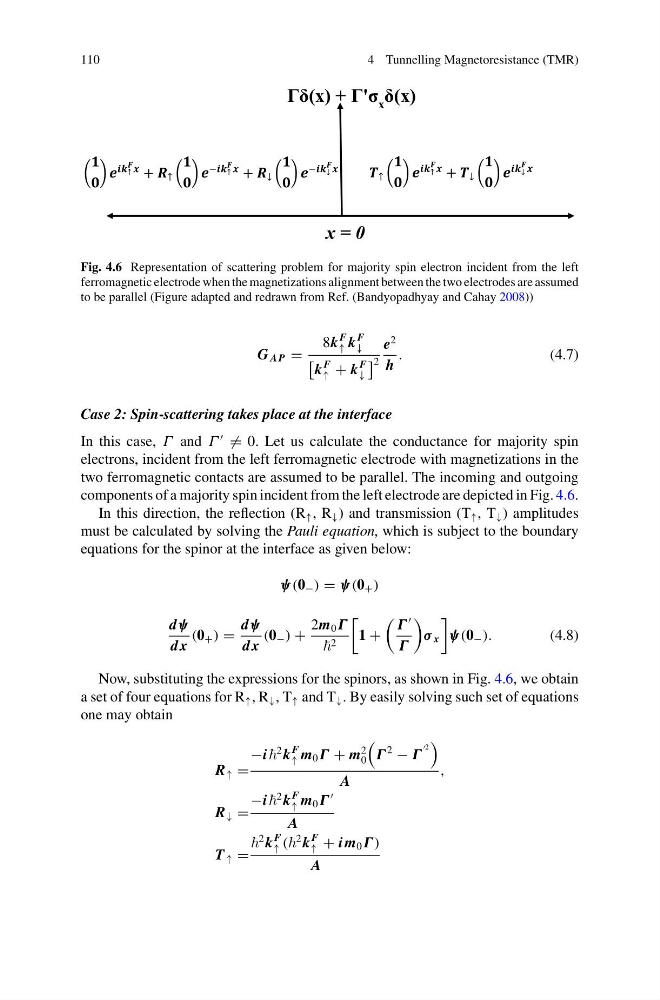
components of a majority spin incident from the left electrode are depicted in Fig. 4.6.
In this direction, the reflection (R ↑ , R ↓ ) and transmission (T ↑ , T ↓ ) amplitudes
must be calculated by solving the Pauli equation, which is subject to the boundary
equations for the spinor at the interface as given below:
ψ(0 − ) = ψ(0 + )
dψ
dx
(0 + ) =
dψ
dx
(0 − ) +
2m 0 Γ
2
1 +
Γ
Γ
σ x
ψ(0 − ).
(4.8)
Now, substituting the expressions for the spinors, as shown in Fig. 4.6, we obtain
a set of four equations for R ↑ , R ↓ , T ↑ and T ↓ . By easily solving such set of equations
one may obtain
R ↑ =
−i
2 k
F
↑ m 0 Γ + m
2
0
Γ
2
− Γ
A
,
R ↓ =
−i
2 k
F
↑ m 0 Γ
A
T ↑ =
2 k
F
↑ (
2 k
F
↑ + i m 0 Γ )
A
4 Tunnelling Magnetoresistance (TMR)
x = 0
Γδ(x) + Γ'σ x δ(x)
↑ + ↑
↑ + ↓
↓
↑
↑ + ↓
↓
Fig. 4.6 Representation of scattering problem for majority spin electron incident from the left
ferromagnetic electrode when the magnetizations alignment between the two electrodes are assumed
to be parallel (Figure adapted and redrawn from Ref. (Bandyopadhyay and Cahay 2008))
G AP =
8k
F
↑ k
F
↓
k
F
↑ + k
F
↓
2
e
2
h
.
(4.7)
Case 2: Spin-scattering takes place at the interface
In this case, Γ and Γ
= 0. Let us calculate the conductance for majority spin
electrons, incident from the left ferromagnetic electrode with magnetizations in the
two ferromagnetic contacts are assumed to be parallel. The incoming and outgoing
components of a majority spin incident from the left electrode are depicted in Fig. 4.6.
In this direction, the reflection (R ↑ , R ↓ ) and transmission (T ↑ , T ↓ ) amplitudes
must be calculated by solving the Pauli equation, which is subject to the boundary
equations for the spinor at the interface as given below:
ψ(0 − ) = ψ(0 + )
dψ
dx
(0 + ) =
dψ
dx
(0 − ) +
2m 0 Γ
2
1 +
Γ
Γ
σ x
ψ(0 − ).
(4.8)
Now, substituting the expressions for the spinors, as shown in Fig. 4.6, we obtain
a set of four equations for R ↑ , R ↓ , T ↑ and T ↓ . By easily solving such set of equations
one may obtain
R ↑ =
−i
2 k
F
↑ m 0 Γ + m
2
0
Γ
2
− Γ
A
,
R ↓ =
−i
2 k
F
↑ m 0 Γ
A
T ↑ =
2 k
F
↑ (
2 k
F
↑ + i m 0 Γ )
A