

4.3 Physical Explanation
111
T ↓ =
−i
2 k
F
↑ m 0 Γ
A
.
(4.9)
where
A =
4 k
F
↑ k
F
↓ + i
2 m 0 Γ
k
F
↑ + k
F
↓
+ m
2
0
Γ
2
− Γ
2
.
(4.10)
Thus, the conductance of the majority spin band in units of e
2 /h is given by
G ↑ =
T ↑
2 +
k
F
↓
k
F
↑
T ↓
2 .
(4.11)
Following exactly the same procedure, involving scattering problem as presented
above, the conductance of electrons incident from the minority spin sub-band can also
be calculated. In this case, the expressions for reflection and transmission amplitudes
are as follows:
R
↑ =
−i
2 k
F
↓ m 0 Γ
A
,
R
↓ = −1 +
4 k
F
↑ k
F
↓ + i
2 k
F
↑ m 0 Γ
A
T
↑ =
−i
2 k
F
↓ m 0 Γ
A
T
↓ =
4 k
F
↑ k
F
↑ + i
2 m 0 Γ k
F
↓
A
.
(4.12)
Therefore, the conductance of electrons originating from the minority spin subband in units of e
2 /h is found to be
G ↓ =
T ↓
2 +
k
F
↑
k
F
↓
T ↑
2 .
(4.13)
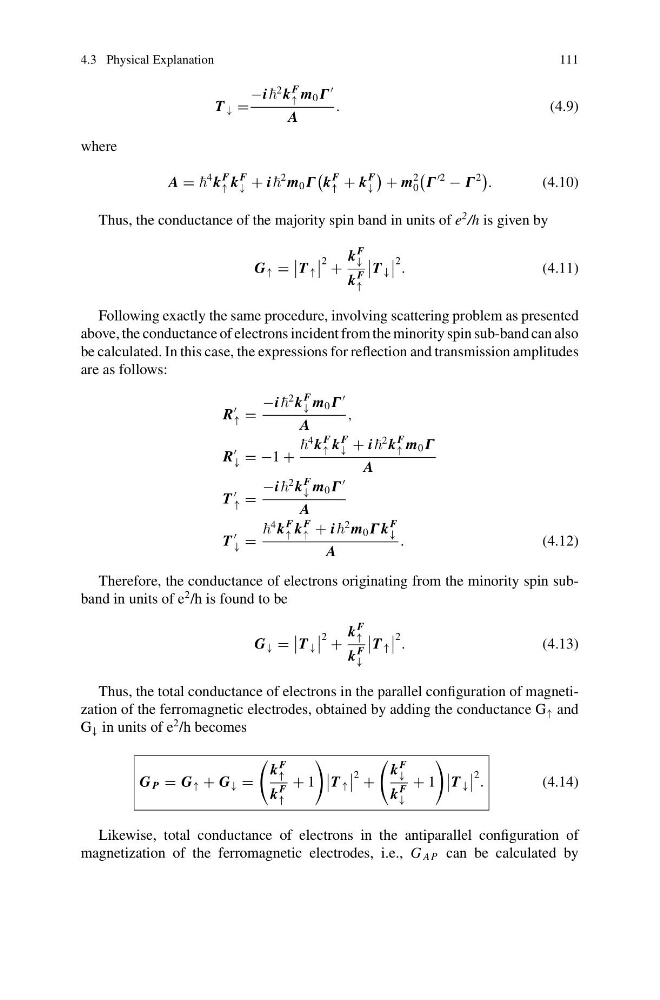
Thus, the total conductance of electrons in the parallel configuration of magnetization of the ferromagnetic electrodes, obtained by adding the conductance G ↑ and
G ↓ in units of e
2 /h becomes
G P = G ↑ + G ↓ =
k
F
↑
k
F
↑
+ 1
T ↑
2 +
k
F
↓
k
F
↓
+ 1
T ↓
2 .
(4.14)
Likewise, total conductance of electrons in the antiparallel configuration of
magnetization of the ferromagnetic electrodes, i.e., G AP can be calculated by
111
T ↓ =
−i
2 k
F
↑ m 0 Γ
A
.
(4.9)
where
A =
4 k
F
↑ k
F
↓ + i
2 m 0 Γ
k
F
↑ + k
F
↓
+ m
2
0
Γ
2
− Γ
2
.
(4.10)
Thus, the conductance of the majority spin band in units of e
2 /h is given by
G ↑ =
T ↑
2 +
k
F
↓
k
F
↑
T ↓
2 .
(4.11)
Following exactly the same procedure, involving scattering problem as presented
above, the conductance of electrons incident from the minority spin sub-band can also
be calculated. In this case, the expressions for reflection and transmission amplitudes
are as follows:
R
↑ =
−i
2 k
F
↓ m 0 Γ
A
,
R
↓ = −1 +
4 k
F
↑ k
F
↓ + i
2 k
F
↑ m 0 Γ
A
T
↑ =
−i
2 k
F
↓ m 0 Γ
A
T
↓ =
4 k
F
↑ k
F
↑ + i
2 m 0 Γ k
F
↓
A
.
(4.12)
Therefore, the conductance of electrons originating from the minority spin subband in units of e
2 /h is found to be
G ↓ =
T ↓
2 +
k
F
↑
k
F
↓
T ↑
2 .
(4.13)
Thus, the total conductance of electrons in the parallel configuration of magnetization of the ferromagnetic electrodes, obtained by adding the conductance G ↑ and
G ↓ in units of e
2 /h becomes
G P = G ↑ + G ↓ =
k
F
↑
k
F
↑
+ 1
T ↑
2 +
k
F
↓
k
F
↓
+ 1
T ↓
2 .
(4.14)
Likewise, total conductance of electrons in the antiparallel configuration of
magnetization of the ferromagnetic electrodes, i.e., G AP can be calculated by