

4.3 Physical Explanation
109
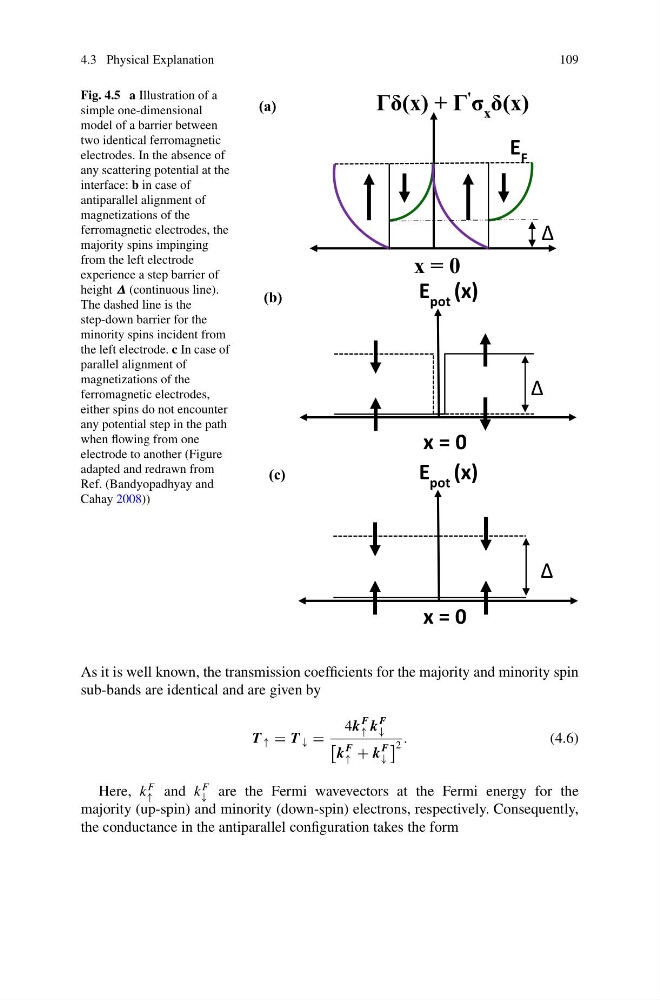
Fig. 4.5 a Illustration of a
simple one-dimensional
model of a barrier between
two identical ferromagnetic
electrodes. In the absence of
any scattering potential at the
interface: b in case of
antiparallel alignment of
magnetizations of the
ferromagnetic electrodes, the
majority spins impinging
from the left electrode
experience a step barrier of
height Δ (continuous line).
The dashed line is the
step-down barrier for the
minority spins incident from
the left electrode. c In case of
parallel alignment of
magnetizations of the
ferromagnetic electrodes,
either spins do not encounter
any potential step in the path
when flowing from one
electrode to another (Figure
adapted and redrawn from
Ref. (Bandyopadhyay and
Cahay 2008))
E F
x = 0
∆
Γδ(x) + Γ
' σ x δ(x)
∆
x = 0
E pot (x)
(a)
(b)
(c)
∆
x = 0
E pot (x)
As it is well known, the transmission coefficients for the majority and minority spin
sub-bands are identical and are given by
T ↑ = T ↓ =
4k
F
↑ k
F
↓
k
F
↑ + k
F
↓
2 .
(4.6)
Here, k
F
↑ and k
F
↓ are the Fermi wavevectors at the Fermi energy for the
majority (up-spin) and minority (down-spin) electrons, respectively. Consequently,
the conductance in the antiparallel configuration takes the form
109
Fig. 4.5 a Illustration of a
simple one-dimensional
model of a barrier between
two identical ferromagnetic
electrodes. In the absence of
any scattering potential at the
interface: b in case of
antiparallel alignment of
magnetizations of the
ferromagnetic electrodes, the
majority spins impinging
from the left electrode
experience a step barrier of
height Δ (continuous line).
The dashed line is the
step-down barrier for the
minority spins incident from
the left electrode. c In case of
parallel alignment of
magnetizations of the
ferromagnetic electrodes,
either spins do not encounter
any potential step in the path
when flowing from one
electrode to another (Figure
adapted and redrawn from
Ref. (Bandyopadhyay and
Cahay 2008))
E F
x = 0
∆
Γδ(x) + Γ
' σ x δ(x)
∆
x = 0
E pot (x)
(a)
(b)
(c)
∆
x = 0
E pot (x)
As it is well known, the transmission coefficients for the majority and minority spin
sub-bands are identical and are given by
T ↑ = T ↓ =
4k
F
↑ k
F
↓
k
F
↑ + k
F
↓
2 .
(4.6)
Here, k
F
↑ and k
F
↓ are the Fermi wavevectors at the Fermi energy for the
majority (up-spin) and minority (down-spin) electrons, respectively. Consequently,
the conductance in the antiparallel configuration takes the form