

106
4 Tunnelling Magnetoresistance (TMR)
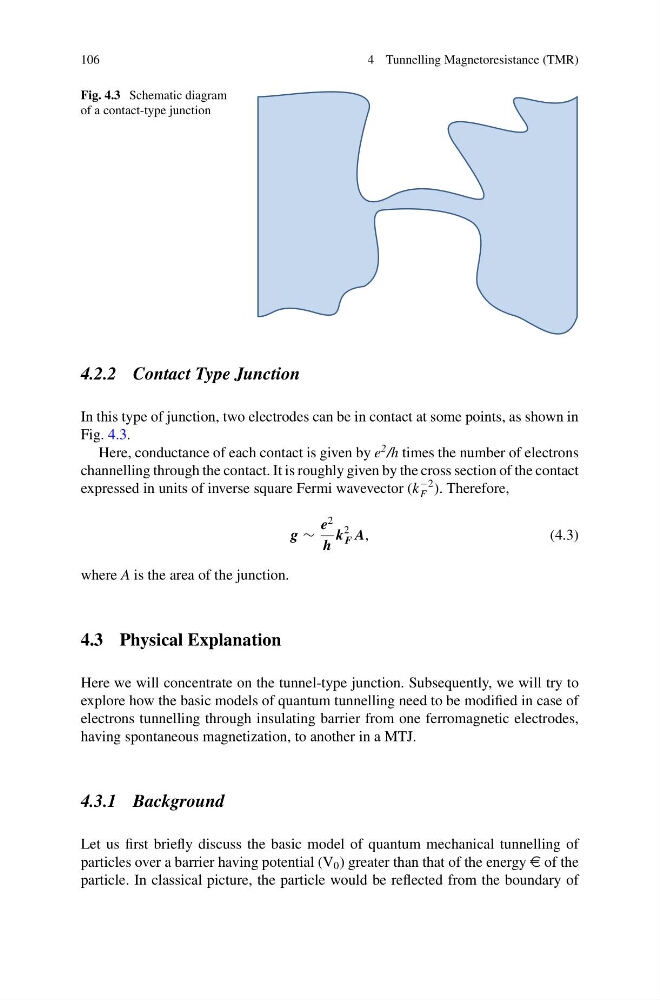
Fig. 4.3 Schematic diagram
of a contact-type junction
4.2.2 Contact Type Junction
In this type of junction, two electrodes can be in contact at some points, as shown in
Fig. 4.3.
Here, conductance of each contact is given by e
2 /h times the number of electrons
channelling through the contact. It is roughly given by the cross section of the contact
expressed in units of inverse square Fermi wavevector (k
−2
F ). Therefore,
g ∼
e
2
h
k
2
F A,
(4.3)
where A is the area of the junction.
4.3 Physical Explanation
Here we will concentrate on the tunnel-type junction. Subsequently, we will try to
explore how the basic models of quantum tunnelling need to be modified in case of
electrons tunnelling through insulating barrier from one ferromagnetic electrodes,
having spontaneous magnetization, to another in a MTJ.
4.3.1 Background
Let us first briefly discuss the basic model of quantum mechanical tunnelling of
particles over a barrier having potential (V 0 ) greater than that of the energy e of the
particle. In classical picture, the particle would be reflected from the boundary of
4 Tunnelling Magnetoresistance (TMR)
Fig. 4.3 Schematic diagram
of a contact-type junction
4.2.2 Contact Type Junction
In this type of junction, two electrodes can be in contact at some points, as shown in
Fig. 4.3.
Here, conductance of each contact is given by e
2 /h times the number of electrons
channelling through the contact. It is roughly given by the cross section of the contact
expressed in units of inverse square Fermi wavevector (k
−2
F ). Therefore,
g ∼
e
2
h
k
2
F A,
(4.3)
where A is the area of the junction.
4.3 Physical Explanation
Here we will concentrate on the tunnel-type junction. Subsequently, we will try to
explore how the basic models of quantum tunnelling need to be modified in case of
electrons tunnelling through insulating barrier from one ferromagnetic electrodes,
having spontaneous magnetization, to another in a MTJ.
4.3.1 Background
Let us first briefly discuss the basic model of quantum mechanical tunnelling of
particles over a barrier having potential (V 0 ) greater than that of the energy e of the
particle. In classical picture, the particle would be reflected from the boundary of