

4.2 Magnetic Junctions
105
4.2.1 Tunnel-Type Junction
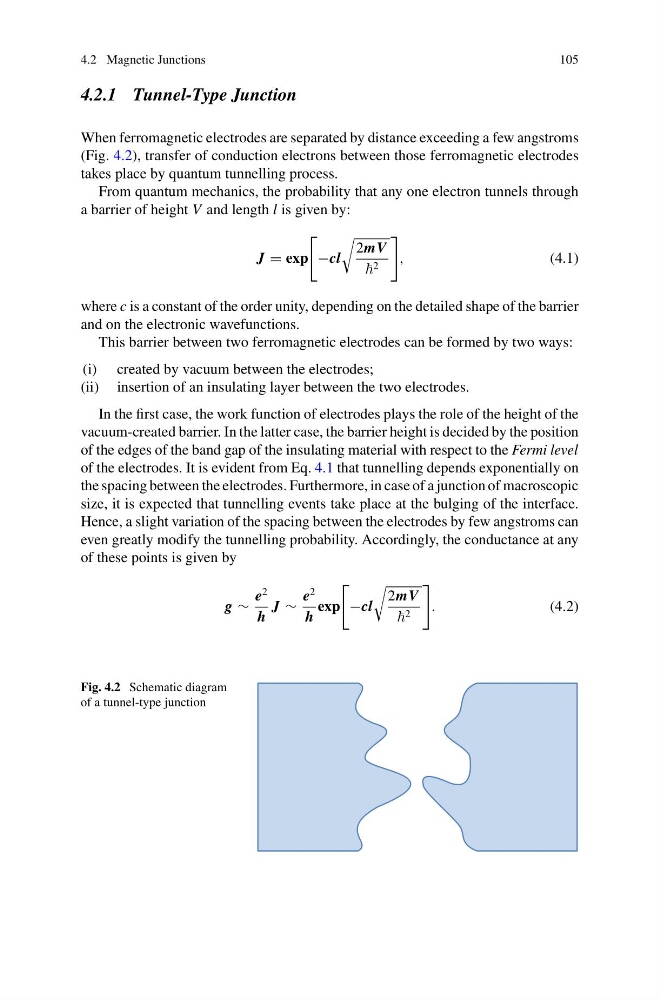
When ferromagnetic electrodes are separated by distance exceeding a few angstroms
(Fig. 4.2), transfer of conduction electrons between those ferromagnetic electrodes
takes place by quantum tunnelling process.
From quantum mechanics, the probability that any one electron tunnels through
a barrier of height V and length l is given by:
J = exp
−cl
2mV
2
,
(4.1)
where c is a constant of the order unity, depending on the detailed shape of the barrier
and on the electronic wavefunctions.
This barrier between two ferromagnetic electrodes can be formed by two ways:
(i) created by vacuum between the electrodes;
(ii) insertion of an insulating layer between the two electrodes.
In the first case, the work function of electrodes plays the role of the height of the
vacuum-created barrier. In the latter case, the barrier height is decided by the position
of the edges of the band gap of the insulating material with respect to the Fermi level
of the electrodes. It is evident from Eq. 4.1 that tunnelling depends exponentially on
the spacing between the electrodes. Furthermore, in case of a junction of macroscopic
size, it is expected that tunnelling events take place at the bulging of the interface.
Hence, a slight variation of the spacing between the electrodes by few angstroms can
even greatly modify the tunnelling probability. Accordingly, the conductance at any
of these points is given by
g ∼
e
2
h
J ∼
e
2
h
exp
−cl
2mV
2
.
(4.2)
Fig. 4.2 Schematic diagram
of a tunnel-type junction
105
4.2.1 Tunnel-Type Junction
When ferromagnetic electrodes are separated by distance exceeding a few angstroms
(Fig. 4.2), transfer of conduction electrons between those ferromagnetic electrodes
takes place by quantum tunnelling process.
From quantum mechanics, the probability that any one electron tunnels through
a barrier of height V and length l is given by:
J = exp
−cl
2mV
2
,
(4.1)
where c is a constant of the order unity, depending on the detailed shape of the barrier
and on the electronic wavefunctions.
This barrier between two ferromagnetic electrodes can be formed by two ways:
(i) created by vacuum between the electrodes;
(ii) insertion of an insulating layer between the two electrodes.
In the first case, the work function of electrodes plays the role of the height of the
vacuum-created barrier. In the latter case, the barrier height is decided by the position
of the edges of the band gap of the insulating material with respect to the Fermi level
of the electrodes. It is evident from Eq. 4.1 that tunnelling depends exponentially on
the spacing between the electrodes. Furthermore, in case of a junction of macroscopic
size, it is expected that tunnelling events take place at the bulging of the interface.
Hence, a slight variation of the spacing between the electrodes by few angstroms can
even greatly modify the tunnelling probability. Accordingly, the conductance at any
of these points is given by
g ∼
e
2
h
J ∼
e
2
h
exp
−cl
2mV
2
.
(4.2)
Fig. 4.2 Schematic diagram
of a tunnel-type junction