

104
4 Tunnelling Magnetoresistance (TMR)
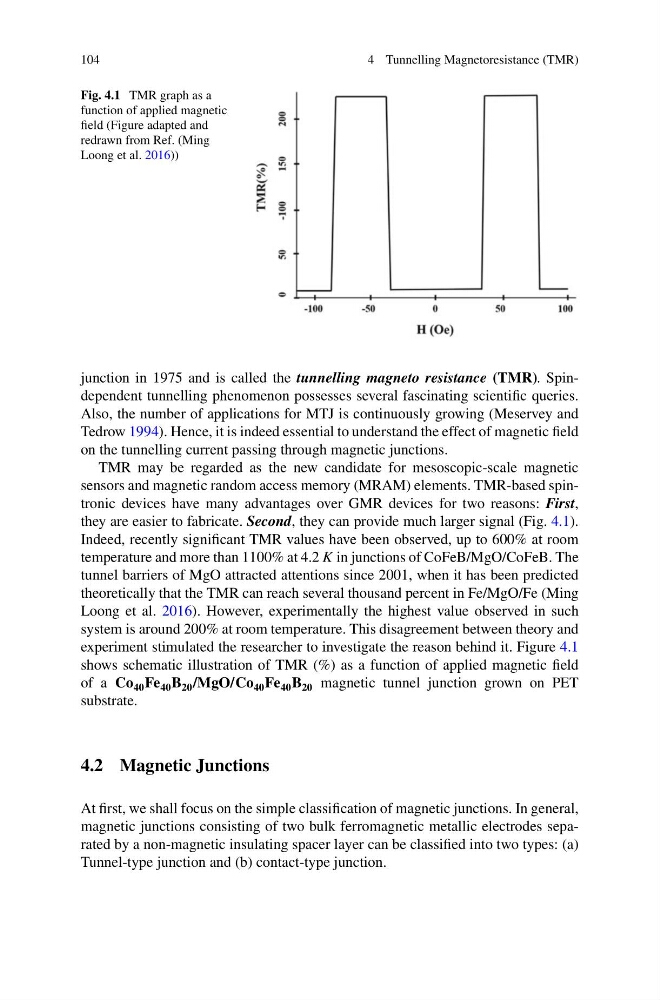
Fig. 4.1 TMR graph as a
function of applied magnetic
field (Figure adapted and
redrawn from Ref. (Ming
Loong et al. 2016))
junction in 1975 and is called the tunnelling magneto resistance (TMR). Spindependent tunnelling phenomenon possesses several fascinating scientific queries.
Also, the number of applications for MTJ is continuously growing (Meservey and
Tedrow 1994). Hence, it is indeed essential to understand the effect of magnetic field
on the tunnelling current passing through magnetic junctions.
TMR may be regarded as the new candidate for mesoscopic-scale magnetic
sensors and magnetic random access memory (MRAM) elements. TMR-based spintronic devices have many advantages over GMR devices for two reasons: First,
they are easier to fabricate. Second, they can provide much larger signal (Fig. 4.1).
Indeed, recently significant TMR values have been observed, up to 600% at room
temperature and more than 1100% at 4.2 K in junctions of CoFeB/MgO/CoFeB. The
tunnel barriers of MgO attracted attentions since 2001, when it has been predicted
theoretically that the TMR can reach several thousand percent in Fe/MgO/Fe (Ming
Loong et al. 2016). However, experimentally the highest value observed in such
system is around 200% at room temperature. This disagreement between theory and
experiment stimulated the researcher to investigate the reason behind it. Figure 4.1
shows schematic illustration of TMR (%) as a function of applied magnetic field
of a Co 40 Fe 40 B 20 /MgO/Co 40 Fe 40 B 20 magnetic tunnel junction grown on PET
substrate.
4.2 Magnetic Junctions
At first, we shall focus on the simple classification of magnetic junctions. In general,
magnetic junctions consisting of two bulk ferromagnetic metallic electrodes separated by a non-magnetic insulating spacer layer can be classified into two types: (a)
Tunnel-type junction and (b) contact-type junction.
4 Tunnelling Magnetoresistance (TMR)
Fig. 4.1 TMR graph as a
function of applied magnetic
field (Figure adapted and
redrawn from Ref. (Ming
Loong et al. 2016))
junction in 1975 and is called the tunnelling magneto resistance (TMR). Spindependent tunnelling phenomenon possesses several fascinating scientific queries.
Also, the number of applications for MTJ is continuously growing (Meservey and
Tedrow 1994). Hence, it is indeed essential to understand the effect of magnetic field
on the tunnelling current passing through magnetic junctions.
TMR may be regarded as the new candidate for mesoscopic-scale magnetic
sensors and magnetic random access memory (MRAM) elements. TMR-based spintronic devices have many advantages over GMR devices for two reasons: First,
they are easier to fabricate. Second, they can provide much larger signal (Fig. 4.1).
Indeed, recently significant TMR values have been observed, up to 600% at room
temperature and more than 1100% at 4.2 K in junctions of CoFeB/MgO/CoFeB. The
tunnel barriers of MgO attracted attentions since 2001, when it has been predicted
theoretically that the TMR can reach several thousand percent in Fe/MgO/Fe (Ming
Loong et al. 2016). However, experimentally the highest value observed in such
system is around 200% at room temperature. This disagreement between theory and
experiment stimulated the researcher to investigate the reason behind it. Figure 4.1
shows schematic illustration of TMR (%) as a function of applied magnetic field
of a Co 40 Fe 40 B 20 /MgO/Co 40 Fe 40 B 20 magnetic tunnel junction grown on PET
substrate.
4.2 Magnetic Junctions
At first, we shall focus on the simple classification of magnetic junctions. In general,
magnetic junctions consisting of two bulk ferromagnetic metallic electrodes separated by a non-magnetic insulating spacer layer can be classified into two types: (a)
Tunnel-type junction and (b) contact-type junction.