

4.3 Physical Explanation
107
such barrier. However, from the point of view of quantum mechanics, the particle
essentially would behave like a matter wave. It can be shown that such matter wave
has finite probability for penetrating the barrier followed by continuation of its travel
as a wave on the other side. The probability of such journey of the particle through
the barrier is characterized by the transmission coefficient. This phenomenon for E
< V 0 , i.e., even when the energy of the particle is less than the barrier height, there
is still a finite probability for the particle to be transmitted through the barrier and
appear at the other side of the barrier. This intriguing result, which differs from the
classical case, is called quantum tunnelling.
4.3.2 Spin-Dependent Conductance of Charge Carriers
Ferromagnetic electrodes possessing spontaneous magnetization suggest the
following:
First, the number of up-spin and down-spin conduction electrons is not equal
because of spin-dependent band structure of the ferromagnet;
Second, the conductance (G) must be spin-dependent. Therefore, the expressions
for conductance, G should be modulated by the density of states (DOS) for each type
of electrons.
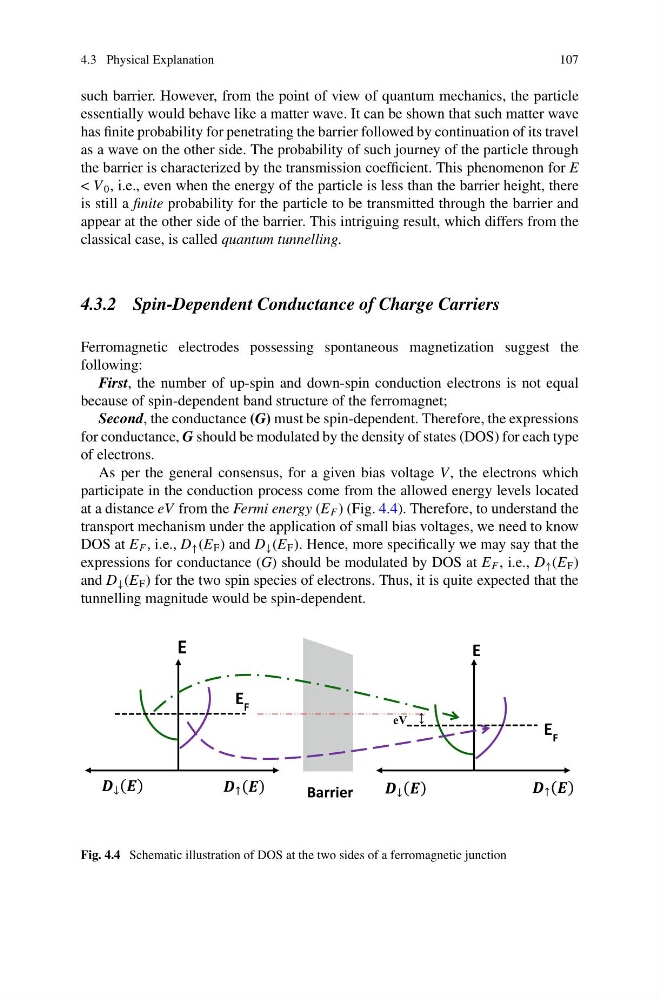
As per the general consensus, for a given bias voltage V, the electrons which
participate in the conduction process come from the allowed energy levels located
at a distance eV from the Fermi energy (E F ) (Fig. 4.4). Therefore, to understand the
transport mechanism under the application of small bias voltages, we need to know
DOS at E F , i.e., D ↑ (E F ) and D ↓ (E F ). Hence, more specifically we may say that the
expressions for conductance (G) should be modulated by DOS at E F , i.e., D ↑ (E F )
and D ↓ (E F ) for the two spin species of electrons. Thus, it is quite expected that the
tunnelling magnitude would be spin-dependent.
Barrier
E F
E
E
eV
E F
↓ ( )
↓ ( )
↑ ( )
↑ ( )
↕
Fig. 4.4 Schematic illustration of DOS at the two sides of a ferromagnetic junction
107
such barrier. However, from the point of view of quantum mechanics, the particle
essentially would behave like a matter wave. It can be shown that such matter wave
has finite probability for penetrating the barrier followed by continuation of its travel
as a wave on the other side. The probability of such journey of the particle through
the barrier is characterized by the transmission coefficient. This phenomenon for E
< V 0 , i.e., even when the energy of the particle is less than the barrier height, there
is still a finite probability for the particle to be transmitted through the barrier and
appear at the other side of the barrier. This intriguing result, which differs from the
classical case, is called quantum tunnelling.
4.3.2 Spin-Dependent Conductance of Charge Carriers
Ferromagnetic electrodes possessing spontaneous magnetization suggest the
following:
First, the number of up-spin and down-spin conduction electrons is not equal
because of spin-dependent band structure of the ferromagnet;
Second, the conductance (G) must be spin-dependent. Therefore, the expressions
for conductance, G should be modulated by the density of states (DOS) for each type
of electrons.
As per the general consensus, for a given bias voltage V, the electrons which
participate in the conduction process come from the allowed energy levels located
at a distance eV from the Fermi energy (E F ) (Fig. 4.4). Therefore, to understand the
transport mechanism under the application of small bias voltages, we need to know
DOS at E F , i.e., D ↑ (E F ) and D ↓ (E F ). Hence, more specifically we may say that the
expressions for conductance (G) should be modulated by DOS at E F , i.e., D ↑ (E F )
and D ↓ (E F ) for the two spin species of electrons. Thus, it is quite expected that the
tunnelling magnitude would be spin-dependent.
Barrier
E F
E
E
eV
E F
↓ ( )
↓ ( )
↑ ( )
↑ ( )
↕
Fig. 4.4 Schematic illustration of DOS at the two sides of a ferromagnetic junction