

3.3 Introduction on Giant Magnetoresistance (GMR)
83
where R ↑↓ and R ↑↑ are the resistances in case of antiferromagnetic (AFM) and
ferromagnetic (FM) orientations of magnetization of successive ferromagnetic films,
respectively.
The most commonly used combinations of ferromagnetic and non-magnetic layers
are Fe/Cr. In case of Fe/Cr multilayer structures, as shown in Fig. 3.3b, the GMR ratio
has been obtained to be approximately 50% (from Eq. 3.4). Similar effect has also
been discovered simultaneously in Fe/Cr/Fe trilayer, as shown in Fig. 3.3b, as well.
However, the GMR effect in this case has been found to be small. The GMR effect
was also obtained in diversified multilayer systems containing various combinations
of ferromagnetic and non-magnetic spacer layers, such as Co/Cu. Also, permalloy
has been used widely as the ferromagnetic component of GMR multilayers.
In particular, the subject of spintronics received wide attention after the discovery
of the fact that the electric current in a metallic multilayered nanostructure, composed
of a series of alternating thin ferromagnetic and non-magnetic layer, is determined by
the relative directions of the magnetizations of the successive ferromagnetic layers.
This suggests that the spin magnetic moment of the electrons has significant role in
the transport of electronic charge.
3.4 Types of GMR
3.4.1 Multilayer GMR
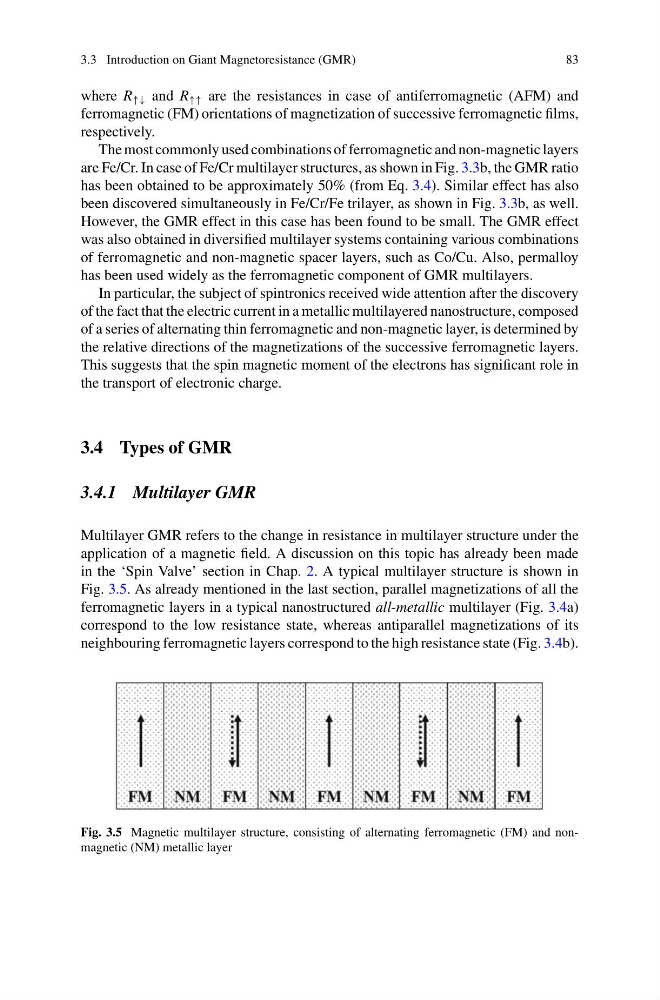
Multilayer GMR refers to the change in resistance in multilayer structure under the
application of a magnetic field. A discussion on this topic has already been made
in the ‘Spin Valve’ section in Chap. 2. A typical multilayer structure is shown in
Fig. 3.5. As already mentioned in the last section, parallel magnetizations of all the
ferromagnetic layers in a typical nanostructured all-metallic multilayer (Fig. 3.4a)
correspond to the low resistance state, whereas antiparallel magnetizations of its
neighbouring ferromagnetic layers correspond to the high resistance state (Fig. 3.4b).
Fig. 3.5 Magnetic multilayer structure, consisting of alternating ferromagnetic (FM) and nonmagnetic (NM) metallic layer
83
where R ↑↓ and R ↑↑ are the resistances in case of antiferromagnetic (AFM) and
ferromagnetic (FM) orientations of magnetization of successive ferromagnetic films,
respectively.
The most commonly used combinations of ferromagnetic and non-magnetic layers
are Fe/Cr. In case of Fe/Cr multilayer structures, as shown in Fig. 3.3b, the GMR ratio
has been obtained to be approximately 50% (from Eq. 3.4). Similar effect has also
been discovered simultaneously in Fe/Cr/Fe trilayer, as shown in Fig. 3.3b, as well.
However, the GMR effect in this case has been found to be small. The GMR effect
was also obtained in diversified multilayer systems containing various combinations
of ferromagnetic and non-magnetic spacer layers, such as Co/Cu. Also, permalloy
has been used widely as the ferromagnetic component of GMR multilayers.
In particular, the subject of spintronics received wide attention after the discovery
of the fact that the electric current in a metallic multilayered nanostructure, composed
of a series of alternating thin ferromagnetic and non-magnetic layer, is determined by
the relative directions of the magnetizations of the successive ferromagnetic layers.
This suggests that the spin magnetic moment of the electrons has significant role in
the transport of electronic charge.
3.4 Types of GMR
3.4.1 Multilayer GMR
Multilayer GMR refers to the change in resistance in multilayer structure under the
application of a magnetic field. A discussion on this topic has already been made
in the ‘Spin Valve’ section in Chap. 2. A typical multilayer structure is shown in
Fig. 3.5. As already mentioned in the last section, parallel magnetizations of all the
ferromagnetic layers in a typical nanostructured all-metallic multilayer (Fig. 3.4a)
correspond to the low resistance state, whereas antiparallel magnetizations of its
neighbouring ferromagnetic layers correspond to the high resistance state (Fig. 3.4b).
Fig. 3.5 Magnetic multilayer structure, consisting of alternating ferromagnetic (FM) and nonmagnetic (NM) metallic layer