

78
3 Worldsheet Path Integral: Scattering Amplitudes
The operators V α i (k i ; σ 0
j ) (a priori off-shell) are called unintegrated operators, by
opposition to the integrated operators V α i (k i ). We will see that both are natural
elements of the BRST cohomology.
To stress that the ˆ
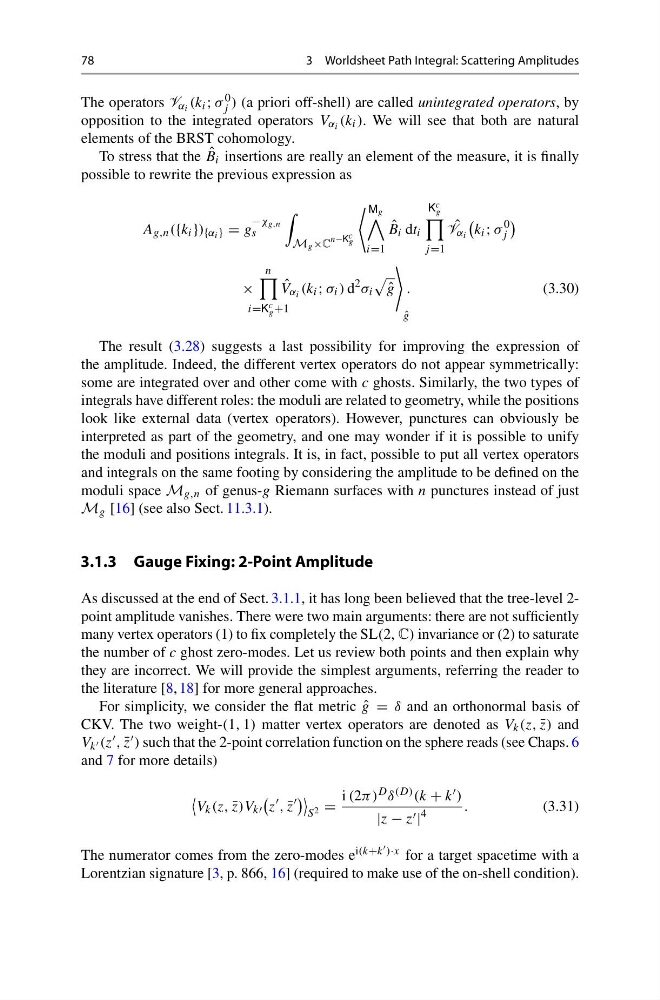
B i insertions are really an element of the measure, it is finally
possible to rewrite the previous expression as
A g,n ({k i }) {α i } = g
−χ g,n
s
M g ×C
n−K c
g
M g
i=1
ˆ
B i dt i
K c
g
j =1
ˆ
V α i
k i ; σ
0
j
×
n
i=K c
g +1
ˆ
V α i (k i ; σ i ) d
2 σ i
ˆ
g
ˆ
g
.
(3.30)
The result (3.28) suggests a last possibility for improving the expression of
the amplitude. Indeed, the different vertex operators do not appear symmetrically:
some are integrated over and other come with c ghosts. Similarly, the two types of
integrals have different roles: the moduli are related to geometry, while the positions
look like external data (vertex operators). However, punctures can obviously be
interpreted as part of the geometry, and one may wonder if it is possible to unify
the moduli and positions integrals. It is, in fact, possible to put all vertex operators
and integrals on the same footing by considering the amplitude to be defined on the
moduli space M g,n of genus-g Riemann surfaces with n punctures instead of just
M g [16] (see also Sect. 11.3.1).
3.1.3 Gauge Fixing: 2-Point Amplitude
As discussed at the end of Sect. 3.1.1, it has long been believed that the tree-level 2point amplitude vanishes. There were two main arguments: there are not sufficiently
many vertex operators (1) to fix completely the SL(2, C) invariance or (2) to saturate
the number of c ghost zero-modes. Let us review both points and then explain why
they are incorrect. We will provide the simplest arguments, referring the reader to
the literature [8, 18] for more general approaches.
For simplicity, we consider the flat metric ˆ
g = δ and an orthonormal basis of
CKV. The two weight-(1, 1) matter vertex operators are denoted as V k (z, ¯
z) and
V k (z , ¯
z ) such that the 2-point correlation function on the sphere reads (see Chaps. 6
and 7 for more details)
V k (z, ¯
z)V k
z
, ¯
z
S 2 =
i (2π) D δ (D) (k + k )
|z − z |
4
.
(3.31)
The numerator comes from the zero-modes e i(k+k )·x for a target spacetime with a
Lorentzian signature [3, p. 866, 16] (required to make use of the on-shell condition).
3 Worldsheet Path Integral: Scattering Amplitudes
The operators V α i (k i ; σ 0
j ) (a priori off-shell) are called unintegrated operators, by
opposition to the integrated operators V α i (k i ). We will see that both are natural
elements of the BRST cohomology.
To stress that the ˆ
B i insertions are really an element of the measure, it is finally
possible to rewrite the previous expression as
A g,n ({k i }) {α i } = g
−χ g,n
s
M g ×C
n−K c
g
M g
i=1
ˆ
B i dt i
K c
g
j =1
ˆ
V α i
k i ; σ
0
j
×
n
i=K c
g +1
ˆ
V α i (k i ; σ i ) d
2 σ i
ˆ
g
ˆ
g
.
(3.30)
The result (3.28) suggests a last possibility for improving the expression of
the amplitude. Indeed, the different vertex operators do not appear symmetrically:
some are integrated over and other come with c ghosts. Similarly, the two types of
integrals have different roles: the moduli are related to geometry, while the positions
look like external data (vertex operators). However, punctures can obviously be
interpreted as part of the geometry, and one may wonder if it is possible to unify
the moduli and positions integrals. It is, in fact, possible to put all vertex operators
and integrals on the same footing by considering the amplitude to be defined on the
moduli space M g,n of genus-g Riemann surfaces with n punctures instead of just
M g [16] (see also Sect. 11.3.1).
3.1.3 Gauge Fixing: 2-Point Amplitude
As discussed at the end of Sect. 3.1.1, it has long been believed that the tree-level 2point amplitude vanishes. There were two main arguments: there are not sufficiently
many vertex operators (1) to fix completely the SL(2, C) invariance or (2) to saturate
the number of c ghost zero-modes. Let us review both points and then explain why
they are incorrect. We will provide the simplest arguments, referring the reader to
the literature [8, 18] for more general approaches.
For simplicity, we consider the flat metric ˆ
g = δ and an orthonormal basis of
CKV. The two weight-(1, 1) matter vertex operators are denoted as V k (z, ¯
z) and
V k (z , ¯
z ) such that the 2-point correlation function on the sphere reads (see Chaps. 6
and 7 for more details)
V k (z, ¯
z)V k
z
, ¯
z
S 2 =
i (2π) D δ (D) (k + k )
|z − z |
4
.
(3.31)
The numerator comes from the zero-modes e i(k+k )·x for a target spacetime with a
Lorentzian signature [3, p. 866, 16] (required to make use of the on-shell condition).