

3.1 Scattering Amplitudes on Moduli Space
79
Review of the Problem
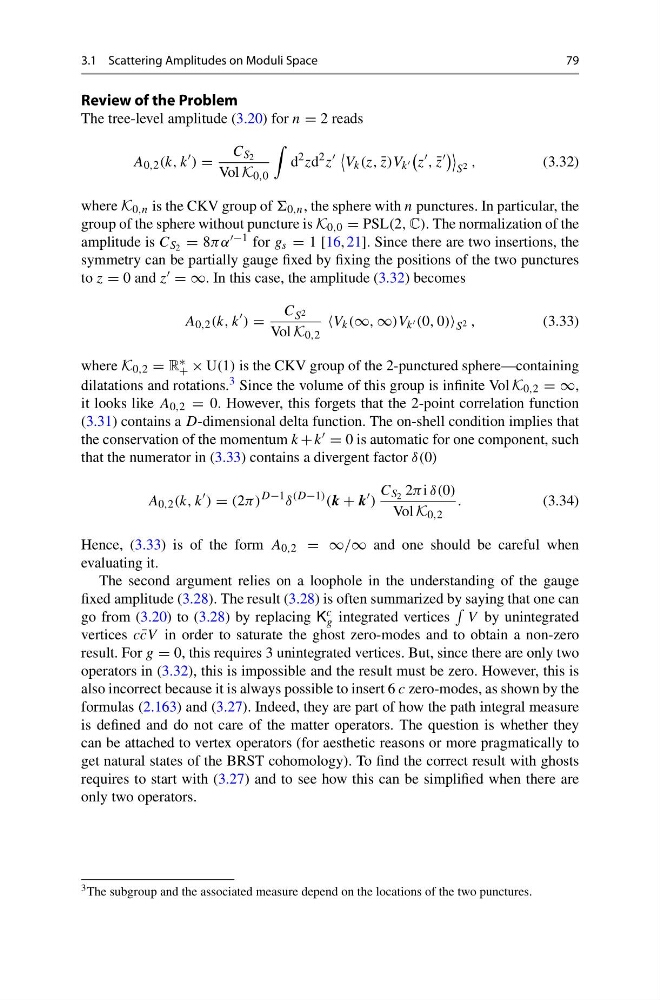
The tree-level amplitude (3.20) for n = 2 reads
A 0,2 (k, k
) =
C S 2
Vol K 0,0
d
2 zd
2 z
V k (z, ¯
z)V k
z
, ¯
z
S 2 ,
(3.32)
where K 0,n is the CKV group of 0,n , the sphere with n punctures. In particular, the
group of the sphere without puncture is K 0,0 = PSL(2, C). The normalization of the
amplitude is C S 2 = 8πα −1 for g s = 1 [16, 21]. Since there are two insertions, the
symmetry can be partially gauge fixed by fixing the positions of the two punctures
to z = 0 and z = ∞. In this case, the amplitude (3.32) becomes
A 0,2 (k, k
) =
C S 2
Vol K 0,2
V k (∞, ∞)V k (0, 0) S 2 ,
(3.33)
where K 0,2 = R ∗
+ × U(1) is the CKV group of the 2-punctured sphere—containing
dilatations and rotations. 3 Since the volume of this group is infinite Vol K 0,2 = ∞,
it looks like A 0,2 = 0. However, this forgets that the 2-point correlation function
(3.31) contains a D-dimensional delta function. The on-shell condition implies that
the conservation of the momentum k + k = 0 is automatic for one component, such
that the numerator in (3.33) contains a divergent factor δ(0)
A 0,2 (k, k
) = (2π)
D−1 δ
(D−1) (k + k
)
C S 2 2π i δ(0)
Vol K 0,2
.
(3.34)
Hence, (3.33) is of the form A 0,2 = ∞/∞ and one should be careful when
evaluating it.
The second argument relies on a loophole in the understanding of the gauge
fixed amplitude (3.28). The result (3.28) is often summarized by saying that one can
go from (3.20) to (3.28) by replacing K c
g integrated vertices
V by unintegrated
vertices c ¯
cV in order to saturate the ghost zero-modes and to obtain a non-zero
result. For g = 0, this requires 3 unintegrated vertices. But, since there are only two
operators in (3.32), this is impossible and the result must be zero. However, this is
also incorrect because it is always possible to insert 6 c zero-modes, as shown by the
formulas (2.163) and (3.27). Indeed, they are part of how the path integral measure
is defined and do not care of the matter operators. The question is whether they
can be attached to vertex operators (for aesthetic reasons or more pragmatically to
get natural states of the BRST cohomology). To find the correct result with ghosts
requires to start with (3.27) and to see how this can be simplified when there are
only two operators.
3 The subgroup and the associated measure depend on the locations of the two punctures.
79
Review of the Problem
The tree-level amplitude (3.20) for n = 2 reads
A 0,2 (k, k
) =
C S 2
Vol K 0,0
d
2 zd
2 z
V k (z, ¯
z)V k
z
, ¯
z
S 2 ,
(3.32)
where K 0,n is the CKV group of 0,n , the sphere with n punctures. In particular, the
group of the sphere without puncture is K 0,0 = PSL(2, C). The normalization of the
amplitude is C S 2 = 8πα −1 for g s = 1 [16, 21]. Since there are two insertions, the
symmetry can be partially gauge fixed by fixing the positions of the two punctures
to z = 0 and z = ∞. In this case, the amplitude (3.32) becomes
A 0,2 (k, k
) =
C S 2
Vol K 0,2
V k (∞, ∞)V k (0, 0) S 2 ,
(3.33)
where K 0,2 = R ∗
+ × U(1) is the CKV group of the 2-punctured sphere—containing
dilatations and rotations. 3 Since the volume of this group is infinite Vol K 0,2 = ∞,
it looks like A 0,2 = 0. However, this forgets that the 2-point correlation function
(3.31) contains a D-dimensional delta function. The on-shell condition implies that
the conservation of the momentum k + k = 0 is automatic for one component, such
that the numerator in (3.33) contains a divergent factor δ(0)
A 0,2 (k, k
) = (2π)
D−1 δ
(D−1) (k + k
)
C S 2 2π i δ(0)
Vol K 0,2
.
(3.34)
Hence, (3.33) is of the form A 0,2 = ∞/∞ and one should be careful when
evaluating it.
The second argument relies on a loophole in the understanding of the gauge
fixed amplitude (3.28). The result (3.28) is often summarized by saying that one can
go from (3.20) to (3.28) by replacing K c
g integrated vertices
V by unintegrated
vertices c ¯
cV in order to saturate the ghost zero-modes and to obtain a non-zero
result. For g = 0, this requires 3 unintegrated vertices. But, since there are only two
operators in (3.32), this is impossible and the result must be zero. However, this is
also incorrect because it is always possible to insert 6 c zero-modes, as shown by the
formulas (2.163) and (3.27). Indeed, they are part of how the path integral measure
is defined and do not care of the matter operators. The question is whether they
can be attached to vertex operators (for aesthetic reasons or more pragmatically to
get natural states of the BRST cohomology). To find the correct result with ghosts
requires to start with (3.27) and to see how this can be simplified when there are
only two operators.
3 The subgroup and the associated measure depend on the locations of the two punctures.