

76
3 Worldsheet Path Integral: Scattering Amplitudes
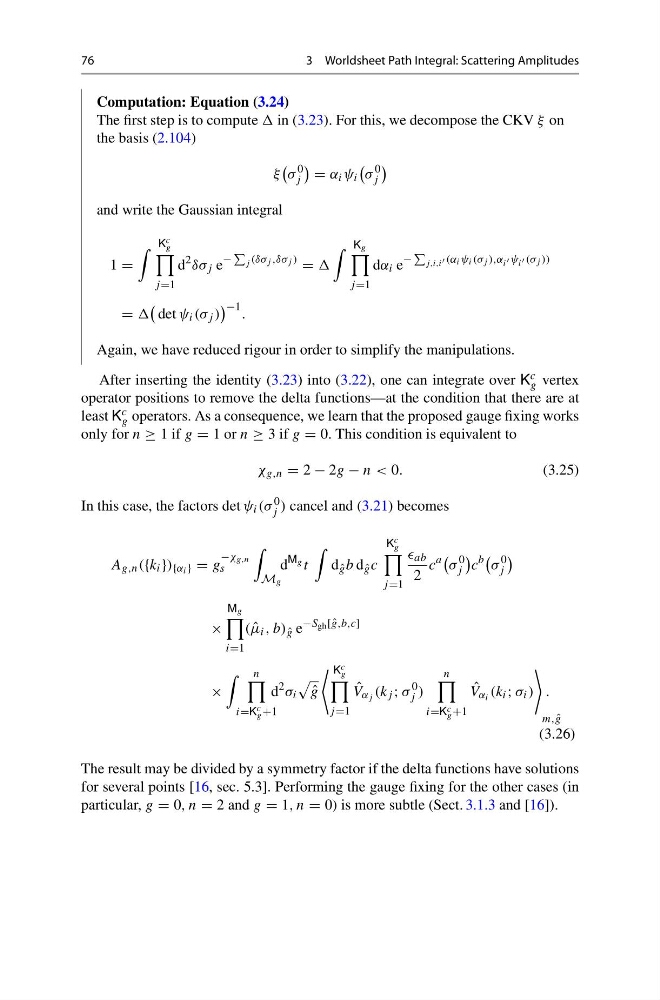
Computation: Equation (3.24)
The first step is to compute in (3.23). For this, we decompose the CKV ξ on
the basis (2.104)
ξ
σ
0
j
= α i ψ i
σ
0
j
and write the Gaussian integral
1 =
K c
g
j =1
d
2 δσ j e
−
j (δσ j ,δσ j ) =
K g
j =1
dα i e
−
j,i,i (α i ψ i (σ j ),α i ψ i (σ j ))
=
det ψ i (σ j )
−1 .
Again, we have reduced rigour in order to simplify the manipulations.
After inserting the identity (3.23) into (3.22), one can integrate over K c
g vertex
operator positions to remove the delta functions—at the condition that there are at
least K c
g operators. As a consequence, we learn that the proposed gauge fixing works
only for n ≥ 1 if g = 1 or n ≥ 3 if g = 0. This condition is equivalent to
χ g,n = 2 − 2g − n < 0.
(3.25)
In this case, the factors det ψ i (σ 0
j ) cancel and (3.21) becomes
A g,n ({k i }) {α i } = g
−χ g,n
s
M g
d
M g t
d ˆ
g b d ˆ
g c
K c
g
j =1
ab
2
c
a
σ
0
j
c
b
σ
0
j
×
M g
i=1
( ˆ
μ i , b) ˆ
g e
−S gh [ ˆ
g,b,c]
×
n
i=K c
g +1
d
2 σ i
ˆ
g
K c
g
j =1
ˆ
V α j (k j ; σ
0
j )
n
i=K c
g +1
ˆ
V α i (k i ; σ i )
m, ˆ
g
.
(3.26)
The result may be divided by a symmetry factor if the delta functions have solutions
for several points [16, sec. 5.3]. Performing the gauge fixing for the other cases (in
particular, g = 0, n = 2 and g = 1, n = 0) is more subtle (Sect. 3.1.3 and [16]).
3 Worldsheet Path Integral: Scattering Amplitudes
Computation: Equation (3.24)
The first step is to compute in (3.23). For this, we decompose the CKV ξ on
the basis (2.104)
ξ
σ
0
j
= α i ψ i
σ
0
j
and write the Gaussian integral
1 =
K c
g
j =1
d
2 δσ j e
−
j (δσ j ,δσ j ) =
K g
j =1
dα i e
−
j,i,i (α i ψ i (σ j ),α i ψ i (σ j ))
=
det ψ i (σ j )
−1 .
Again, we have reduced rigour in order to simplify the manipulations.
After inserting the identity (3.23) into (3.22), one can integrate over K c
g vertex
operator positions to remove the delta functions—at the condition that there are at
least K c
g operators. As a consequence, we learn that the proposed gauge fixing works
only for n ≥ 1 if g = 1 or n ≥ 3 if g = 0. This condition is equivalent to
χ g,n = 2 − 2g − n < 0.
(3.25)
In this case, the factors det ψ i (σ 0
j ) cancel and (3.21) becomes
A g,n ({k i }) {α i } = g
−χ g,n
s
M g
d
M g t
d ˆ
g b d ˆ
g c
K c
g
j =1
ab
2
c
a
σ
0
j
c
b
σ
0
j
×
M g
i=1
( ˆ
μ i , b) ˆ
g e
−S gh [ ˆ
g,b,c]
×
n
i=K c
g +1
d
2 σ i
ˆ
g
K c
g
j =1
ˆ
V α j (k j ; σ
0
j )
n
i=K c
g +1
ˆ
V α i (k i ; σ i )
m, ˆ
g
.
(3.26)
The result may be divided by a symmetry factor if the delta functions have solutions
for several points [16, sec. 5.3]. Performing the gauge fixing for the other cases (in
particular, g = 0, n = 2 and g = 1, n = 0) is more subtle (Sect. 3.1.3 and [16]).