

3.1 Scattering Amplitudes on Moduli Space
75
For the moment, only the b ghosts come with zero-modes. Then, c zero-modes can
be introduced in (3.21)
A g,n = g
−χ g,n
s
M g
d
M g t
ckv [ ˆ
g] −1
det ψ i
σ 0
j
×
d ˆ
g b d ˆ
g c
K c
g
j =1
ab
2
c
a
σ
0
j
c
b
σ
0
j
M g
i=1
( ˆ
μ i , b) ˆ
g e
−S gh [ ˆ
g,b,c]
×
n
i=1
d
2 σ i
ˆ
g
n
i=1
ˆ
V α i (k i ; σ i )
m, ˆ
g
,
(3.22)
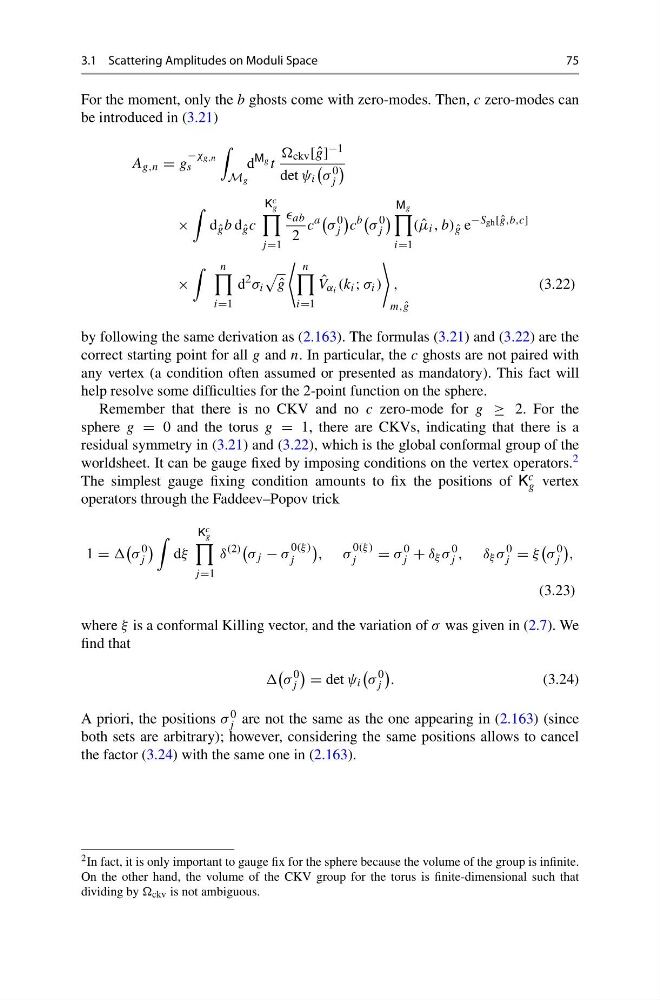
by following the same derivation as (2.163). The formulas (3.21) and (3.22) are the
correct starting point for all g and n. In particular, the c ghosts are not paired with
any vertex (a condition often assumed or presented as mandatory). This fact will
help resolve some difficulties for the 2-point function on the sphere.
Remember that there is no CKV and no c zero-mode for g ≥ 2. For the
sphere g = 0 and the torus g = 1, there are CKVs, indicating that there is a
residual symmetry in (3.21) and (3.22), which is the global conformal group of the
worldsheet. It can be gauge fixed by imposing conditions on the vertex operators. 2
The simplest gauge fixing condition amounts to fix the positions of K c
g vertex
operators through the Faddeev–Popov trick
1 =
σ
0
j
dξ
K c
g
j =1
δ
(2)
σ j − σ
0(ξ )
j
, σ
0(ξ )
j
= σ
0
j + δ ξ σ
0
j , δ ξ σ
0
j = ξ
σ
0
j
,
(3.23)
where ξ is a conformal Killing vector, and the variation of σ was given in (2.7). We
find that
σ
0
j
= det ψ i
σ
0
j
.
(3.24)
A priori, the positions σ 0
j are not the same as the one appearing in (2.163) (since
both sets are arbitrary); however, considering the same positions allows to cancel
the factor (3.24) with the same one in (2.163).
2 In fact, it is only important to gauge fix for the sphere because the volume of the group is infinite.
On the other hand, the volume of the CKV group for the torus is finite-dimensional such that
dividing by ckv is not ambiguous.
75
For the moment, only the b ghosts come with zero-modes. Then, c zero-modes can
be introduced in (3.21)
A g,n = g
−χ g,n
s
M g
d
M g t
ckv [ ˆ
g] −1
det ψ i
σ 0
j
×
d ˆ
g b d ˆ
g c
K c
g
j =1
ab
2
c
a
σ
0
j
c
b
σ
0
j
M g
i=1
( ˆ
μ i , b) ˆ
g e
−S gh [ ˆ
g,b,c]
×
n
i=1
d
2 σ i
ˆ
g
n
i=1
ˆ
V α i (k i ; σ i )
m, ˆ
g
,
(3.22)
by following the same derivation as (2.163). The formulas (3.21) and (3.22) are the
correct starting point for all g and n. In particular, the c ghosts are not paired with
any vertex (a condition often assumed or presented as mandatory). This fact will
help resolve some difficulties for the 2-point function on the sphere.
Remember that there is no CKV and no c zero-mode for g ≥ 2. For the
sphere g = 0 and the torus g = 1, there are CKVs, indicating that there is a
residual symmetry in (3.21) and (3.22), which is the global conformal group of the
worldsheet. It can be gauge fixed by imposing conditions on the vertex operators. 2
The simplest gauge fixing condition amounts to fix the positions of K c
g vertex
operators through the Faddeev–Popov trick
1 =
σ
0
j
dξ
K c
g
j =1
δ
(2)
σ j − σ
0(ξ )
j
, σ
0(ξ )
j
= σ
0
j + δ ξ σ
0
j , δ ξ σ
0
j = ξ
σ
0
j
,
(3.23)
where ξ is a conformal Killing vector, and the variation of σ was given in (2.7). We
find that
σ
0
j
= det ψ i
σ
0
j
.
(3.24)
A priori, the positions σ 0
j are not the same as the one appearing in (2.163) (since
both sets are arbitrary); however, considering the same positions allows to cancel
the factor (3.24) with the same one in (2.163).
2 In fact, it is only important to gauge fix for the sphere because the volume of the group is infinite.
On the other hand, the volume of the CKV group for the torus is finite-dimensional such that
dividing by ckv is not ambiguous.