

74
3 Worldsheet Path Integral: Scattering Amplitudes
diffeomorphism and Weyl invariant
δ ξ V α i (k i ) = δ ξ
d
2 σ
√ g V α i (k i ; σ ) = 0,
(3.19a)
δ ω V α i (k i ) = δ ω
d
2 σ
√ g V α i (k i ; σ ) = 0,
(3.19b)
with the variations defined in (2.7) and (2.11). Diffeomorphism invariance is
straightforward if the states are integrated worldsheet scalars. However, if the states
are classically Weyl invariant, they are not necessary so at the quantum level:
vertex operators are composite operators, which need to be renormalized to be welldefined at the quantum level. Renormalization introduces a scale that breaks Weyl
invariance. Enforcing it to be a symmetry of the vertex operators leads to constraints
on the latter. We will not enter in the details since it depends on the matter CFT,
and we will assume that the operators V α i (k i ) are indeed Weyl invariant (see [16,
sec. 3.6] for more details). In the rest of this book, we will use CFT techniques
developed in Chap. 6. The Einstein–Hilbert action is clearly invariant under both
symmetries since it is a topological quantity.
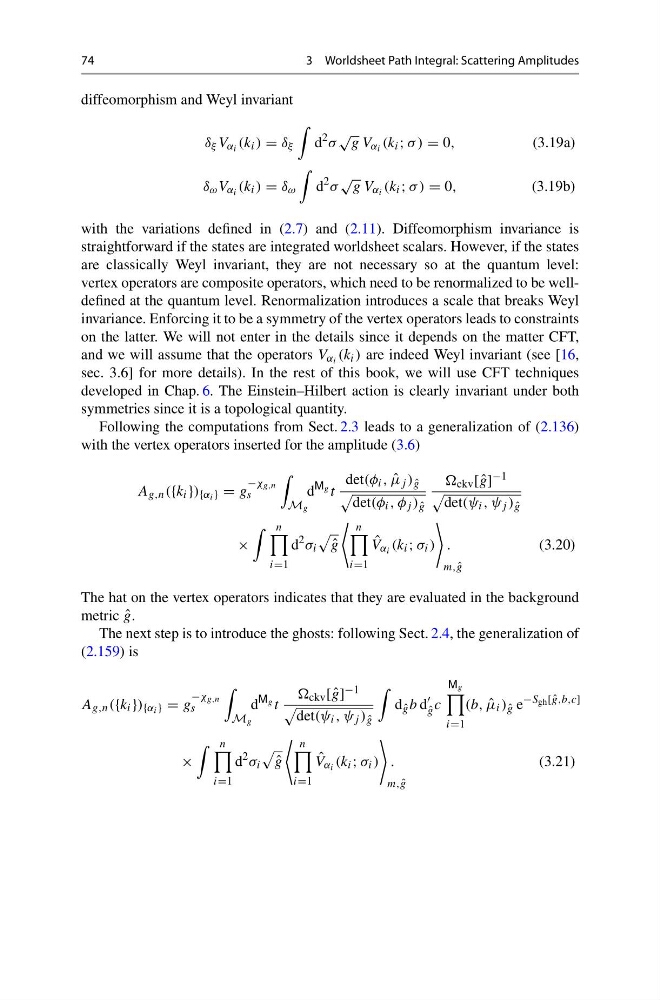
Following the computations from Sect. 2.3 leads to a generalization of (2.136)
with the vertex operators inserted for the amplitude (3.6)
A g,n ({k i }) {α i } = g
−χ g,n
s
M g
d
M g t
det(φ i , ˆ
μ j ) ˆ
g
det(φ i , φ j ) ˆ
g
ckv [ ˆ
g] −1
det(ψ i , ψ j ) ˆ
g
×
n
i=1
d
2 σ i
ˆ
g
n
i=1
ˆ
V α i (k i ; σ i )
m, ˆ
g
.
(3.20)
The hat on the vertex operators indicates that they are evaluated in the background
metric ˆ
g.
The next step is to introduce the ghosts: following Sect. 2.4, the generalization of
(2.159) is
A g,n ({k i }) {α i } = g
−χ g,n
s
M g
d
M g t
ckv [ ˆ
g] −1
det(ψ i , ψ j ) ˆ
g
d ˆ
g b d
ˆ
g c
M g
i=1
(b, ˆ
μ i ) ˆ
g e
−S gh [ ˆ
g,b,c]
×
n
i=1
d
2 σ i
ˆ
g
n
i=1
ˆ
V α i (k i ; σ i )
m, ˆ
g
.
(3.21)
3 Worldsheet Path Integral: Scattering Amplitudes
diffeomorphism and Weyl invariant
δ ξ V α i (k i ) = δ ξ
d
2 σ
√ g V α i (k i ; σ ) = 0,
(3.19a)
δ ω V α i (k i ) = δ ω
d
2 σ
√ g V α i (k i ; σ ) = 0,
(3.19b)
with the variations defined in (2.7) and (2.11). Diffeomorphism invariance is
straightforward if the states are integrated worldsheet scalars. However, if the states
are classically Weyl invariant, they are not necessary so at the quantum level:
vertex operators are composite operators, which need to be renormalized to be welldefined at the quantum level. Renormalization introduces a scale that breaks Weyl
invariance. Enforcing it to be a symmetry of the vertex operators leads to constraints
on the latter. We will not enter in the details since it depends on the matter CFT,
and we will assume that the operators V α i (k i ) are indeed Weyl invariant (see [16,
sec. 3.6] for more details). In the rest of this book, we will use CFT techniques
developed in Chap. 6. The Einstein–Hilbert action is clearly invariant under both
symmetries since it is a topological quantity.
Following the computations from Sect. 2.3 leads to a generalization of (2.136)
with the vertex operators inserted for the amplitude (3.6)
A g,n ({k i }) {α i } = g
−χ g,n
s
M g
d
M g t
det(φ i , ˆ
μ j ) ˆ
g
det(φ i , φ j ) ˆ
g
ckv [ ˆ
g] −1
det(ψ i , ψ j ) ˆ
g
×
n
i=1
d
2 σ i
ˆ
g
n
i=1
ˆ
V α i (k i ; σ i )
m, ˆ
g
.
(3.20)
The hat on the vertex operators indicates that they are evaluated in the background
metric ˆ
g.
The next step is to introduce the ghosts: following Sect. 2.4, the generalization of
(2.159) is
A g,n ({k i }) {α i } = g
−χ g,n
s
M g
d
M g t
ckv [ ˆ
g] −1
det(ψ i , ψ j ) ˆ
g
d ˆ
g b d
ˆ
g c
M g
i=1
(b, ˆ
μ i ) ˆ
g e
−S gh [ ˆ
g,b,c]
×
n
i=1
d
2 σ i
ˆ
g
n
i=1
ˆ
V α i (k i ; σ i )
m, ˆ
g
.
(3.21)