

3.1 Scattering Amplitudes on Moduli Space
73
3. A single particle in the far past propagating to the far future without interacting
is a connected and physical process [7, p. 133].
4. It is required by the unitarity of the 2-point amplitude [8].
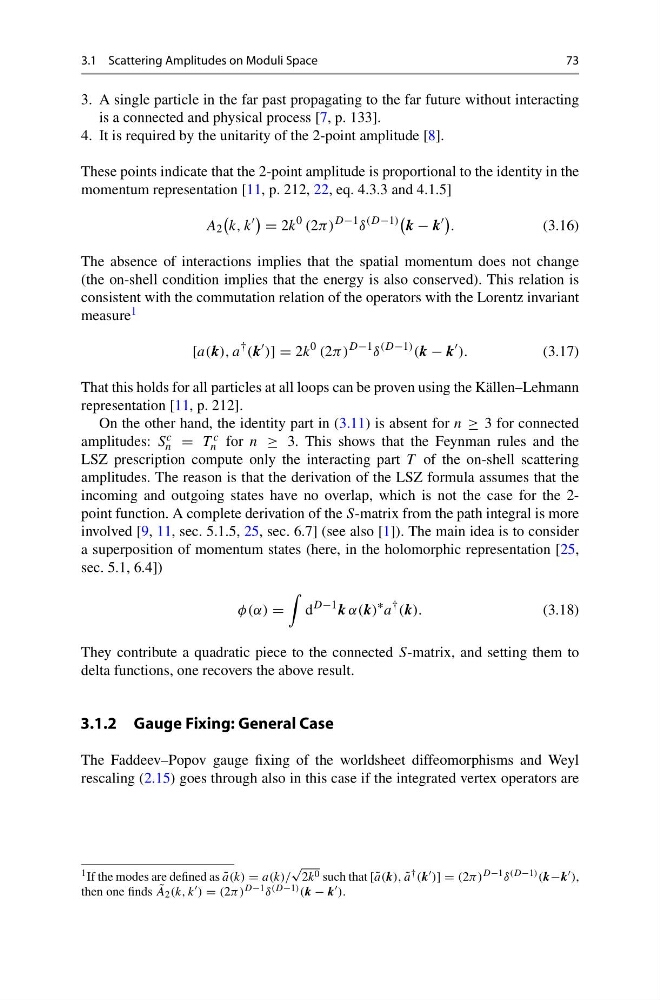
These points indicate that the 2-point amplitude is proportional to the identity in the
momentum representation [11, p. 212, 22, eq. 4.3.3 and 4.1.5]
A 2
k, k
= 2k
0 (2π)
D−1 δ
(D−1)
k − k
.
(3.16)
The absence of interactions implies that the spatial momentum does not change
(the on-shell condition implies that the energy is also conserved). This relation is
consistent with the commutation relation of the operators with the Lorentz invariant
measure 1
[a(k), a
† (k
)] = 2k
0 (2π)
D−1 δ
(D−1) (k − k
).
(3.17)
That this holds for all particles at all loops can be proven using the Källen–Lehmann
representation [11, p. 212].
On the other hand, the identity part in (3.11) is absent for n ≥ 3 for connected
amplitudes: S c
n = T c
n for n ≥ 3. This shows that the Feynman rules and the
LSZ prescription compute only the interacting part T of the on-shell scattering
amplitudes. The reason is that the derivation of the LSZ formula assumes that the
incoming and outgoing states have no overlap, which is not the case for the 2point function. A complete derivation of the S-matrix from the path integral is more
involved [9, 11, sec. 5.1.5, 25, sec. 6.7] (see also [1]). The main idea is to consider
a superposition of momentum states (here, in the holomorphic representation [25,
sec. 5.1, 6.4])
φ(α) =
d
D−1
k α(k)
∗ a
† (k).
(3.18)
They contribute a quadratic piece to the connected S-matrix, and setting them to
delta functions, one recovers the above result.
3.1.2 Gauge Fixing: General Case
The Faddeev–Popov gauge fixing of the worldsheet diffeomorphisms and Weyl
rescaling (2.15) goes through also in this case if the integrated vertex operators are
1 If the modes are defined as ˜
a(k) = a(k)/
√
2k 0 such that [ ˜
a(k), ˜
a † (k )] = (2π) D−1 δ (D−1) (k−k ),
then one finds ˜
A 2 (k, k ) = (2π) D−1 δ (D−1) (k − k ).
73
3. A single particle in the far past propagating to the far future without interacting
is a connected and physical process [7, p. 133].
4. It is required by the unitarity of the 2-point amplitude [8].
These points indicate that the 2-point amplitude is proportional to the identity in the
momentum representation [11, p. 212, 22, eq. 4.3.3 and 4.1.5]
A 2
k, k
= 2k
0 (2π)
D−1 δ
(D−1)
k − k
.
(3.16)
The absence of interactions implies that the spatial momentum does not change
(the on-shell condition implies that the energy is also conserved). This relation is
consistent with the commutation relation of the operators with the Lorentz invariant
measure 1
[a(k), a
† (k
)] = 2k
0 (2π)
D−1 δ
(D−1) (k − k
).
(3.17)
That this holds for all particles at all loops can be proven using the Källen–Lehmann
representation [11, p. 212].
On the other hand, the identity part in (3.11) is absent for n ≥ 3 for connected
amplitudes: S c
n = T c
n for n ≥ 3. This shows that the Feynman rules and the
LSZ prescription compute only the interacting part T of the on-shell scattering
amplitudes. The reason is that the derivation of the LSZ formula assumes that the
incoming and outgoing states have no overlap, which is not the case for the 2point function. A complete derivation of the S-matrix from the path integral is more
involved [9, 11, sec. 5.1.5, 25, sec. 6.7] (see also [1]). The main idea is to consider
a superposition of momentum states (here, in the holomorphic representation [25,
sec. 5.1, 6.4])
φ(α) =
d
D−1
k α(k)
∗ a
† (k).
(3.18)
They contribute a quadratic piece to the connected S-matrix, and setting them to
delta functions, one recovers the above result.
3.1.2 Gauge Fixing: General Case
The Faddeev–Popov gauge fixing of the worldsheet diffeomorphisms and Weyl
rescaling (2.15) goes through also in this case if the integrated vertex operators are
1 If the modes are defined as ˜
a(k) = a(k)/
√
2k 0 such that [ ˜
a(k), ˜
a † (k )] = (2π) D−1 δ (D−1) (k−k ),
then one finds ˜
A 2 (k, k ) = (2π) D−1 δ (D−1) (k − k ).