

72
3 Worldsheet Path Integral: Scattering Amplitudes
question of gauge fixing tree-level 2-point amplitude (Sect. 3.1.3). It has long been
believed that (2.28) computes only the interacting part (amputated Green functions),
but it has been understood recently that this is not correct and that (2.28) computes
the S-matrix.
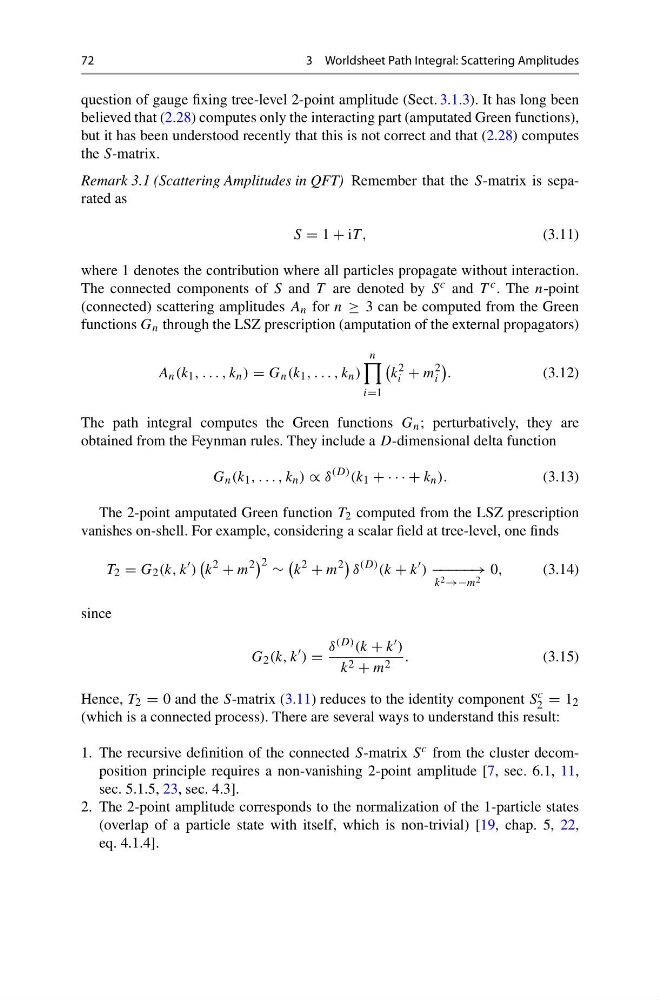
Remark 3.1 (Scattering Amplitudes in QFT) Remember that the S-matrix is separated as
S = 1 + iT ,
(3.11)
where 1 denotes the contribution where all particles propagate without interaction.
The connected components of S and T are denoted by S c and T c . The n-point
(connected) scattering amplitudes A n for n ≥ 3 can be computed from the Green
functions G n through the LSZ prescription (amputation of the external propagators)
A n (k 1 , . . . , k n ) = G n (k 1 , . . . , k n )
n
i=1
k
2
i + m
2
i
.
(3.12)
The path integral computes the Green functions G n ; perturbatively, they are
obtained from the Feynman rules. They include a D-dimensional delta function
G n (k 1 , . . . , k n ) ∝ δ
(D) (k 1 + · · · + k n ).
(3.13)
The 2-point amputated Green function T 2 computed from the LSZ prescription
vanishes on-shell. For example, considering a scalar field at tree-level, one finds
T 2 = G 2 (k, k
)
k
2
+ m
2
2 ∼
k
2
+ m
2
δ
(D) (k + k
) − −−−−→
k 2 →−m 2
0,
(3.14)
since
G 2 (k, k
) =
δ (D) (k + k )
k 2 + m 2 .
(3.15)
Hence, T 2 = 0 and the S-matrix (3.11) reduces to the identity component S c
2 = 1 2
(which is a connected process). There are several ways to understand this result:
1. The recursive definition of the connected S-matrix S c from the cluster decomposition principle requires a non-vanishing 2-point amplitude [7, sec. 6.1, 11,
sec. 5.1.5, 23, sec. 4.3].
2. The 2-point amplitude corresponds to the normalization of the 1-particle states
(overlap of a particle state with itself, which is non-trivial) [19, chap. 5, 22,
eq. 4.1.4].
3 Worldsheet Path Integral: Scattering Amplitudes
question of gauge fixing tree-level 2-point amplitude (Sect. 3.1.3). It has long been
believed that (2.28) computes only the interacting part (amputated Green functions),
but it has been understood recently that this is not correct and that (2.28) computes
the S-matrix.
Remark 3.1 (Scattering Amplitudes in QFT) Remember that the S-matrix is separated as
S = 1 + iT ,
(3.11)
where 1 denotes the contribution where all particles propagate without interaction.
The connected components of S and T are denoted by S c and T c . The n-point
(connected) scattering amplitudes A n for n ≥ 3 can be computed from the Green
functions G n through the LSZ prescription (amputation of the external propagators)
A n (k 1 , . . . , k n ) = G n (k 1 , . . . , k n )
n
i=1
k
2
i + m
2
i
.
(3.12)
The path integral computes the Green functions G n ; perturbatively, they are
obtained from the Feynman rules. They include a D-dimensional delta function
G n (k 1 , . . . , k n ) ∝ δ
(D) (k 1 + · · · + k n ).
(3.13)
The 2-point amputated Green function T 2 computed from the LSZ prescription
vanishes on-shell. For example, considering a scalar field at tree-level, one finds
T 2 = G 2 (k, k
)
k
2
+ m
2
2 ∼
k
2
+ m
2
δ
(D) (k + k
) − −−−−→
k 2 →−m 2
0,
(3.14)
since
G 2 (k, k
) =
δ (D) (k + k )
k 2 + m 2 .
(3.15)
Hence, T 2 = 0 and the S-matrix (3.11) reduces to the identity component S c
2 = 1 2
(which is a connected process). There are several ways to understand this result:
1. The recursive definition of the connected S-matrix S c from the cluster decomposition principle requires a non-vanishing 2-point amplitude [7, sec. 6.1, 11,
sec. 5.1.5, 23, sec. 4.3].
2. The 2-point amplitude corresponds to the normalization of the 1-particle states
(overlap of a particle state with itself, which is non-trivial) [19, chap. 5, 22,
eq. 4.1.4].