

3.1 Scattering Amplitudes on Moduli Space
71
The σ i dependence of each
√
g will be omitted from now on since no confusion is
possible. The following equivalent notations will be used:
A g,n ({k i }) {α i } := A g,n (k 1 , . . . , k n ) α 1 ,...,α n := A g,n
V α 1 (k 1 ), . . . , V α n (k n )
.
(3.7)
The complete (perturbative) amplitude is found by summing over all genus
A n (k 1 , . . . , k n ) α 1 ,...,α n =
∞
g=0
A g,n (k 1 , . . . , k n ) α 1 ,...,α n .
(3.8)
We omit a genus-dependent normalization that can be determined from unitarity [16]. Sometimes, it is convenient to extract the factor e − 0 χ g,n of the amplitude
A g,n to display explicitly the genus expansion, but we will not follow this
convention here. Since each term of the sum scales as A g,n ∝ g
2g+n−2
s
, this
expression clearly shows that worldsheet amplitudes are perturbative by definition:
this motivates the construction of a string field theory from which the full nonperturbative S-matrix can theoretically be computed.
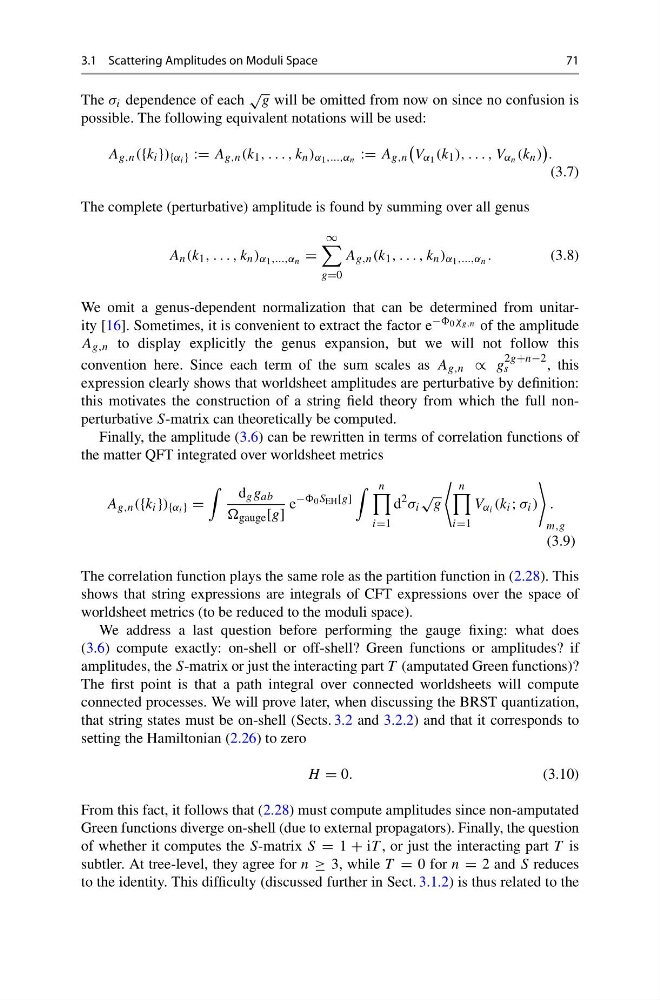
Finally, the amplitude (3.6) can be rewritten in terms of correlation functions of
the matter QFT integrated over worldsheet metrics
A g,n ({k i }) {α i } =
d g g ab
gauge [g]
e
− 0 S EH [g]
n
i=1
d
2 σ i
√ g
n
i=1
V α i (k i ; σ i )
m,g
.
(3.9)
The correlation function plays the same role as the partition function in (2.28). This
shows that string expressions are integrals of CFT expressions over the space of
worldsheet metrics (to be reduced to the moduli space).
We address a last question before performing the gauge fixing: what does
(3.6) compute exactly: on-shell or off-shell? Green functions or amplitudes? if
amplitudes, the S-matrix or just the interacting part T (amputated Green functions)?
The first point is that a path integral over connected worldsheets will compute
connected processes. We will prove later, when discussing the BRST quantization,
that string states must be on-shell (Sects. 3.2 and 3.2.2) and that it corresponds to
setting the Hamiltonian (2.26) to zero
H = 0.
(3.10)
From this fact, it follows that (2.28) must compute amplitudes since non-amputated
Green functions diverge on-shell (due to external propagators). Finally, the question
of whether it computes the S-matrix S = 1 + iT , or just the interacting part T is
subtler. At tree-level, they agree for n ≥ 3, while T = 0 for n = 2 and S reduces
to the identity. This difficulty (discussed further in Sect. 3.1.2) is thus related to the
71
The σ i dependence of each
√
g will be omitted from now on since no confusion is
possible. The following equivalent notations will be used:
A g,n ({k i }) {α i } := A g,n (k 1 , . . . , k n ) α 1 ,...,α n := A g,n
V α 1 (k 1 ), . . . , V α n (k n )
.
(3.7)
The complete (perturbative) amplitude is found by summing over all genus
A n (k 1 , . . . , k n ) α 1 ,...,α n =
∞
g=0
A g,n (k 1 , . . . , k n ) α 1 ,...,α n .
(3.8)
We omit a genus-dependent normalization that can be determined from unitarity [16]. Sometimes, it is convenient to extract the factor e − 0 χ g,n of the amplitude
A g,n to display explicitly the genus expansion, but we will not follow this
convention here. Since each term of the sum scales as A g,n ∝ g
2g+n−2
s
, this
expression clearly shows that worldsheet amplitudes are perturbative by definition:
this motivates the construction of a string field theory from which the full nonperturbative S-matrix can theoretically be computed.
Finally, the amplitude (3.6) can be rewritten in terms of correlation functions of
the matter QFT integrated over worldsheet metrics
A g,n ({k i }) {α i } =
d g g ab
gauge [g]
e
− 0 S EH [g]
n
i=1
d
2 σ i
√ g
n
i=1
V α i (k i ; σ i )
m,g
.
(3.9)
The correlation function plays the same role as the partition function in (2.28). This
shows that string expressions are integrals of CFT expressions over the space of
worldsheet metrics (to be reduced to the moduli space).
We address a last question before performing the gauge fixing: what does
(3.6) compute exactly: on-shell or off-shell? Green functions or amplitudes? if
amplitudes, the S-matrix or just the interacting part T (amputated Green functions)?
The first point is that a path integral over connected worldsheets will compute
connected processes. We will prove later, when discussing the BRST quantization,
that string states must be on-shell (Sects. 3.2 and 3.2.2) and that it corresponds to
setting the Hamiltonian (2.26) to zero
H = 0.
(3.10)
From this fact, it follows that (2.28) must compute amplitudes since non-amputated
Green functions diverge on-shell (due to external propagators). Finally, the question
of whether it computes the S-matrix S = 1 + iT , or just the interacting part T is
subtler. At tree-level, they agree for n ≥ 3, while T = 0 for n = 2 and S reduces
to the identity. This difficulty (discussed further in Sect. 3.1.2) is thus related to the