

70
3 Worldsheet Path Integral: Scattering Amplitudes
genus g with n punctures (or marked points). The external states are represented by
integrated vertex operators
V α (k i ) :=
d
2 σ
g(σ ) V α (k; σ ).
(3.2)
The vertex operators V α (k; σ ) are built from the matter CFT operators and from
the worldsheet metric g ab . The functional dependence is omitted to not overload
the notation, but one should read V α (k; σ ) := V α [g, ,](k; σ ). The integration
over the state positions is necessary because the mapping of the tube to a point
is arbitrary. Another viewpoint is that it is needed to obtain an expression invariant
under worldsheet diffeomorphisms. The vertex operators described general states
that not necessarily on-shell: this restriction will be found later when discussing the
BRST invariance of scattering amplitudes (Sect. 3.2.2).
Following Sect. 2.3.5, the Einstein–Hilbert action with boundary term
S EH [g] :=
1
4π
d
2 σ
√
g R +
1
2π
ds k = χ g,n
(3.3)
inserted in the path integral equals the Euler characteristics χ g,n (the g in χ g,n
denotes the genus). On a surface with punctures, the latter is shifted by the number
of punctures (which are equivalent to boundaries or disks) with respect to (2.4)
χ g,n := χ(( g,n ) = 2 − 2g − n.
(3.4)
This gives the normalization factor
g
−χ g,n
s
= e
− 0 S EH [g] ,
, 0 := ln g s .
(3.5)
The correctness factor can be verified by inspection of the Riemann surface for
the scattering of n strings at g-loops. In particular, the string coupling constant is
by definition the interaction strength for the scattering of 3 strings at tree-level.
Moreover, the tree-level 2-point amplitude contains no interaction and should have
no power of g s . This factor can also be obtained by unitarity [16].
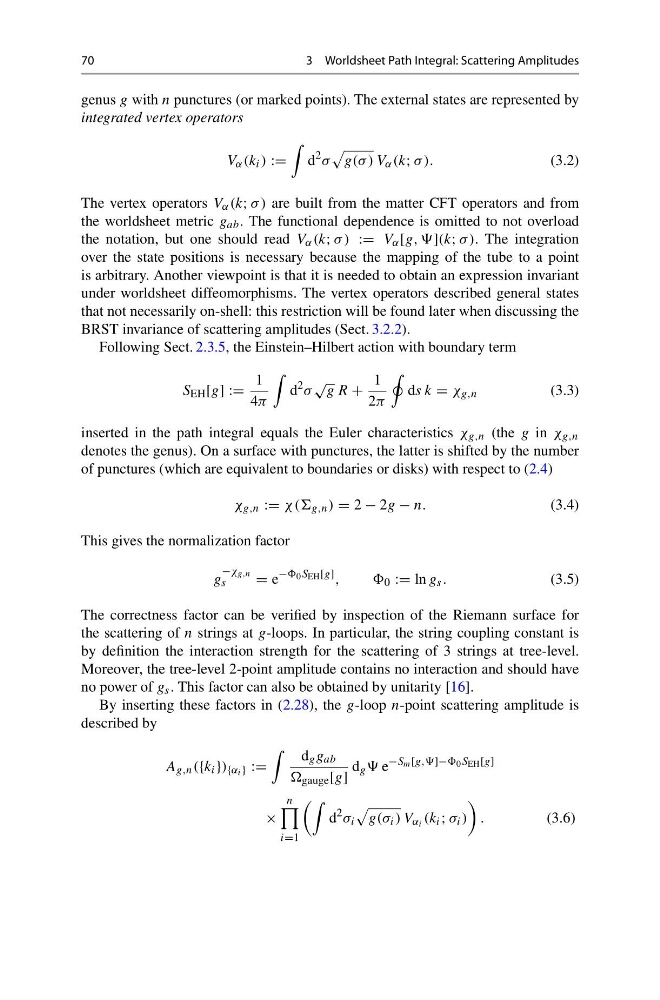
By inserting these factors in (2.28), the g-loop n-point scattering amplitude is
described by
A g,n ({k i }) {α i } :=
d g g ab
gauge [g]
d g e
−S m [g,,]− 0 S EH [g]
×
n
i=1
d
2 σ i
g(σ i ) V α i (k i ; σ i )
.
(3.6)
3 Worldsheet Path Integral: Scattering Amplitudes
genus g with n punctures (or marked points). The external states are represented by
integrated vertex operators
V α (k i ) :=
d
2 σ
g(σ ) V α (k; σ ).
(3.2)
The vertex operators V α (k; σ ) are built from the matter CFT operators and from
the worldsheet metric g ab . The functional dependence is omitted to not overload
the notation, but one should read V α (k; σ ) := V α [g, ,](k; σ ). The integration
over the state positions is necessary because the mapping of the tube to a point
is arbitrary. Another viewpoint is that it is needed to obtain an expression invariant
under worldsheet diffeomorphisms. The vertex operators described general states
that not necessarily on-shell: this restriction will be found later when discussing the
BRST invariance of scattering amplitudes (Sect. 3.2.2).
Following Sect. 2.3.5, the Einstein–Hilbert action with boundary term
S EH [g] :=
1
4π
d
2 σ
√
g R +
1
2π
ds k = χ g,n
(3.3)
inserted in the path integral equals the Euler characteristics χ g,n (the g in χ g,n
denotes the genus). On a surface with punctures, the latter is shifted by the number
of punctures (which are equivalent to boundaries or disks) with respect to (2.4)
χ g,n := χ(( g,n ) = 2 − 2g − n.
(3.4)
This gives the normalization factor
g
−χ g,n
s
= e
− 0 S EH [g] ,
, 0 := ln g s .
(3.5)
The correctness factor can be verified by inspection of the Riemann surface for
the scattering of n strings at g-loops. In particular, the string coupling constant is
by definition the interaction strength for the scattering of 3 strings at tree-level.
Moreover, the tree-level 2-point amplitude contains no interaction and should have
no power of g s . This factor can also be obtained by unitarity [16].
By inserting these factors in (2.28), the g-loop n-point scattering amplitude is
described by
A g,n ({k i }) {α i } :=
d g g ab
gauge [g]
d g e
−S m [g,,]− 0 S EH [g]
×
n
i=1
d
2 σ i
g(σ i ) V α i (k i ; σ i )
.
(3.6)