

44
2 Worldsheet Path Integral: Vacuum Amplitudes
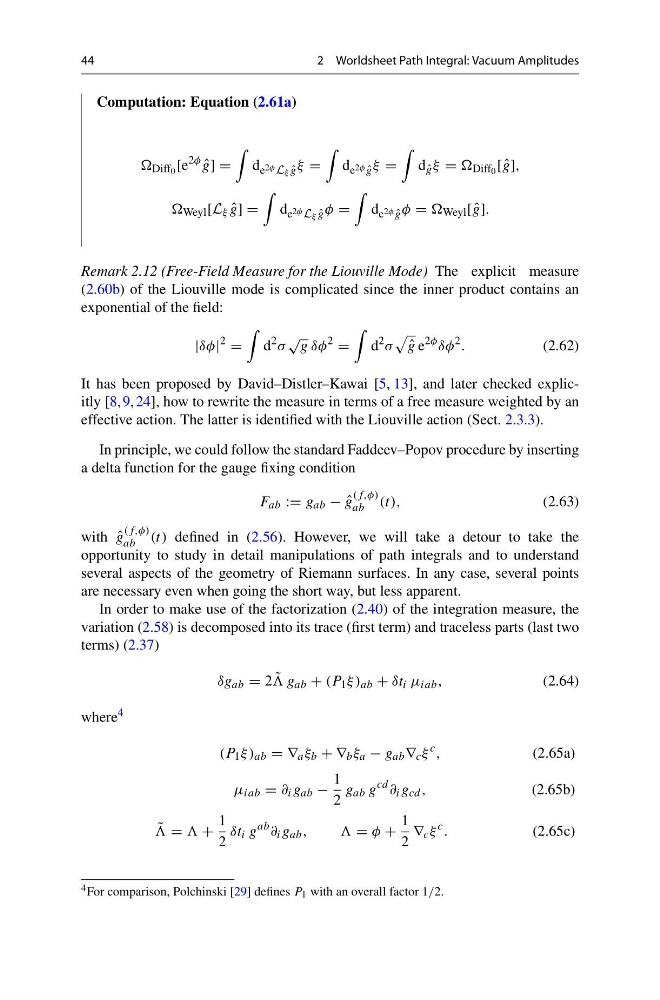
Computation: Equation (2.61a)
Diff 0 [e
2φ
ˆ
g] =
d e 2φ L ξ ˆ
g ξ =
d e 2φ ˆ
g ξ =
d ˆ
g ξ = Diff 0 [ ˆ
g],
Weyl [L ξ ˆ
g] =
d e 2φ L ξ ˆ
g φ =
d e 2φ ˆ
g φ = Weyl [ ˆ
g].
Remark 2.12 (Free-Field Measure for the Liouville Mode) The explicit measure
(2.60b) of the Liouville mode is complicated since the inner product contains an
exponential of the field:
|δφ|
2
=
d
2 σ
√
g δφ
2
=
d
2 σ
ˆ
g e
2φ δφ
2 .
(2.62)
It has been proposed by David–Distler–Kawai [5, 13], and later checked explicitly [8, 9, 24], how to rewrite the measure in terms of a free measure weighted by an
effective action. The latter is identified with the Liouville action (Sect. 2.3.3).
In principle, we could follow the standard Faddeev–Popov procedure by inserting
a delta function for the gauge fixing condition
F ab := g ab − ˆ
g
(f,φ)
ab (t),
(2.63)
with ˆ
g
(f,φ)
ab (t) defined in (2.56). However, we will take a detour to take the
opportunity to study in detail manipulations of path integrals and to understand
several aspects of the geometry of Riemann surfaces. In any case, several points
are necessary even when going the short way, but less apparent.
In order to make use of the factorization (2.40) of the integration measure, the
variation (2.58) is decomposed into its trace (first term) and traceless parts (last two
terms) (2.37)
δg ab = 2 ˜
g ab + (P 1 ξ) ab + δt i μ iab ,
(2.64)
where 4
(P 1 ξ) ab = ∇ a ξ b + ∇ b ξ a − g ab ∇ c ξ
c ,
(2.65a)
μ iab = ∂ i g ab −
1
2
g ab g
cd ∂ i g cd ,
(2.65b)
˜
= +
1
2
δt i g
ab ∂ i g ab ,
,= φ +
1
2
∇ c ξ
c .
(2.65c)
4 For comparison, Polchinski [29] defines P 1 with an overall factor 1/2.
2 Worldsheet Path Integral: Vacuum Amplitudes
Computation: Equation (2.61a)
Diff 0 [e
2φ
ˆ
g] =
d e 2φ L ξ ˆ
g ξ =
d e 2φ ˆ
g ξ =
d ˆ
g ξ = Diff 0 [ ˆ
g],
Weyl [L ξ ˆ
g] =
d e 2φ L ξ ˆ
g φ =
d e 2φ ˆ
g φ = Weyl [ ˆ
g].
Remark 2.12 (Free-Field Measure for the Liouville Mode) The explicit measure
(2.60b) of the Liouville mode is complicated since the inner product contains an
exponential of the field:
|δφ|
2
=
d
2 σ
√
g δφ
2
=
d
2 σ
ˆ
g e
2φ δφ
2 .
(2.62)
It has been proposed by David–Distler–Kawai [5, 13], and later checked explicitly [8, 9, 24], how to rewrite the measure in terms of a free measure weighted by an
effective action. The latter is identified with the Liouville action (Sect. 2.3.3).
In principle, we could follow the standard Faddeev–Popov procedure by inserting
a delta function for the gauge fixing condition
F ab := g ab − ˆ
g
(f,φ)
ab (t),
(2.63)
with ˆ
g
(f,φ)
ab (t) defined in (2.56). However, we will take a detour to take the
opportunity to study in detail manipulations of path integrals and to understand
several aspects of the geometry of Riemann surfaces. In any case, several points
are necessary even when going the short way, but less apparent.
In order to make use of the factorization (2.40) of the integration measure, the
variation (2.58) is decomposed into its trace (first term) and traceless parts (last two
terms) (2.37)
δg ab = 2 ˜
g ab + (P 1 ξ) ab + δt i μ iab ,
(2.64)
where 4
(P 1 ξ) ab = ∇ a ξ b + ∇ b ξ a − g ab ∇ c ξ
c ,
(2.65a)
μ iab = ∂ i g ab −
1
2
g ab g
cd ∂ i g cd ,
(2.65b)
˜
= +
1
2
δt i g
ab ∂ i g ab ,
,= φ +
1
2
∇ c ξ
c .
(2.65c)
4 For comparison, Polchinski [29] defines P 1 with an overall factor 1/2.