

2.3 Faddeev–Popov Gauge Fixing
45
The objects μ i are called Beltrami differentials and correspond to traceless Teichmüller deformations (the factor of 1/2 comes from the symmetrization of the metric
indices). The decomposition emphasizes which variations are independent from
each other. In particular, changes to the trace of the metric due to a diffeomorphism
generated by ξ or a modification of the moduli parameters can be compensated by
a Weyl rescaling.
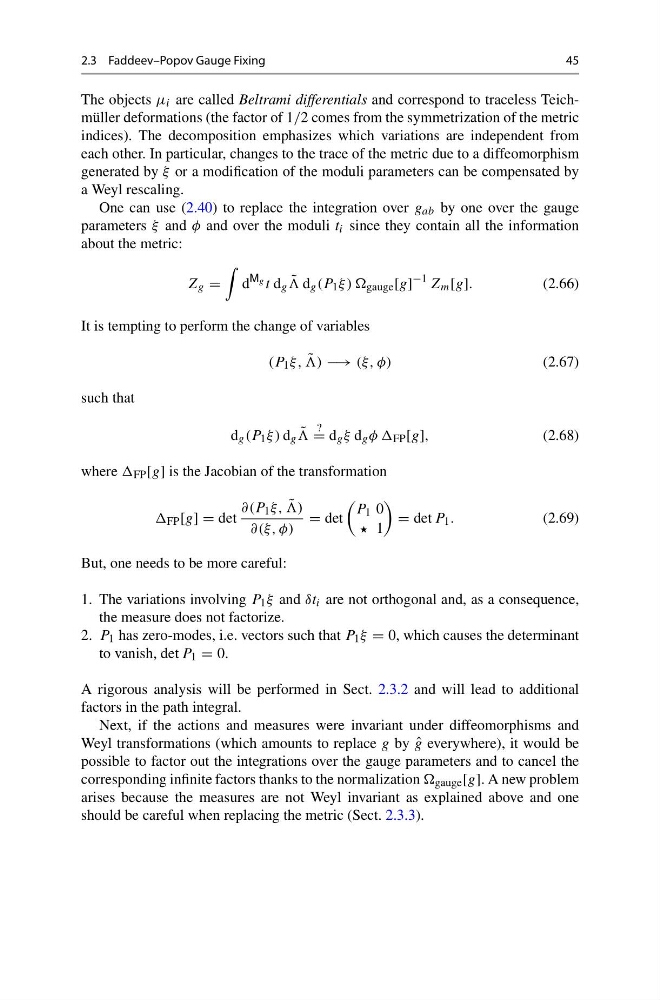
One can use (2.40) to replace the integration over g ab by one over the gauge
parameters ξ and φ and over the moduli t i since they contain all the information
about the metric:
Z g =
d
M g t d g ˜
d g (P 1 ξ) ) gauge [g]
−1 Z m [g].
(2.66)
It is tempting to perform the change of variables
(P 1 ξ, ˜
) −→ (ξ, φ)
(2.67)
such that
d g (P 1 ξ) d g ˜
?
= d g ξ d g φ φ FP [g],
(2.68)
where FP [g] is the Jacobian of the transformation
FP [g] = det
∂(P 1 ξ, ˜
)
∂(ξ, φ)
= det
P 1 0
1
= det P 1 .
(2.69)
But, one needs to be more careful:
1. The variations involving P 1 ξ and δt i are not orthogonal and, as a consequence,
the measure does not factorize.
2. P 1 has zero-modes, i.e. vectors such that P 1 ξ = 0, which causes the determinant
to vanish, det P 1 = 0.
A rigorous analysis will be performed in Sect. 2.3.2 and will lead to additional
factors in the path integral.
Next, if the actions and measures were invariant under diffeomorphisms and
Weyl transformations (which amounts to replace g by ˆ
g everywhere), it would be
possible to factor out the integrations over the gauge parameters and to cancel the
corresponding infinite factors thanks to the normalization gauge [g]. A new problem
arises because the measures are not Weyl invariant as explained above and one
should be careful when replacing the metric (Sect. 2.3.3).
45
The objects μ i are called Beltrami differentials and correspond to traceless Teichmüller deformations (the factor of 1/2 comes from the symmetrization of the metric
indices). The decomposition emphasizes which variations are independent from
each other. In particular, changes to the trace of the metric due to a diffeomorphism
generated by ξ or a modification of the moduli parameters can be compensated by
a Weyl rescaling.
One can use (2.40) to replace the integration over g ab by one over the gauge
parameters ξ and φ and over the moduli t i since they contain all the information
about the metric:
Z g =
d
M g t d g ˜
d g (P 1 ξ) ) gauge [g]
−1 Z m [g].
(2.66)
It is tempting to perform the change of variables
(P 1 ξ, ˜
) −→ (ξ, φ)
(2.67)
such that
d g (P 1 ξ) d g ˜
?
= d g ξ d g φ φ FP [g],
(2.68)
where FP [g] is the Jacobian of the transformation
FP [g] = det
∂(P 1 ξ, ˜
)
∂(ξ, φ)
= det
P 1 0
1
= det P 1 .
(2.69)
But, one needs to be more careful:
1. The variations involving P 1 ξ and δt i are not orthogonal and, as a consequence,
the measure does not factorize.
2. P 1 has zero-modes, i.e. vectors such that P 1 ξ = 0, which causes the determinant
to vanish, det P 1 = 0.
A rigorous analysis will be performed in Sect. 2.3.2 and will lead to additional
factors in the path integral.
Next, if the actions and measures were invariant under diffeomorphisms and
Weyl transformations (which amounts to replace g by ˆ
g everywhere), it would be
possible to factor out the integrations over the gauge parameters and to cancel the
corresponding infinite factors thanks to the normalization gauge [g]. A new problem
arises because the measures are not Weyl invariant as explained above and one
should be careful when replacing the metric (Sect. 2.3.3).