

2.3 Faddeev–Popov Gauge Fixing
43
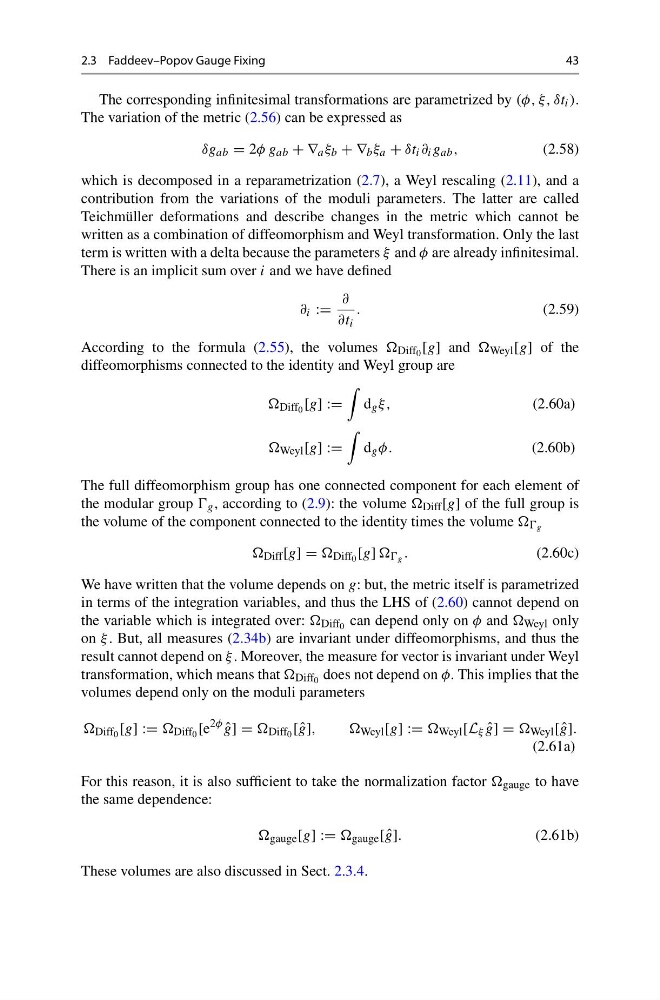
The corresponding infinitesimal transformations are parametrized by (φ, ξ, δt i ).
The variation of the metric (2.56) can be expressed as
δg ab = 2φ g ab + ∇ a ξ b + ∇ b ξ a + δt i ∂ i g ab ,
(2.58)
which is decomposed in a reparametrization (2.7), a Weyl rescaling (2.11), and a
contribution from the variations of the moduli parameters. The latter are called
Teichmüller deformations and describe changes in the metric which cannot be
written as a combination of diffeomorphism and Weyl transformation. Only the last
term is written with a delta because the parameters ξ and φ are already infinitesimal.
There is an implicit sum over i and we have defined
∂ i :=
∂
∂t i
.
(2.59)
According to the formula (2.55), the volumes Diff 0 [g] and Weyl [g] of the
diffeomorphisms connected to the identity and Weyl group are
Diff 0 [g] :=
d g ξ,
(2.60a)
Weyl [g] :=
d g φ.
(2.60b)
The full diffeomorphism group has one connected component for each element of
the modular group g , according to (2.9): the volume Diff [g] of the full group is
the volume of the component connected to the identity times the volume g
Diff [g] = Diff 0 [g] g .
(2.60c)
We have written that the volume depends on g: but, the metric itself is parametrized
in terms of the integration variables, and thus the LHS of (2.60) cannot depend on
the variable which is integrated over: Diff 0 can depend only on φ and Weyl only
on ξ . But, all measures (2.34b) are invariant under diffeomorphisms, and thus the
result cannot depend on ξ . Moreover, the measure for vector is invariant under Weyl
transformation, which means that Diff 0 does not depend on φ. This implies that the
volumes depend only on the moduli parameters
Diff 0 [g] := Diff 0 [e
2φ
ˆ
g] = Diff 0 [ ˆ
g],
, Weyl [g] := Weyl [L ξ ˆ
g] = Weyl [ ˆ
g].
(2.61a)
For this reason, it is also sufficient to take the normalization factor gauge to have
the same dependence:
gauge [g] := gauge [ ˆ
g].
(2.61b)
These volumes are also discussed in Sect. 2.3.4.
43
The corresponding infinitesimal transformations are parametrized by (φ, ξ, δt i ).
The variation of the metric (2.56) can be expressed as
δg ab = 2φ g ab + ∇ a ξ b + ∇ b ξ a + δt i ∂ i g ab ,
(2.58)
which is decomposed in a reparametrization (2.7), a Weyl rescaling (2.11), and a
contribution from the variations of the moduli parameters. The latter are called
Teichmüller deformations and describe changes in the metric which cannot be
written as a combination of diffeomorphism and Weyl transformation. Only the last
term is written with a delta because the parameters ξ and φ are already infinitesimal.
There is an implicit sum over i and we have defined
∂ i :=
∂
∂t i
.
(2.59)
According to the formula (2.55), the volumes Diff 0 [g] and Weyl [g] of the
diffeomorphisms connected to the identity and Weyl group are
Diff 0 [g] :=
d g ξ,
(2.60a)
Weyl [g] :=
d g φ.
(2.60b)
The full diffeomorphism group has one connected component for each element of
the modular group g , according to (2.9): the volume Diff [g] of the full group is
the volume of the component connected to the identity times the volume g
Diff [g] = Diff 0 [g] g .
(2.60c)
We have written that the volume depends on g: but, the metric itself is parametrized
in terms of the integration variables, and thus the LHS of (2.60) cannot depend on
the variable which is integrated over: Diff 0 can depend only on φ and Weyl only
on ξ . But, all measures (2.34b) are invariant under diffeomorphisms, and thus the
result cannot depend on ξ . Moreover, the measure for vector is invariant under Weyl
transformation, which means that Diff 0 does not depend on φ. This implies that the
volumes depend only on the moduli parameters
Diff 0 [g] := Diff 0 [e
2φ
ˆ
g] = Diff 0 [ ˆ
g],
, Weyl [g] := Weyl [L ξ ˆ
g] = Weyl [ ˆ
g].
(2.61a)
For this reason, it is also sufficient to take the normalization factor gauge to have
the same dependence:
gauge [g] := gauge [ ˆ
g].
(2.61b)
These volumes are also discussed in Sect. 2.3.4.