

C Quantum Field Theory
405
Example C.1: p-Form Gauge Theory
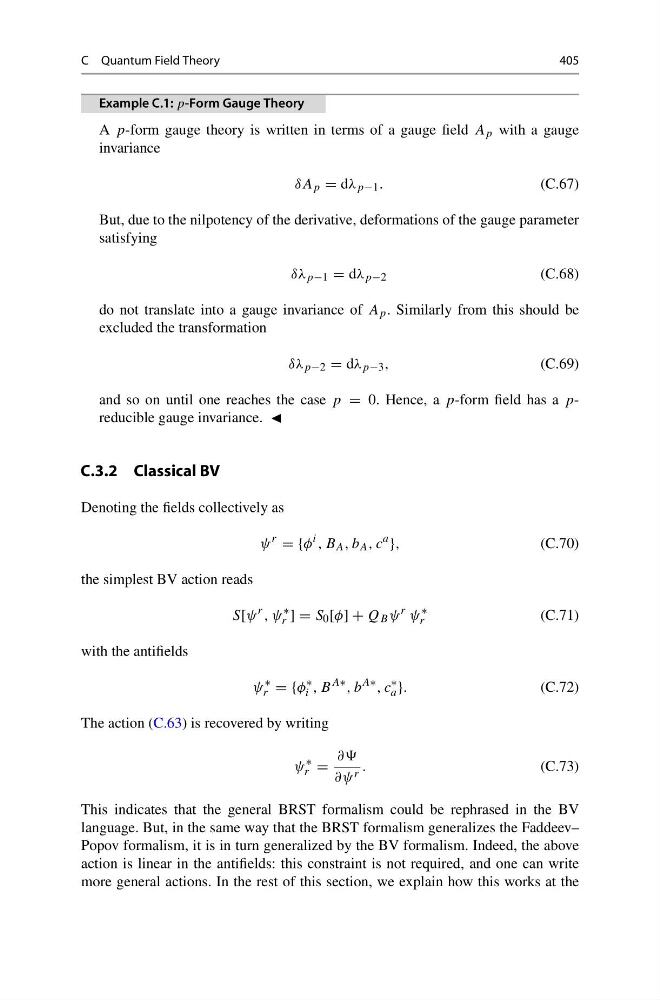
A p-form gauge theory is written in terms of a gauge field A p with a gauge
invariance
δA p = dλ p−1 .
(C.67)
But, due to the nilpotency of the derivative, deformations of the gauge parameter
satisfying
δλ p−1 = dλ p−2
(C.68)
do not translate into a gauge invariance of A p . Similarly from this should be
excluded the transformation
δλ p−2 = dλ p−3 ,
(C.69)
and so on until one reaches the case p = 0. Hence, a p-form field has a preducible gauge invariance.
C.3.2 Classical BV
Denoting the fields collectively as
ψ
r
= {φ
i , B A , b A , c
a
},
(C.70)
the simplest BV action reads
S[ψ
r , ψ
∗
r ] = S 0 [φ] + Q B ψ
r ψ
∗
r
(C.71)
with the antifields
ψ
∗
r = {φ
∗
i , B
A∗ , b
A∗ , c
∗
a }.
(C.72)
The action (C.63) is recovered by writing
ψ
∗
r =
∂∂
∂ψ r .
(C.73)
This indicates that the general BRST formalism could be rephrased in the BV
language. But, in the same way that the BRST formalism generalizes the Faddeev–
Popov formalism, it is in turn generalized by the BV formalism. Indeed, the above
action is linear in the antifields: this constraint is not required, and one can write
more general actions. In the rest of this section, we explain how this works at the
405
Example C.1: p-Form Gauge Theory
A p-form gauge theory is written in terms of a gauge field A p with a gauge
invariance
δA p = dλ p−1 .
(C.67)
But, due to the nilpotency of the derivative, deformations of the gauge parameter
satisfying
δλ p−1 = dλ p−2
(C.68)
do not translate into a gauge invariance of A p . Similarly from this should be
excluded the transformation
δλ p−2 = dλ p−3 ,
(C.69)
and so on until one reaches the case p = 0. Hence, a p-form field has a preducible gauge invariance.
C.3.2 Classical BV
Denoting the fields collectively as
ψ
r
= {φ
i , B A , b A , c
a
},
(C.70)
the simplest BV action reads
S[ψ
r , ψ
∗
r ] = S 0 [φ] + Q B ψ
r ψ
∗
r
(C.71)
with the antifields
ψ
∗
r = {φ
∗
i , B
A∗ , b
A∗ , c
∗
a }.
(C.72)
The action (C.63) is recovered by writing
ψ
∗
r =
∂∂
∂ψ r .
(C.73)
This indicates that the general BRST formalism could be rephrased in the BV
language. But, in the same way that the BRST formalism generalizes the Faddeev–
Popov formalism, it is in turn generalized by the BV formalism. Indeed, the above
action is linear in the antifields: this constraint is not required, and one can write
more general actions. In the rest of this section, we explain how this works at the